Showing posts with label Christmas. Show all posts

Wednesday, January 7, 2026

Heavenly Army: Christmas

Christmas                                                                                 Luke 2: 1-20                              Christmas Eve is my least favorite time to preach…partly because there are no new takes on this story.  It’s a story we all know so well, in so many different forms.  Yet, I would guess, that there are some things we don’t know as well as we think we do.  I remember my first New Testament class in college. I thought it would be an easy class for me as I had been going to church and Sunday school (which was called CCD in the Catholic Church) every week for my whole life. The professor, probably understanding that some of us were a little overly confident, started with a series of questions that seemed obvious, but were not.  We got most of them wrong.  One he liked to ask was, how many magi were there?  Well?  Anyone?  We all said three but then he pointed out, it never says how many there were, just how many gifts there were.  And the magi don’t even appear in our reading from Luke. 

It is the Gospel of Matthew that has the Kings and the star.  In Luke, we have shepherds and the heavenly host, but no star, no kings.  Those poor shepherds had no star to follow.  The angels told them that the sign they were to look for was “a child wrapped in bands of cloth lying in a manger.”  Bethlehem was (and is) a fairly small town, but it wasn’t that small.  They had to do some searching. 

                Those shepherds were motivated.  An angel had spoken to them and informed them that the Messiah, the Lord, had been born.  It wasn’t just one angel, it was an angel with the multitude of the heavenly host.  Now, when we see this depicted in movies or art, it’s usually a very gentle and bucolic scene.  There is a soft light, maybe one to two angels who don’t look scary or intimidating.  But if that was the case why would it say that the shepherds were terrified?  And that was before the heavenly host showed up. 

Until I started preaching this text, I never considered what a heavenly host meant.  Perhaps a few angels with harps? The Greek word that is translated to host is army. This was heaven’s army, all there to deliver a message.  Ironically, it was a message of peace: “Glory to God in the highest heaven, and on earth peace among those who he favors.”


                It’s an interesting juxtaposition, an army delivering a message of peace.  God sent this army not to fight, but to tell a few powerless shepherds that the Messiah had come down in the form of a helpless baby.  Most of us have probably held a newborn baby at some point.  They are tiny.  They can’t even hold their head up.  That is how God decided to show up, not with the heavenly army that would have probably been a lot more impressive, but a baby dependent on two humans who also had little power.

                I understand the symbolism of God coming to earth as a human so God could have the experience of walking with us. But sometimes I wonder, why wasn’t God born to a great king or political leader? Then God would not have to sleep in an animal trough.  Jesus would have been protected and his message would have gone farther because important and influential people would have been listening.  Jesus would never had to die because he would have been related to the people in power.  It would have been so much easier.  Or…if you are not liking that idea, Jesus could have been born to the same parents in the same place, but that heavenly army could have stuck around…just in case.  That would have been a lot less risky.  No one would mess with the guy who had the heavenly army backing him up.

                God could have taken any of those options, but no.  God chose to be born like any other child, to parents who were good and holy, but not people with power or influence. I love that about God, but sometimes it also makes me crazy and frustrated.  There are days when I think, we could use a heavenly host right about now, to straighten things out around here.  God has yet to take this recommendation from me. 

                Most days, I feel powerless and a little overwhelmed.  Sometimes that makes me feel weak.  What if we could take our perceived weakness and understand it for what it actually is, vulnerability. The beauty of that vulnerability is that it is something that our creator and savior understands, because he experienced it—as a baby who couldn’t hold his head up, as a young child learning to speak, as a teenager struggling with all the crazy stuff that happens, as a young man who would be abandoned by his friends and then die a horrible death.  That death didn’t make Jesus weak (even though some chose to believe it and maybe still do).  That death allowed him to rise again.  Could he have called on the heavenly host to rescue him from that gruesome death? Yes. But once again, God chose the path that aligned Godself with the most powerless and dejected human beings.

                That is what we celebrate on Christmas, a God who displayed power not with might and armies, but with compassion and love.  Don’t get me wrong, Jesus did miraculous things in his time on earth, but it was never to control people or display his greatness…it was to heal people (their bodies and their souls).  Jesus didn’t defeat the tyranny of the Roman Empire.  If he wanted to do that, he would have brought the army.  Instead, he lived in a way that displayed humility and service.  He died in a way that showed courage and surrender.  He rose again not to bring vengeance on the people who abandoned him, but to forgive them and inspire them.   

                On Christmas, we can and should bask in the warmth of his glory, but also remember that God’s work is not yet done, not even close.   It is up to us, to do that work.

Sunday, December 24, 2023

What Mary Knew: Christmas Eve

 Year B, Christmas Eve                                                    Luke 2:1-20                                                                        

            I am going to share a little clergy secret…which you would only know if you followed dozens and dozens of pastors on social media.  Most pastors in the Episcopal Church or other churches with similar theologies don’t like the song “Mary, did you know?” Some of them really hate it and write scathing comments or even create memes about why, yes of course Mary knew every single thing that was going to happen.  She was the mother of God. 

Now if you don’t know the song—don’t worry I am not going to sing it.  It’s basically a series of questions for Mary as she holds her infant son. It’s everything from: “Did you know he would be God?” to a list of all the miracles he did. “Did you know he would walk on water, cure the blind, etc.?”  The reason so many people don’t like it is because they think it belittles Mary.  Here is my 2nd little secret…I kind of like the song and since I became a mother of a boy, I tear up every time I hear it because it reminds me of all the things that will happen to my son, that will hurt, that I won’t be able to control.  And if I think too much about that, I kind of lose my mind.  It helps me understand Mary a little more.

            Obviously, Mary knew some important things.  The Angel Gabriel told her that she would conceive a son and name him Jesus.  He would be the son of the Most High and would receive the throne of King David.  His kingdom would never end.  Those are where the details ended as far as the Angel Gabriel.  But later, Mary made a pronouncement called the Magnificat which showed that she had a good idea of who this son would be.  He would be a revolutionary and a prophet.  He would transform the world in that he would bring down the powerful and lift up the lowly. 

The next hint we have is in the Gospel reading we heard tonight. The angels told the shepherds that on that night, a baby was born, who was the Messiah, the Lord.  The shepherds then passed on this message to Mary and Joseph.  The next piece of information Mary got was from two prophets she encountered in the temple when she brought Jesus for his naming ceremony when he was 8 days old. The prophets told Mary and Joseph that their son would be a light for revelation to the Gentiles, and the glory of your people Israel.

            So far, it was all good and uplifting news.  No doubt it would have been overwhelming, but still positive. But then the prophet Simeon added a little twist: “This child is destined to cause the falling and rising of many in Israel, and to be a sign that will be spoken against, so that the thoughts of many hearts will be revealed. And a sword will pierce your own soul too.”  I am sure Mary was already afraid…just because weight of the knowledge that she was raising the Messiah.  That had to be intimidating. But now she knew her son’s life would not be easy---that he would anger people and that something would happen that would be so devastating, it would pierce her soul.  That’s what Mary knew.  That’s a whole lot.  Yet still, it seems to me that the angels, the shepherds, and the prophets were stingy with the details. 

            Thank God they were.  How could she have coped if when she held her infant child, she knew everything that would happen to him? We know that Mary was a strong person with extraordinary faith, but how much can a new parent possibly bare?  I mean, if that was me and I knew all that would happen, I might ask, “Do we really need a savior?  If so, can someone else be that savior?”

            We don’t know exactly how old Mary was.  At the time, girls would be engaged at 12 or 13 and married at 15 or 16.  Let’s go with 15.  Let’s even take out the child element and imagine yourself at 15.  Would you want your 15 year old self to know everything that would happen to you? I wouldn’t.  Some of it would have made me happy.  It would have been good to know I would be married in my late 20s.  It would have made dating a lot less stressful.  But I would not have wanted to know that I would be infertile. It would have been too much to process at that time. I would not have wanted to know that I would almost die at the age of 44 from a mysterious illness.  There are things in our life we can’t imagine surviving until we have no choice but to survive.

Let’s assume for a moment that Mary was the strongest, most faithful teenager in the world—do you think she could have held a child who she knew would be crucified and not fall into 1,000 pieces?  No, I don’t think Mary knew everything. She knew enough.  She had faith, faith that would carry her through seeing a child insulted, abandoned, betrayed, arrested and killed.   She was one of the only people who stayed at the cross while he died.

            Now you might be thinking…this is Christmas…not Good Friday.  Why are you talking about the sad stuff?  If you look at the end of our Gospel readings it describes the joyful and excited shepherds and the amazement of those around Mary.  Then it says, “But Mary treasured all these words and pondered them in her heart.”  She treasured those words, but she also pondered them. In my mind she was preparing, preparing for all that was to come.

            The reality is that we all face heart breaking things in our life…some more than others. What gets us through those times, are those words that Mary treasured.  They were words about a Messiah and a Savior---a God so committed to his people that he would risk being born to a human, to be completely dependent on a girl to care for him. Mary was a faithful Jew.  She knew the God of the Hebrew scriptures.  But now, this God was here, with her, dependent on her. She knew this God in a way she could not have possibly known before.

And that was the gift that God gave to all humanity on Christmas…God with us. God with us in the grime, grit, pain, joy and laughter of our life here on earth.  This God sacrificed everything for the people of this world.  This God would not make our lives easy, but this God would make our lives holy, equipped with the knowledge that we are beloved and worthy of God’s love…that no matter how hard life might get, how weary we might be, how lonely we might feel, we are never alone.  God was born to a girl in a small town so we would know God and always have him with us.

            I am not too concerned about what Mary knew.  What I care is what you---the people of God-- know.  If you don’t already, I want you to know that God is with you.  You are not alone.  

Thursday, December 16, 2021

Joy and a Brood of Vipers: December 12, 2021

Advent 3, Year C                                  Zephaniah 3:14-20                                                     

I have been ordained for 16 years now and  it’s taken me about that long to grow accustomed to the lectionary readings that we read every Advent.  Despite the fact that I had been going to church every Sunday for my entire life, I remember looking at the readings assigned for the Sundays during Advent when I was first ordained and thinking, what in the world is going on here? These don’t make me feel good.  Why is there so much John the Baptist?  We need more feel good stuff, more joy because this is supposed to be a joyful season.  Isn’t that what they say, “It’s the most wonderful time of the year.”  Finally, on the 3rd Sunday of Advent we get a little joy in the first few readings.  But we are still stuck with John the Baptist calling us a “brood of vipers.”  So I will start with the other readings for now.

            Zephaniah…now that is an interesting one.  The Book of Zephaniah is only three chapters long.  We know little about the author.  Some believe that Zephaniah was writing and preaching right after the reign of a horrible king, which explains the first two chapters detailing how awful everything is. It might be hard to believe based on our reading for today, but Zephaniah is considered one of the gloomiest parts of the Bible.  In fact, the 2nd verse of this book is, “I will utterly sweep away everything from the face of the earth, says the Lord.” That is how bad things are.  The prophet concluded that God’s only option for this land and these people was total destruction.  Remember, God promised never to do that after the great flood.  Things were so bad, Zephaniah thought complete destruction was the only option.  Just start over again.          

            The Book of Zephaniah was written after Israel and Judah split.  Israel had been conquered and Judah was on the cusp of being conquered.   Zephaniah seemed to have little hope.  But as is so often the case in the books of the Bible, something shifts dramatically in the middle of chapter three.  After the accusations, the judgment and the warnings, suddenly there is joy.  “Sing aloud, O daughter Zion; shout, O Israel! Rejoice and exult with all your heart; O daughter of Jerusalem!”

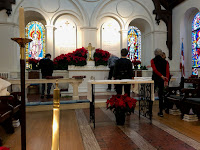
Christmas 2020--no inside service, but we still decorated.
This reading comes up every three years right at this time, but never has that line struck me so profoundly.  We went months without meeting in person and then several more months without being able to sing.  While we remain masked when we sing, I now realize what a gift we have been given for this Christmas.  We get to sing Christmas carols on Christmas.  Do you remember how much we longed for that last year? Sure, many of us look forward to Christmas carols every year, but it’s so much more meaningful when we know what it’s like to be deprived of them, when we know what it’s like not to be able to sing aloud and rejoice. 

Yet, it remains a little awkward.  We are still wearing masks and trying to be careful.  We are still in the middle of a pandemic that is supposed to be long over. How can we truly sing with joy? How can we shout in exultation when shouting is dangerous?

            That is what is so astonishingly appropriate about this reading from Zephaniah.  This joy that comes in chapter three is that much more incredible because it’s not supposed to be there.  Why? Because nothing seems to have changed.  Judah was conquered. The Hebrew people still struggled mightily.  But God decided to show up anyway.  God’s presence broke through the fear, the sadness and even the hate.  That is true joy---joy that is grounded in God’s presence. 

It’s the same in our reading from Philippians.  Paul was writing from prison.  He knew there was a good chance he would be executed. He had every reason to be sad, angry and anxious.  But he was able to tell the people to rejoice and not to worry.  Why?  Because, “The Lord is near.”  That is what Paul wrote in his letter to the Philippians.  That is what Zephaniah also said 100’s of years before, “The Lord is in your midst…”  And while John the Baptist is kind of scary and intimidating, he was saying the same thing in our Gospel today, “God is coming and that is good news.” That doesn’t mean there won’t be hard times. That doesn’t mean we don’t have to prepare, repent, try to be better.  It means that God is coming no matter what.

Joshua has been talking a lot about Santa’s list and I confess we have as well.  But I finally said, “You know Joshua, I don’t know what Santa will do. But I can promise you that we will give you presents no matter what. Because that is what we do as parents. We love our children, no matter what.  That is the kind of love that God has shown us over and over again  over the course of human history. Unrelenting and completely unreasonable---love.

We have no idea if the people of Judah ever repented or changed their ways.  In the end, it wasn’t about them.  It was about God choosing to love them no matter what.  I read a quote in a commentary that I just loved. It said, “…true repentance bows in helpless submission in the face of this great forgiveness.”[1] 

Sometimes we have to know what it is to be forgiven before we can find the strength or courage to ask for that forgiveness, or even know that we need it.  Sometimes we have to experience utter desolation to understand joy. And sometimes, our voices have to be silenced to know what it truly means to sing.


[1] Andrew H. Bartelt, “Third Sunday in Advent,” in Concordia Journal 11:6 (Nov 1985), 227.

Sunday, December 23, 2018

Expect the Unexpected: Dec. 23, 2018


Year C Advent 4                                                                      
Micah 5:1-5  
                                                                                     
            Advent is all about waiting, preparation and expectation.  That is what we have been telling you for three weeks now.  It’s true in that we are preparing for the birth of Christ. Our refrain when we light our Advent candles is “Come Lord Jesus.”  Yet here is the irony-- the readings we hear in the season of Advent, perhaps even the majority of the Bible stories we know and love-- tells us that God loves to surprise us.  Essentially we are telling you to “expect the unexpected,” which might be the worst advice anyone has ever given or received.  It’s right up there with “don’t worry.”
            A few weeks ago we learned that Elizabeth, a woman previously considered barren, would give birth in her old age.  Her son would be a locust eating, camel hair wearing, prophet. Instead of acquiring a religious degree and living in one of the places of power (like Jerusalem), he preached from the wilderness and told people to repent.  He was an unexpected prophet.  But then again, who better to prepare the way for a Messiah who would shock the world with his refusal to conform and his insistence on associating with the marginalized and oppressed?
            As we know, John was not the only prophet who was a little different.  Our Old Testament is chock-full of prophets, typically the people you would least expect to be prophets.  Micah was a prophet who lived about 700 years before the birth of Jesus Christ. The first verse of our reading for today speaks of a siege.  The city of Jerusalem was under siege.  They were trapped by their own walls.  Defeat was inevitable.  The city and the king would fall.  Imagine what that would be like, just waiting for death or imprisonment, knowing there is nothing you can do to escape. Yet after that verse which declared the siege and the imminent destruction of all they knew and loved, Micah switched gears.  “Bethlehem, who are one of the little clans of Judah, from you shall come forth one who is to rule Israel.” 
            Bethlehem had a certain notoriety at that point in time.  That was where King David had come from.  King David had been an unlikely king.  He was a shepherd and the youngest of his family.  It was an odd choice for God.  However, as one would expect of one chosen by God, he was a mighty king.  It was expected that the Messiah would come from the line of David.  However the line of David and the hometown of David are two different things. This reference to a Messiah coming from the same backwater town of David was strange.  It was especially strange that Micah would bring it up at this very point, when they were under siege and their present king was about to die.
            Yet isn’t that often the way--when we feel as though we are truly under siege--relief and hope can come in the most unexpected places….or in the most bizarre dreams.  Micah prophesied something almost unimaginable.  This leader, born in the small town of Bethlehem, would rule not with money and armies, but with a shepherd’s crook. Instead of depriving people of things to enforce his rule, he would feed the people.  He would do all these things in the strength of the Lord.  He would bring peace to his people who are now under siege. 
            While that sounds very nice, we know now that none of the people Micah was talking to would experience that peace on earth.  The city was taken over. Many of the people were enslaved.  But that picture that Micah painted never quite faded.  It lived on in people’s hopes and dreams. It gave those who remained something to live for.  It gave those who died, a foretaste of their imminent future in life everlasting. 
            Our Bible is full of prophesies and dreams.  So many of these visions from our prophets contain God’s dream for us.  They are full of hope and promise.  We ignore them at our own peril.  Unfortunately our divine imagination has been limited by the acceptance of our present reality.  Many consider the stories of the Bible as fairytales or myths.  But these stories contain radical truth.  They may be hard to believe, but some of the most extraordinary things in life are things we never could have imagined.  The more comfortable we become with our present reality and the more reluctant we are to imagine God’s dream for us, the less likely we are to experience the dream. 
            Our Gospel reading contains what we refer to as the Magnificat.  It is essentially written in the form of a song.  But it is more than praise or worship.  It is prophesy.  It is God’s dream for our world—a dream that Mary interpreted for all of us.  “He has shown strength with his arm; he has scattered the proud in the thoughts of their hearts.  He has brought down the powerful from their thrones, and lifted up the lowly; he has filled the hungry with good things, and the sent the rich away empty.” She was able to articulate that dream because that dream lived within her in the form of an unborn child.  A child who would turn the entire world upside down.  What people thought was reality wasn’t real at all.  Jesus brought the world truth. 
            700 years before Mary shared her prophesy, Micah prophesized about a shepherd who would feed his people and bring peace to a violent nation.  Jesus was a carpenter, not a shepherd, but he fed the people.  He fed thousands with a couple fish and a loaf of bread. He inspired thousands more with his words and actions.  That was only in his lifetime.  Billions, trillions have been fed by his legacy of love since his death and resurrection. 
Yet….despite all that….we know that he did not bring peace. Look at Israel.  It is a land that has never known peace.  And our nation isn’t much better.  Violence plagues us.  Some look around and conclude that Jesus’ words and actions had no effect…no better than a dream. That could not be farther from the truth.  A dream only remains a dream if we refuse to allow it to manifest.  
                        We still carry the dream.  But we have to do more than carry it. We have to do more than talk about it in our churches.  We must live like that dream of peace and salvation is real for us...like we are trying to bring it forth, not just in the next life, but this life. In John’s Gospel, Jesus told his disciples, “Do not let your hearts be troubled.  Believe in me...”  No matter how troubled our hearts become, we cannot give up the dream.  Christmas is almost upon us.  Let us take that day and the 12 days after to bask in the glow of that dream, a dream that became real in the form of a baby boy.  That dream lives today in our hearts and actions.  Carry the dream. Share the dream.  One day it will be the only reality we know.

Monday, December 15, 2014

Dec. 14, 2014: Joy

It's Ok to be Sad on Christmas

Year B, Advent 3                
Isaiah 61:1-4, 8-11, Psalm 126, & 1 Thess 5:1-24
 
            Finally, we have some perkier readings.  They are not about sorrow, repentance, sin, or the end of the world.  Now we can really get into the Christmas cheer!  We even light a pink candle, and that is so much prettier.  Some people even call this joy Sunday because of the apparent shift in the tenor of the readings.  The word joy is used 3 times in our 7 verse Psalm.  We also hear references to joy in Isaiah.  After some serious downers over the past couple of weeks, Isaiah appears to be all about gladness and rejoicing today.  Even Paul, who has never been described as perky starts this portion of his letter to the Thessalonians with “Rejoice always…”

            I looked at these texts and I thought, thank goodness we are through with all of those depressing texts.  Now we can really get ready for the fun part of Christmas. I can put up my Christmas decorations without feeling mildly guilty.  I can listen to Christmas music, especially the happy stuff.  But that eagerness passed pretty quickly as I realized I was not ready to let go to the contemplative and countercultural aspects of Advent.

            The longer I spend as priest in the church, the more I realize that while Christmas is a happy time for many, it is a difficult time for many as well.  I have talked to several colleagues and we have all agreed that more people die or get very sick during this time than any other.  That means that there are more families who are mourning either a very recent loss or the anniversary of a loss.  Even if you did not lose a loved one during this time, you are certainly reminded of that loss in a time when we talk about the importance of being with your friends and family.  The implication is that if you are not with friends and family, then you aren’t really celebrating Christmas.

            I have not experienced the loss that many of you have, but I find that Christmas always makes me a little melancholy.  I experience that feeling whenever I am in a place or a time when I feel this pressure to be cheerful and happy, when I feel as though I have to hide any negative emotions, even minor ones. 

            I am not sharing this because I am trying to make you all sad and suck the cheer out of the holiday, but because I know that there are a lot of people who suffer at this time of year, and if we talk about it and bring it out into the open, then maybe more people will feel comfortable in church.  A lot of people are afraid to show any kind of negative feeling in church.  They feel as though they need to put on their best face when they come to church.  People often tell me they don’t come to church because it makes them cry and they do not want to cry in front of other people.  While I understand that discomfort, I think that church should be the one public place where crying is absolutely ok.  Before I was a priest I used to occasionally cry in church because it was a place where I felt safe and free to be vulnerable.  I wish that for all of you.

            Let me tell you a little secret about these texts about joy.  They are not texts about pure joy or perfect bliss.  They are a little more complex than that.  Let’s consider Isaiah. Isaiah proclaimed that he was bringing “good news to the oppressed, to bind up the broken hearted… to comfort all who mourn…- to give them…the oil of gladness instead of mourning….”  He would not have been asking God to bind up the broken hearted or comfort the mourners if the people were not broken hearted and mourning. 

We have been hearing from Isaiah for several weeks and we know that the people of Judah have been going through numerous ups and down.  They were exiled in Babylon where they spent all their time hoping for a return to Jerusalem.  When they returned, they were devastated to see the place was in ruins.  They continued to struggle as they rebuilt and there is no evidence in the Book of Isaiah that it was an easy task.  There was no happy ending for the people of Israel, at least not the kind of happy ending we expect around Christmas.  Yes they came home.  Yes, they were eventually able to rebuild; but it was never easy.  By the time Jesus was born, they were under the control of the Romans and desperate for a Messiah to save them. 

            The Psalm also appears happier than it is.  It begins with them reminiscing about the good times when God was present in their lives and their mouths were filled with laughter.  But things have changed and now they are asking God to restore their fortunes.  The end of the Psalm reads, “Those who sowed with tears will reap with songs of joy.”  The people are weeping now and asking God for a time when they will be singing songs of joy...but right now they are weeping. 

            Paul is both easier and harder to explain.  He explains why we should rejoice always.  We rejoice because that is the will of God.  You might think, well that is even more pressure!  I have to be cheerful because God wants me to be cheerful.  But joy is not the same thing as cheerful and happy.  I just received one of those Christmas cards with a child laughing and then it just says, “Joyful” (or something like that).  Those are cute cards, but they don’t always send the right message.  Being joyful is not always about laughing and having fun. It’s about rejoicing in the Lord. 

Now I realize that sounds horribly vague.  A couple of years I got another Christmas card from a friend with three children.  On one side of the card was a picture of the three children looking cute and happy.  On the other side was a picture of the whole family, a couple people with strained smiles, one child clearly having a fit and the father pretending to sob (at least I assume he was pretending).  That I think is a better picture of Christian joy.  It’s messier than the joy that is advertised on tv, catalogues and cards.  Sometimes real life can bring us, pain, loneliness and fear.   None of those things sound joyful, but someone experiencing those things can still know the joy of God.  Sadness isn’t always a bad thing.  It’s a part of who we are.  More importantly, it is part of who Jesus was and is.  Jesus experienced the complex array of human emotions. 

            Frederick Buechner, a Christian writer and preacher, wrote that tears are often God speaking to us about the mystery of where we have come from and where God is calling us next.[1]  This is not always the case, but consider those moments when either you just cry out of nowhere or you feel that need to cry and you don’t.  And I am not just talking about tears of sadness…but all those powerful emotions that come with tears: anger, fear, elation, grief, relief, etc.  What if God is speaking to you in those moments?  And if we take those moments to consider what God is saying, or even just consider God, then we will find Christian joy.  Anytime we interact with the sacred and the holy…that is a time of joy even if it is cloaked in tears.

            If you are sad on Christmas, please don’t feel ashamed or like you are less of a Christian.  Let yourself cry, even in church on Christmas Eve.  Find comfort in that release, that moment where God nourishes those dry places in your life.  If you are happy on Christmas, then that’s great too.  But don’t just let it end there.  Look for Jesus in your happiness.  If you can find him there, then you will find true Christian joy.  When those two things come together, it is immensely beautiful.  If you are happy, find someone who is not.  Don’t tell them to cheer up.  Don’t tell them how happy you are.  Tell them that you care about them.  That is greatest gift you can give.  That is the gift that Jesus gave us when he became human.  In this act he was saying, “I love you so much that I am here with you, in your pain, your fear, and your laughter.”  That is where we can always find joy, in the presence of Jesus here with us.