Showing posts with label Joy. Show all posts

Wednesday, December 20, 2023

Dreams, Nostalgia and Joy: Dec 17, 2023

 Year B, Advent 3                            Psalm 126                                                   

    Today is unofficially known as Gaudete Sunday---which is Latin for Joy—Joy Sunday. Upon hearing the readings, you probably noticed a shift in tone from the last several weeks.  We also light the pink candle to signify this movement toward joy and I get to wear my pink stole which my last church gave me because I kept threatening to turn everything pink on the 3rd Sunday of Advent.  I wasn’t actually going to do that, but I liked to see the panic that flickered across their faces before I admitted I was kidding.  Plus, I just really like pink.
The readings are definitely more joyful this week.  Not a single person gets sent into outer darkness where there will be weeping and gnashing of teeth.  Nothing is consumed in fire and it doesn’t appear that anyone is even yelling.  But these texts aren’t coming from a Hallmark Christmas movie, the references to joy are a little more nuanced.  While Psalm 126 uses the word joy 3 times and certainly carries elements of hope, that hope is wrapped in lament.

When the Lord restored the fortunes of Zion, then were we like those who dream. Then was our mouth filled with laughter, and our tongue with shouts of joy. Then they said among the nations, "The Lord has done great things for them."  Notice the use of the past tense. Then…then were we like those who dream…then was our mouth filled with laughter. It sounds almost nostalgic.  But it’s clearly more than that.


The church has always been great at talking about the past.  The first church I served at was 100 years old.  They talked just as much about the past as the 413 year old church I just came from.  And of all the wonderful stories that could have been told…do you know what era I heard the most about—the 1960s.  This is partly because many of the members still remembered the 1960’s.  But also because that was when the churches (all churches) were bursting at the seams. During the 1950s, church membership grew at a faster rate than the population itself.  It was a rate of growth that was unprecedented and never seen again.  But for those who had been around during that time, that was the gold standard and the question was always—how do we get back to that?


Nostalgia is not bad in and of itself.  In fact, while nostalgia can often be associated with sadness or loneliness, nostalgia also acts as a defense against unhappiness.  It can bring relief to a negative mood.[1]  Yet sometimes, especially in churches, I fear that nostalgia can hold us back.  It’s a safe place, but our faith is supposed to challenge us…not merely comfort us.


There are examples in the Bible of nostalgia holding people back.  After Moses led the people out of slavery, they were in the wilderness and there was a lot of complaining and even reminiscing about how great life was when they were enslaved. In the Book of Numbers they said, “‘If only we had meat to eat!  We remember the fish we used to eat in Egypt for nothing, the cucumbers, the melons, the leeks, the onions, and the garlic; but now our strength is dried up, and there is nothing at all but this manna to look at.’” There were times when they would have returned if Moses has been willing.  Nostalgia confines us to what we know.  There is no room for dreaming with nostalgia.


That’s why I don’t think this Psalm is about nostalgia.  It’s about hope. When the Lord restored the fortunes of Zion, then were we like those who dream. Then was our mouth filled with laughter, and our tongue with shouts of joy.” They were dreamers.  They were remembering a time when they could dream, when their mouths were filled with laughter.  They weren’t remembering when they all had nice houses and good food.  They weren’t remembering when their places of worship were beautiful and full. 


The joy that the psalmist speaks of is a joy remembered and a joy anticipated.[2] It’s a joy that doesn’t come from human action, but God’s action.  They know that joy will return because God is faithful.  This psalm portrays the expanse of human experiences. Yes, there are tears, but some of those tears will reap joy. 


It’s more than just the idea, “Well sure, you are sad now, but you will get over it.”  No, it means that the tears we shed can water the dry and parched ground that surrounds us.  Then joy will grow from the tear saturated ground.  “Those who go out weeping, carrying the seed, will come again with joy, shouldering their sheaves.”  This Psalm isn’t intending to minimalize the grief and pain people experience and imply that every heart ache and pain will bring new joy.  We know that is not true.  But with God, we are on holy ground.  That holy ground is littered with seeds of hope.


That’s why we can’t go backwards.  We honor the past.  We learn from it, but it can’t nourish us. We have seeds that need tending now.  We have dreams that we have forgotten. They hover on the cusp of our consciousness just waiting to come out. 


I know that you at Christ Church had a long transition. So many people have mentioned that to me.  That liminal place can be very challenging.  Some of you are still grieving the loss of beloved clergy and some may still be wondering if I am the person who can lead you.  I believe I am that person---the person who can help you till this ground because God has called me to be with you, and you, the people of Christ Church have called me as well.  God wants us all to dream again.  We need to help one another because it’s really easy to get stuck in the weeds and forget that there is something beautiful and holy beyond the weeds.


 It’s challenging to dream and believe that things can be different, even better. Fortunately we are in a place that has a history of dreaming and defying the status quo.  We are on holy ground.  May the joy of Gaudete Sunday nourish us and the ground we tread.  


[1] https://www.theatlantic.com/family/archive/2023/03/nostalgia-defense-unhappiness-happy-memories/673320/

[2] James Mays. p. 399

Thursday, December 16, 2021

Joy and a Brood of Vipers: December 12, 2021

Advent 3, Year C                                  Zephaniah 3:14-20                                                     

I have been ordained for 16 years now and  it’s taken me about that long to grow accustomed to the lectionary readings that we read every Advent.  Despite the fact that I had been going to church every Sunday for my entire life, I remember looking at the readings assigned for the Sundays during Advent when I was first ordained and thinking, what in the world is going on here? These don’t make me feel good.  Why is there so much John the Baptist?  We need more feel good stuff, more joy because this is supposed to be a joyful season.  Isn’t that what they say, “It’s the most wonderful time of the year.”  Finally, on the 3rd Sunday of Advent we get a little joy in the first few readings.  But we are still stuck with John the Baptist calling us a “brood of vipers.”  So I will start with the other readings for now.

            Zephaniah…now that is an interesting one.  The Book of Zephaniah is only three chapters long.  We know little about the author.  Some believe that Zephaniah was writing and preaching right after the reign of a horrible king, which explains the first two chapters detailing how awful everything is. It might be hard to believe based on our reading for today, but Zephaniah is considered one of the gloomiest parts of the Bible.  In fact, the 2nd verse of this book is, “I will utterly sweep away everything from the face of the earth, says the Lord.” That is how bad things are.  The prophet concluded that God’s only option for this land and these people was total destruction.  Remember, God promised never to do that after the great flood.  Things were so bad, Zephaniah thought complete destruction was the only option.  Just start over again.          

            The Book of Zephaniah was written after Israel and Judah split.  Israel had been conquered and Judah was on the cusp of being conquered.   Zephaniah seemed to have little hope.  But as is so often the case in the books of the Bible, something shifts dramatically in the middle of chapter three.  After the accusations, the judgment and the warnings, suddenly there is joy.  “Sing aloud, O daughter Zion; shout, O Israel! Rejoice and exult with all your heart; O daughter of Jerusalem!”

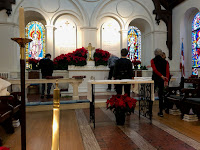
Christmas 2020--no inside service, but we still decorated.
This reading comes up every three years right at this time, but never has that line struck me so profoundly.  We went months without meeting in person and then several more months without being able to sing.  While we remain masked when we sing, I now realize what a gift we have been given for this Christmas.  We get to sing Christmas carols on Christmas.  Do you remember how much we longed for that last year? Sure, many of us look forward to Christmas carols every year, but it’s so much more meaningful when we know what it’s like to be deprived of them, when we know what it’s like not to be able to sing aloud and rejoice. 

Yet, it remains a little awkward.  We are still wearing masks and trying to be careful.  We are still in the middle of a pandemic that is supposed to be long over. How can we truly sing with joy? How can we shout in exultation when shouting is dangerous?

            That is what is so astonishingly appropriate about this reading from Zephaniah.  This joy that comes in chapter three is that much more incredible because it’s not supposed to be there.  Why? Because nothing seems to have changed.  Judah was conquered. The Hebrew people still struggled mightily.  But God decided to show up anyway.  God’s presence broke through the fear, the sadness and even the hate.  That is true joy---joy that is grounded in God’s presence. 

It’s the same in our reading from Philippians.  Paul was writing from prison.  He knew there was a good chance he would be executed. He had every reason to be sad, angry and anxious.  But he was able to tell the people to rejoice and not to worry.  Why?  Because, “The Lord is near.”  That is what Paul wrote in his letter to the Philippians.  That is what Zephaniah also said 100’s of years before, “The Lord is in your midst…”  And while John the Baptist is kind of scary and intimidating, he was saying the same thing in our Gospel today, “God is coming and that is good news.” That doesn’t mean there won’t be hard times. That doesn’t mean we don’t have to prepare, repent, try to be better.  It means that God is coming no matter what.

Joshua has been talking a lot about Santa’s list and I confess we have as well.  But I finally said, “You know Joshua, I don’t know what Santa will do. But I can promise you that we will give you presents no matter what. Because that is what we do as parents. We love our children, no matter what.  That is the kind of love that God has shown us over and over again  over the course of human history. Unrelenting and completely unreasonable---love.

We have no idea if the people of Judah ever repented or changed their ways.  In the end, it wasn’t about them.  It was about God choosing to love them no matter what.  I read a quote in a commentary that I just loved. It said, “…true repentance bows in helpless submission in the face of this great forgiveness.”[1] 

Sometimes we have to know what it is to be forgiven before we can find the strength or courage to ask for that forgiveness, or even know that we need it.  Sometimes we have to experience utter desolation to understand joy. And sometimes, our voices have to be silenced to know what it truly means to sing.


[1] Andrew H. Bartelt, “Third Sunday in Advent,” in Concordia Journal 11:6 (Nov 1985), 227.

Tuesday, December 25, 2018

Joy not Happiness: December 25, 2018


 Psalm 98, John 1:1-14   
                                        

            I do not know about the rest of you, but it seems that every year Christmas gets a little crazier.  I look forward to it every year and then the season seems to attack me mid December.  I can no longer stand the sound of Christmas carols.  The bright lights annoy me.  I turn into a scrooge and find myself counting down the days until the 25th, when the madness is over, and I can finally take it all in, peacefully.   I realize that this is a precarious position for a priest to take. I mean, this should be the time when we love our job the most. Everyone comes to church, everyone is excited.  Yet somewhere along the line, it all became too exhausting.  Somewhere along the line, I forgot about joy.
              It’s not that you can every completely forget about joy. It’s on all the Christmas cards.  It’s in all the music.  But what is it really?  The word joy appears in the Bible about 250 times in some form or another.  Often, like in the Psalm for today, it is an expression of praise.  “Shout with joy to the Lord, all you lands; lift up your voice, rejoice, and sing.”  Psalm 98, like many of the Psalms, is a mix of praise and exhortation.  The Psalmist is not only praising God, he is encouraging others to do so as well. 
            One cannot help but wonder what was going on in the Psalmist life that would cause such excitement and spirit.  Some have concluded that this Psalm was the result of a military victory.  Verse 3 reads, “The Lord has made known his victory; his righteousness has he openly shown in the sight of the nations.”  I prefer to think that no event was the cause for this outpouring of joy, it was more of an awareness. 
            We know from our reading of the Psalms as a whole that the author(s) experienced many hardships.  The Psalms of lament are just as plentiful as the Psalms of praise and thanksgiving.  Many of the Psalms have elements of both lament and praise.  Even the most heart wrenching, and depressing Psalms end with praise.  It is easy to get in the habit of thanking God only when things are going well. Yet the Psalmist knew that God deserved praise at all times. 
            While some form of the word joy appears in the bible hundreds of times, forms of the word happiness only occur 25 times.  In the English language, these words are often used interchangeably.  But this is not so in the Bible. Happiness depends on circumstances.  If something good happens, then we are happy.  When we consider moments in our life when we were happy, they are almost always dependent on an event, like a wedding, or the birth of a child.  Joy has more to do with the spirit of God in you.  It does not depend on the situation.  It has to do with your knowledge and awareness of God’s action in your life.  By that rationale, you could experience sorrow, and still be joyful. 
            If you look up “how to be happy” on Amazon, you will get thousands of results.  There is a whole section called, “Happiness-self help.”  Most are how to books like, “How to make yourself happy”, “How we choose to be happy”, and “What happy people know.”  The majority indicate that your efforts will allow you to be happy.  That’s what happiness is about.  It’s about our own efforts providing positive outcomes.  If you look up “how to be joyful” on the same site, you will come up with much fewer.  Only about 10 are actually relevant and most are religious.  Why are their so few books on making yourself joyful? Because there is no systematic approach to being joyful.  It’s all about reliance on God. 
            So why even desire it? If it is not something we can achieve with our own hard work, what’s the point?  In C.S. Lewis’ autobiography, Surprised by Joy, he describes joy as, “an unsatisfied desire which is itself more desirable than any other satisfaction…I doubt whether anyone who has tasted it would ever, if both were in his power, exchange it for all the pleasures in the world.”   Well that sounds pretty tempting.  How do we acquire this elusive joy?  The most frustrating thing about joy is also the most beautiful thing about it. You can’t earn it. You can’t force it.  Whereas happiness is something we pursue, like we pursue any accomplishment, joy is something that is given.  It was given to us when God gave us the power to be the children of God. 
That line from John has challenged me during my sermon preparation.  “He gave them power to become children of God, who were born, not of blood or of the will of the flesh or of the will of man, but of God.”  This is a completely different understanding of power than we are accustomed to.   But when we put it in the context of joy, it starts to come together.  We have been given the power to become children of God.  And when we are able to fully appreciate that power, then we will know pure joy.  That does not mean that we will know constant happiness.  That does not mean things will fall into place and our life will turn out just as we always wanted.  It means that we have finally accepted our role as God’s children.  Jesus’ birth, death, and resurrection was what gave us that power.  And once we have that, we have no choice but to shout with the joy, and join with the rivers and the sea in exultation. 
            I suppose I have always put too much emphasis on the idea of being happy during Advent and Christmas.  Then, when I was not happy I thought I must be missing something.  Yet now I realize that it’s about joy, not happiness. If happiness comes along with it, all the better.  But for now, I will rest in my awareness of God’s presence and that will bring me joy.  So I wish you not a merry Christmas, but a joyful one. 

Wednesday, December 16, 2015

Nonetheless: December 13, 2015

Advent 3, Year C             
Zephaniah 3:14-20                                                                

 
On August 6, 1945, an atomic bomb was dropped on Hiroshima.  Many were killed, but some survived. Sadako Sasaki was only two years old when the bomb was dropped a mile from her home.  She was unscathed as were many of her family.  They were the survivors, those who remained after so many had been killed.  However, 10 years after the bomb was dropped, her family discovered that Sadako had leukemia which at the time was referred to as “A-bomb disease.” [1]  She was told by the doctor that she had less than a year to live.  She was determined to live and tried hard to leave the hospital whenever she could.  On August 6th, they had a ceremony near the site of the atomic bomb’s epicenter, which had been recently named Peace Park.  She was not able to stay but heard a song while she was there.  She sang it all the way home and as she lay in her hospital bed bleeding and in pain, she continued to sing. [2]  She even taught the song to her roommate. While she was in the hospital, a group donated origami paper for the patients.  A legend at the time was that if you fold 1000 paper cranes, your wish would be granted.  Sadako set out to accomplish this task in hopes that her wish for life would be granted.  She did not stop at 1000.  She continued to fold them until she died.  On one of the cranes, the discovered that she had written, “I will write peace on your wings and you will fly all over the world.”

            I learned about Sadaka’s story after I read a commentary that referenced her briefly.  As I read more about her, I could not tear myself away from the story.  The part about her singing in her hospital bed reminded me of our reading from Zephaniah.   Our reading begins with, “Sing aloud, O daughter of Zion, shout, O Israel!”  This comes after two and a half chapters of the prophet Zephaniah railing against the people saying that God will destroy the people and the land because they have not obeyed God.   Zephaniah went on and on about the horrible things that would happen to the people of Judah as a result of their behavior.  Yet if you look at our reading for today the prophet seems downright cheery.  Not only does he encourage the people to shout for joy, he describes a God who will “rejoice over you with gladness…exult over you with loud singing as on a day of festival.”  

            This is quite a change from the God who wanted to destroy them. The Book of Zephaniah is only three chapters long and in the first two and a half chapters,  Zephaniah was not a happy prophet.  It is unclear what exactly was going on but some people have surmised that the beginning part was before the Babylonian exile where there was all kinds of bad behavior. Then the Babylonians came and carted off most of the Hebrew people, leaving a small group to remain.  Because of the hopeful and joyful tone of the last chapter, scholars and readers have hypothesized that these words of hope were for those who remained in Jerusalem, the survivors.  These people, often referred to as the remnant, had seen their holy city destroyed.  They saw their loved ones carted away to a foreign land to serve their enemy as slaves.  They undoubtedly saw many of their friends and family killed.  They were left behind to pick up the pieces and pray that they would not be left alone forever.

            This is a hard place to be, left behind and still living in terror.  They still lived in this familiar place, but it could not have been more different.  Where there was once a beautiful temple, there was now rubble.  Where there was once a vibrant community, there were now only small pockets of traumatized people.  Now Zephaniah is telling them to rejoice and exult with all your heart.  It’s like when you are having the worst day of your life and someone comes along and says, “Cheer up.”  That is never helpful! Zephaniah was not telling the people to cheer up or be happy.  He was telling them that God was there with them in the rubble.  God was with their families who had been taken to Babylon. 

Zephaniah wrote, “Do not fear, O Zion; do not let your hands grow weak.”  That line about your hands growing weak caught my attention. I wonder if the people were weary of putting their homes and their lives back together and God was telling them, “Don’t give up!  Keep rebuilding.  Keep starting over.  I will be your strength when you are weary.”   We need that strength when we are starting over.  God was providing not only the strength but the inspiration and joy as well.  When they could not sing, he sang for them. God sang and sang until the song became their reason for dusting themselves off and starting again. 

            A theologian named Karl Barth described Biblical joy as a defiant “nonetheless.”  For instance, the Hebrew people might have said: “The world is against us.  We live in constant fear for our lives.  Our holy city stands in rubble.  Nonetheless…God is with us today and God is singing.”   Sadaka might have said, “I am dying.  My country lost 150,000 lives in 3 days.  It seems as though all hope is lost.  Nonetheless, I will continue to sing for peace and I will make these cranes until I die.” 

That is the power of God.  God does not ensure that bad won’t things happen.  When we feel abandoned- living in the rubble of our lives, God gives our weak hands strength to keep building, keep starting over.  God gives us people like Sadaka to inspire us.  Her death could have led to hatred and bitterness. Instead, her 7th grade classmates decided that they would raise the money to build a monument in her honor at Peace Park.  The Children’s Peace Monument depicts a girl with her hands outstretched and paper crane in her hand.  This story has spread far and wide.   Every year, about 10 million cranes are offered before the monument.  At the base of the monument, there is a plaque that reads, "This is our cry. This is our prayer. For building peace in this world."

            Sadaka and her community built peace, one paper crane at a time.  It seems like strange building blocks, does it not?  Origami paper cranes are delicate and easy to crush.  But when they start to fill a hospital room, they provide hope.  When they fill a park that was once the scene of disaster and agony, they fill the hearts of the world.  I imagine Sadaka lying in her hospital bed singing her song for peace with God standing beside her singing that same song.  Sometimes the song that God sings for us is one of sorrow for our pain.  Yet I find comfort in a God who will sing for us when we are too weak, who will find joy for us when our eyes are too clouded to see the joy. 

            We are at a place in our country where we are living in fear.  We are afraid for our country.  We are afraid for those outside our borders.  Every time we turn on the news, we find something new to fear, something new to grieve. The best way to combat fear is with joy.  Our songs cannot keep us safe in a literal sense but they will give us strength to start again, and again, and again. And when we remember that God is singing with us, then our song has the power to cover the whole world with joy.  As we prepare for Christmas, for the birth of the Prince of Peace, let us remember that peace and joy are not for Christmas alone. 


[1] http://www.pcf.city.hiroshima.jp/virtual/VirtualMuseum_e/exhibit_e/exh0107_e/exh01071_e.html
[2] http://www.pcf.city.hiroshima.jp/virtual/VirtualMuseum_e/exhibit_e/exh0107_e/exh01072_e.html

Sunday, October 18, 2015

Where's the joy? October 18, 2015

Year B, Pentecost 21                                                                         
Job 38: 1-7, 34-41 & Mark 10:35-45                                                             

            When our stewardship chair (Eleanor) and I decided on a date for the ministry fair and the kick off to our Fall stewardship season, I immediately looked at the readings for the day.  Since our theme is joy, I was hoping I could find something related to joy in the readings.  When I saw the Old Testament reading was Job, I knew I was in trouble.   The only thing worse would have been the Book of Lamentations.  But I thought, well this is the end of Job….this is where God finally answers Job’s prayer.  Surely this is the good news we have been waiting for.  As I mentioned last week, the primary question that Job had was not why all these bad things were happening, but where God was in the midst of the pain and suffering. One would hope that when that answer came, there would be relief, possibly even joy.

            Then I read the text and it did not make me joyful.   The text begins with, “Then the Lord answered Job out of the whirlwind…” First of all, it is almost never good news when God enters the conversation with a storm.  It’s not like the storm was a coincidence. This was God’s storm.  From the storm, God said, “Who is this that darkens counsel by words without knowledge? Gird up your loins like a man, I will question you, and you shall declare to me.”  That is not the tone that I was expecting.  I have read this text many times and every time it comes up, it shocks me.  To begin, God told Job that he knew nothing.  Then there is the “gird up your loins” line which seems a little peculiar.  In biblical times this phrase was used when people were preparing for battle, when great courage was expected.  God was basically saying, get ready because this is going to get uncomfortable.  This is not going to be an easy conversation.

            God proceeded to ask Job over 70 questions…none of which Job could answer…none of which he was expected to answer.  The first question is a good example of what comes, “Where were you when I laid the foundation of the earth?”  If I was to sum up the questions, it would probably come down to, “Do you have any idea who you are talking to?”  One would think that would be an obvious question.  Job has been questioning God. But what God is saying is that any knowledge that Job may think he has is a tiny tiny fraction of what God knows.  It is a mere drop in the ocean of God’s vast knowledge. And I understand that (as much as my tiny tiny human brain can) but I still find myself disturbed by God’s response.  After all that Job has been through, I would think that it would not be too much to ask for a little compassion on the part of God.  We know that God is a loving God, but that side of God is not evident in this reading.

            I could say, well this is the Old Testament vengeful and wrathful God.  Jesus brought us the softer and gentler side of God.  Yet I do not really believe that.  I believe that the God we meet in the Old Testament is the very same God that we meet in the New Testament.  It’s just different sides to a very complex and incomprehensible God.  At the same time, as Christians we have received some special intel from God.  God came in the form of a man so that we could get to know God.  God wanted to be known.  God also knew that as humans, we needed to know him.  We need a relationship with God. So God with his infinite power and infinite knowledge was born to a peasant in the form of a baby and then lived among real people, people like Job, who wanted to be in the presence of God. 

            This is not to say that once Jesus came in the form of man, we all got with the program.  We can see from the Gospel reading that even the disciples were still having trouble understanding.  Jesus had just told them about his death so they would understand the kind of sacrifice he was making.  They responded by asking him whether they could be in the seat of power when he received glory.  While Job could not understand the God of absolute power, the disciples could not understand a God who acted as a servant.  Not only that, but Jesus expects us all to be servants.

            Where is joy…where is the joy in a God who comes from the storm and makes us uncomfortable?  Where is the joy in a God who asks us to sacrifice and serve?  It’s not a happy or carefree joy, but it is joy.  There is joy because we have a God who is present in our lives.  When God asked Job all of those questions, the questions referenced many of Job’s questions.  God had been listening to all that ranting and raving.  While Jesus has asked us to make sacrifices and serve others, he is only asking what he has already done.  We have a God who listens to us, knows us, wants us to know him, and who wants us to experience joy, not only here but in the life to come.  

            One of the questions that God asked Job was, “Who laid [the earth’s] cornerstone when the morning stars sang together and all the heavenly beings shouted with joy?”  The joy that God brings is bigger than us.  We have a God to whom the stars sing and the heavenly beings shout with joy.  And that same God who has the power to create the stars-- came down from heaven so that he could heal the sick, feed the hungry, give hope to the hopeless, forgive the sins of many and then be insulted, betrayed, abandoned, beaten and killed.  There is nothing we can do, nothing we can say to a thank a God who did all of that. 

There is another hymn that is sung around Christmas that I love.  The last verse is:

 What can I give Him, poor as I am?

If I were a shepherd, I would bring a lamb;

If I were a Wise Man, I would do my part;

Yet what I can I give Him: give my heart.[1]

Our God, the creator of all things, the salvation of all people continues to ask something of us.  God thinks that we have something to give.  There is joy in that.  God thinks that we have something to give.  Who are we to question God?


[1] In the Bleak Midwinter, Christian Rossetti

Sunday, July 12, 2015

Put on Your Dancing Shoes! July 12, 2015

2 Samuel 6: 1-19                                                                       
Year B, Pentecost 7                                                                          

            The stories of King David are great stories for children.  There is drama, adventure and intrigue.  There are winners and losers.  There is music and dancing.  You really can’t ask for anything better than that for children. Yet when you really delve into the stories of  David, things get a little more complicated.  In children’s stories, David is always the hero.  He is always the good guy.  But when we look at all the stories together (the big picture), we find that is not the case.  David, like most people, is a bit of a mixed bag.  There are some who want to raise him up as an exemplar of a servant of God.  There are others who want to demonize him because of some of his more blatant sins (of which there is no shortage).  Many people just take him for what we he was, a human who sinned and relied on God’s love and forgiveness. 

                David is most commonly known as one of the great kings of Israel.  He was handpicked by God to replace King Saul.  He was a great warrior and succeeded in uniting two different kingdoms.  He took control of Jerusalem and brought the holy ark into Jerusalem…making Jerusalem the dwelling place of God.  That is where our reading for today picks up…the ark’s entrance into Jerusalem.  However, you will note if you look at our reading for today, it leaves out about 6 verses.  In the first five verses, we hear of David and the chosen men of Israel moving the ark.  David and all the house of Israel were dancing in front of the ark.  There were lyres, harps, tambourines and castanets.  It was quite a party.  Then something strange happened. The oxen pulling the ark stumbled and Uzzah who was walking beside the ark reached out his hand to steady the ark.  He was immediately struck dead because God was mad that he touched the ark.   It seems like a bit of an overreaction. One can understand why the people who put together the lectionary took this section out of our reading.  It’s troubling.  And it’s not just troubling to us today; it was upsetting to the group of people who were carrying this ark.  Here they were, trying to carry the ark of God, the presence of God and one person got killed just for reaching out his hand to steady it.

                As a result of the sudden death of Uzzah, David became afraid and angry at God, which is rarely a good combination.  He decided that this ark was dangerous and there was no way he was bringing this dangerous thing into his city.  So he left it with someone else and returned to Jerusalem without the ark.   He left it with this person for 3 months and during that time this person received many blessings… which of course made David want the ark again.   He had either forgotten that it was dangerous, or perhaps it was now worth the danger because the potential blessings it could bestow. 

                That is where we pick back up with our reading for today.  Once again we find David dancing and leaping before the ark as it was carried into Jerusalem.  Before he entered Jerusalem he stopped and made a sacrifice to God just to make sure that he would stay in God’s good graces.  It would seem that all was well in the world again.  But then we have another piece that seems completely out of left field.  Michal, who is referred to as the daughter of Saul, saw David doing his dance and she despised him in her heart.   Saul was the king before David and David defeated him in battle.  So one can understand why Saul’s daughter might not be super fond of David.  But….Michal was also David’s wife. She had saved David from her father.  She loved David.  After our reading ends, Michal confronts David and tells him that he was not honoring God, he was honoring himself and he was doing it like any vulgar person might, quite scantily clad.  This is the last we hear from Michal.

                You might be wondering why I chose to share all this.  I could have left it the way it was, a joyful dance before the presence of the Lord.  And I thought about that. I was going to talk about joy and what it is to be completely joyful before the Lord.   But I realized that was not really what this was about.  That would not have been true to the spirit of the text.  You all deserve the full story, not just the parts that are easy to digest.

                The truth is that God doesn’t always act in ways that we understand.  There are a lot of theories about why Uzzah was struck dead.  It was a display of the power of God.  Or, the wrong people were carrying the ark and that displeased God.  Or they were not treating the ark with the respect that it deserved.   While those are noble attempts at understanding the actions of God, they don’t make a whole lot of sense. I am not sure anything explains it.  Sometimes, we have to live with the ambiguity of a God that is all powerful and completely incomprehensible.   I am not saying that we need to worry about God striking us down because we upset him, but it is important that we remember that God is always in charge and if we try to wrestle God for power, we will most surely lose that match.

The other truth is that sometimes the most faithful people choose the easy road.  They realize that their walk with God is about to get a little dicey and so they let go of God…just for awhile and then they pick God back up when it is more convenient, less dangerous.   While David was not punished for dropping God off with a neighbor, he missed out on 3 months of blessings…3 months when he could have been in the presence of God.  We all have moments when we are faced with a decision.  We can either keep walking with God knowing that it might make things difficult.  It might make us unpopular.  Or we can let God take a back seat for awhile because really….we already have too much on our plate.  Things are already difficult enough without having to please God.  We have to please enough people…we just need a break.  That might very well happen, because none of us are perfect and neither was David.  The important thing is that instead of waiting an even longer time (we already took 3 months off, what’s 3 more?) instead, we return to God…will all our heart, all our energy.

                The story says that David was dancing with all his might.   Michal thought he was showing off and making a spectacle of himself, but I think he was just trying to make up for some lost time.  He was trying to pack three months of praising God into one long dance.  I admire that effort.  It is a noble aspiration.  There will be times when we have more joy than we know what to do with. The important thing is that we hold that joy in our heart so that the next time the road with Christ gets a little bumpy and the dance becomes a crawl…we remember that joyful dance, maybe even listen to the music that went along with the dance. Because the truth is that dancing with God (even on a really difficult road) is a lot easier than crawling without him. So let’s put on our dancing shoes. 

Monday, December 15, 2014

Dec. 14, 2014: Joy

It's Ok to be Sad on Christmas

Year B, Advent 3                
Isaiah 61:1-4, 8-11, Psalm 126, & 1 Thess 5:1-24
 
            Finally, we have some perkier readings.  They are not about sorrow, repentance, sin, or the end of the world.  Now we can really get into the Christmas cheer!  We even light a pink candle, and that is so much prettier.  Some people even call this joy Sunday because of the apparent shift in the tenor of the readings.  The word joy is used 3 times in our 7 verse Psalm.  We also hear references to joy in Isaiah.  After some serious downers over the past couple of weeks, Isaiah appears to be all about gladness and rejoicing today.  Even Paul, who has never been described as perky starts this portion of his letter to the Thessalonians with “Rejoice always…”

            I looked at these texts and I thought, thank goodness we are through with all of those depressing texts.  Now we can really get ready for the fun part of Christmas. I can put up my Christmas decorations without feeling mildly guilty.  I can listen to Christmas music, especially the happy stuff.  But that eagerness passed pretty quickly as I realized I was not ready to let go to the contemplative and countercultural aspects of Advent.

            The longer I spend as priest in the church, the more I realize that while Christmas is a happy time for many, it is a difficult time for many as well.  I have talked to several colleagues and we have all agreed that more people die or get very sick during this time than any other.  That means that there are more families who are mourning either a very recent loss or the anniversary of a loss.  Even if you did not lose a loved one during this time, you are certainly reminded of that loss in a time when we talk about the importance of being with your friends and family.  The implication is that if you are not with friends and family, then you aren’t really celebrating Christmas.

            I have not experienced the loss that many of you have, but I find that Christmas always makes me a little melancholy.  I experience that feeling whenever I am in a place or a time when I feel this pressure to be cheerful and happy, when I feel as though I have to hide any negative emotions, even minor ones. 

            I am not sharing this because I am trying to make you all sad and suck the cheer out of the holiday, but because I know that there are a lot of people who suffer at this time of year, and if we talk about it and bring it out into the open, then maybe more people will feel comfortable in church.  A lot of people are afraid to show any kind of negative feeling in church.  They feel as though they need to put on their best face when they come to church.  People often tell me they don’t come to church because it makes them cry and they do not want to cry in front of other people.  While I understand that discomfort, I think that church should be the one public place where crying is absolutely ok.  Before I was a priest I used to occasionally cry in church because it was a place where I felt safe and free to be vulnerable.  I wish that for all of you.

            Let me tell you a little secret about these texts about joy.  They are not texts about pure joy or perfect bliss.  They are a little more complex than that.  Let’s consider Isaiah. Isaiah proclaimed that he was bringing “good news to the oppressed, to bind up the broken hearted… to comfort all who mourn…- to give them…the oil of gladness instead of mourning….”  He would not have been asking God to bind up the broken hearted or comfort the mourners if the people were not broken hearted and mourning. 

We have been hearing from Isaiah for several weeks and we know that the people of Judah have been going through numerous ups and down.  They were exiled in Babylon where they spent all their time hoping for a return to Jerusalem.  When they returned, they were devastated to see the place was in ruins.  They continued to struggle as they rebuilt and there is no evidence in the Book of Isaiah that it was an easy task.  There was no happy ending for the people of Israel, at least not the kind of happy ending we expect around Christmas.  Yes they came home.  Yes, they were eventually able to rebuild; but it was never easy.  By the time Jesus was born, they were under the control of the Romans and desperate for a Messiah to save them. 

            The Psalm also appears happier than it is.  It begins with them reminiscing about the good times when God was present in their lives and their mouths were filled with laughter.  But things have changed and now they are asking God to restore their fortunes.  The end of the Psalm reads, “Those who sowed with tears will reap with songs of joy.”  The people are weeping now and asking God for a time when they will be singing songs of joy...but right now they are weeping. 

            Paul is both easier and harder to explain.  He explains why we should rejoice always.  We rejoice because that is the will of God.  You might think, well that is even more pressure!  I have to be cheerful because God wants me to be cheerful.  But joy is not the same thing as cheerful and happy.  I just received one of those Christmas cards with a child laughing and then it just says, “Joyful” (or something like that).  Those are cute cards, but they don’t always send the right message.  Being joyful is not always about laughing and having fun. It’s about rejoicing in the Lord. 

Now I realize that sounds horribly vague.  A couple of years I got another Christmas card from a friend with three children.  On one side of the card was a picture of the three children looking cute and happy.  On the other side was a picture of the whole family, a couple people with strained smiles, one child clearly having a fit and the father pretending to sob (at least I assume he was pretending).  That I think is a better picture of Christian joy.  It’s messier than the joy that is advertised on tv, catalogues and cards.  Sometimes real life can bring us, pain, loneliness and fear.   None of those things sound joyful, but someone experiencing those things can still know the joy of God.  Sadness isn’t always a bad thing.  It’s a part of who we are.  More importantly, it is part of who Jesus was and is.  Jesus experienced the complex array of human emotions. 

            Frederick Buechner, a Christian writer and preacher, wrote that tears are often God speaking to us about the mystery of where we have come from and where God is calling us next.[1]  This is not always the case, but consider those moments when either you just cry out of nowhere or you feel that need to cry and you don’t.  And I am not just talking about tears of sadness…but all those powerful emotions that come with tears: anger, fear, elation, grief, relief, etc.  What if God is speaking to you in those moments?  And if we take those moments to consider what God is saying, or even just consider God, then we will find Christian joy.  Anytime we interact with the sacred and the holy…that is a time of joy even if it is cloaked in tears.

            If you are sad on Christmas, please don’t feel ashamed or like you are less of a Christian.  Let yourself cry, even in church on Christmas Eve.  Find comfort in that release, that moment where God nourishes those dry places in your life.  If you are happy on Christmas, then that’s great too.  But don’t just let it end there.  Look for Jesus in your happiness.  If you can find him there, then you will find true Christian joy.  When those two things come together, it is immensely beautiful.  If you are happy, find someone who is not.  Don’t tell them to cheer up.  Don’t tell them how happy you are.  Tell them that you care about them.  That is greatest gift you can give.  That is the gift that Jesus gave us when he became human.  In this act he was saying, “I love you so much that I am here with you, in your pain, your fear, and your laughter.”  That is where we can always find joy, in the presence of Jesus here with us.