Showing posts with label COVID. Show all posts

Thursday, December 16, 2021

Joy and a Brood of Vipers: December 12, 2021

Advent 3, Year C                                  Zephaniah 3:14-20                                                     

I have been ordained for 16 years now and  it’s taken me about that long to grow accustomed to the lectionary readings that we read every Advent.  Despite the fact that I had been going to church every Sunday for my entire life, I remember looking at the readings assigned for the Sundays during Advent when I was first ordained and thinking, what in the world is going on here? These don’t make me feel good.  Why is there so much John the Baptist?  We need more feel good stuff, more joy because this is supposed to be a joyful season.  Isn’t that what they say, “It’s the most wonderful time of the year.”  Finally, on the 3rd Sunday of Advent we get a little joy in the first few readings.  But we are still stuck with John the Baptist calling us a “brood of vipers.”  So I will start with the other readings for now.

            Zephaniah…now that is an interesting one.  The Book of Zephaniah is only three chapters long.  We know little about the author.  Some believe that Zephaniah was writing and preaching right after the reign of a horrible king, which explains the first two chapters detailing how awful everything is. It might be hard to believe based on our reading for today, but Zephaniah is considered one of the gloomiest parts of the Bible.  In fact, the 2nd verse of this book is, “I will utterly sweep away everything from the face of the earth, says the Lord.” That is how bad things are.  The prophet concluded that God’s only option for this land and these people was total destruction.  Remember, God promised never to do that after the great flood.  Things were so bad, Zephaniah thought complete destruction was the only option.  Just start over again.          

            The Book of Zephaniah was written after Israel and Judah split.  Israel had been conquered and Judah was on the cusp of being conquered.   Zephaniah seemed to have little hope.  But as is so often the case in the books of the Bible, something shifts dramatically in the middle of chapter three.  After the accusations, the judgment and the warnings, suddenly there is joy.  “Sing aloud, O daughter Zion; shout, O Israel! Rejoice and exult with all your heart; O daughter of Jerusalem!”
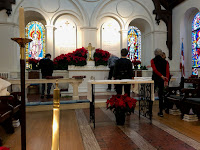
Christmas 2020--no inside service, but we still decorated.
This reading comes up every three years right at this time, but never has that line struck me so profoundly.  We went months without meeting in person and then several more months without being able to sing.  While we remain masked when we sing, I now realize what a gift we have been given for this Christmas.  We get to sing Christmas carols on Christmas.  Do you remember how much we longed for that last year? Sure, many of us look forward to Christmas carols every year, but it’s so much more meaningful when we know what it’s like to be deprived of them, when we know what it’s like not to be able to sing aloud and rejoice. 

Yet, it remains a little awkward.  We are still wearing masks and trying to be careful.  We are still in the middle of a pandemic that is supposed to be long over. How can we truly sing with joy? How can we shout in exultation when shouting is dangerous?

            That is what is so astonishingly appropriate about this reading from Zephaniah.  This joy that comes in chapter three is that much more incredible because it’s not supposed to be there.  Why? Because nothing seems to have changed.  Judah was conquered. The Hebrew people still struggled mightily.  But God decided to show up anyway.  God’s presence broke through the fear, the sadness and even the hate.  That is true joy---joy that is grounded in God’s presence. 

It’s the same in our reading from Philippians.  Paul was writing from prison.  He knew there was a good chance he would be executed. He had every reason to be sad, angry and anxious.  But he was able to tell the people to rejoice and not to worry.  Why?  Because, “The Lord is near.”  That is what Paul wrote in his letter to the Philippians.  That is what Zephaniah also said 100’s of years before, “The Lord is in your midst…”  And while John the Baptist is kind of scary and intimidating, he was saying the same thing in our Gospel today, “God is coming and that is good news.” That doesn’t mean there won’t be hard times. That doesn’t mean we don’t have to prepare, repent, try to be better.  It means that God is coming no matter what.

Joshua has been talking a lot about Santa’s list and I confess we have as well.  But I finally said, “You know Joshua, I don’t know what Santa will do. But I can promise you that we will give you presents no matter what. Because that is what we do as parents. We love our children, no matter what.  That is the kind of love that God has shown us over and over again  over the course of human history. Unrelenting and completely unreasonable---love.

We have no idea if the people of Judah ever repented or changed their ways.  In the end, it wasn’t about them.  It was about God choosing to love them no matter what.  I read a quote in a commentary that I just loved. It said, “…true repentance bows in helpless submission in the face of this great forgiveness.”[1] 

Sometimes we have to know what it is to be forgiven before we can find the strength or courage to ask for that forgiveness, or even know that we need it.  Sometimes we have to experience utter desolation to understand joy. And sometimes, our voices have to be silenced to know what it truly means to sing.


[1] Andrew H. Bartelt, “Third Sunday in Advent,” in Concordia Journal 11:6 (Nov 1985), 227.

Tuesday, November 9, 2021

Forget Normal: November 7, 2021

 Year B, All Saints                                                            Revelation 21:1-6a                                              

            I can’t think of anyone who has ever told me that the Book of Revelation is their favorite book of the Bible.  Anyone?  If it is, that’s ok.  It just makes you unique. Despite the lack of popularity around the Book of Revelation, there are a few passages that bring incredible comfort to those who hear them, including the passage we heard today.  It might be familiar because we often use it at funerals.  In fact, all the readings from today are ones that are recommended for funerals. The part from Revelation that usually appeals to most people is: “God himself will be with them; he will wipe every tear from their eyes. Death will be no more; mourning and crying will be no more, for the first things have passed away.”  The part that speaks to most of us is the release from pain, the visual of God wiping the tears from the eyes of those who are suffering.  It moves me every time I hear it or read it.

            If you read the rest of the Book of Revelation, you will see why this release from suffering is so important. There was a lot of pain and suffering before we get to chapter 21. There were beasts, lakes of fire, dragons, Satan, huge storms, rivers of blood… plagues.  We think the last year and a half has been bad….imagine 1,000 years of this--plus dragons and rivers of blood.  Then again, it kind of feels like 1,000 years, doesn’t it?  5 million people have died from Coronavirus alone.  That doesn’t even include all the other ways that people have suffered and died.  This might be the perfect time for us to dwell a little on the Book of Revelation.  If we don’t take it too literally (which I don’t think was ever intended) then maybe we can identify with this book, now, more than ever.

            While the visual of God wiping the tears from our eyes and the end of death and mourning is powerful and comforting, there are other parts of this reading that not only comfort, but inspire.  The writer talks about a new heaven and new earth. It begins with, “Then I saw a new heaven and a new earth, for the first heaven and the first earth have passed away, and the sea was no more.”  Usually when we talk about the world ending, it’s threatening and scary.  But this part of the Book of Revelation gives hope because it allows for this new heaven and new earth, this opportunity to make all things new. 

It’s strange that the writer specified that the sea is no more.  Why even mention that?  Can’t we assume if the old earth is passing away, the sea is included? In Biblical times, the sea represented division. It was what separated people from one another.  It represented a barrier to human relationships.  For God, it isn’t enough to create an entirely new heaven and earth, God wants to ensure that relationships will be renewed as well. There will be no division between red and blue, Christians and Muslims, conservatives and liberals, vegetarians and bacon lovers.  The barriers will be removed and we will once again live as God intended.

            Much of this might seem irrelevant to us today.  If this is about the end times, why are we talking about it now? The Episcopal Church doesn’t talk about the end times.  But what if this is about more than the end? What if we were able to translate this vision of the future to our present?  For the first few months of the pandemic, we talked about going back to normal.  Then we realized that probably wasn’t going to happen, so we talked about the new normal.  But no one really knows what that means, and let’s face, it doesn’t sound that appealing.  Because when we say “new normal” we just focus on things we need to change, not by choice but by necessity.  We all know that change is hard and disruptive. Why in the world would be want to go through that disruption to achieve normality? Normality was never that good in the first place.          

            When the author of Revelation wrote, “See, I am making all things new.”—it wasn’t a threat.  It was a promise.  Because once you have been through lakes of fire, rivers of blood, dragons, beasts, and plagues, “new” sounds pretty good. Instead of worrying about what will have to change or what we can change back, perhaps we can focus on how to make things news.  If what we read in this text of the Book of Revelation is a vision for this perfect future, there must be a way to bring parts of that perfect future to our present world.  I can think of one way: let’s get rid of the seas that divides us. We have planes now and cell phones.  We can overcome the sear.  The only thing that actually divides us is our pride.  Enough of the divisions.  Enough of the fear mongering. Don’t we have enough anxiety without stoking the flames of unnecessary fear?  Normal. We don’t need to go back to normal. We need to go back to God.  Return to God. Make all things new.

Thursday, February 25, 2021

Praising in the midst: February 28, 2021

 Year B, Lent 2                                                 Psalm 22: 22-30                                                         

            I remember in the first few months of the pandemic reading the predictions of the number of deaths. They were saying 100,000 to 200,000 people would die.  At the time, that was unfathomable. Yet now such predictions seem almost quaint and optimistic.  This week, we reached 500,000.  500,000 people have died from COVID in one year.  That is four times the population of Hampton.  And this isn’t over. 

“My God, my God, why have you forsaken me?”     

            I am sure you recognize those words. That is the first verse of Psalm 22, the psalm that Jesus quoted from the cross as he died.  I imagine those words, or words like them have been expressed far too frequently over the last year.  “Why have you forsaken us?” We always read Psalm 22 on Good Friday—not the whole psalm, the first 21 verses. 

Our psalm appointed for today, the 2nd Sunday of Lent, is Psalm 22, verses 22 through 30.  It’s almost like a different psalm entirely.  The first 21 verses of Psalm 22 contains memorable verses like: “But as for me, I am a worm and no man” or “I am poured out like water; all my bones are out of joint; my heart within my breast is melting wax.” It is a lament psalm at its best and most dramatic. I mean, it had to be powerful for Jesus to quote it from the cross. 

This portion of the psalm that is appointed for today is far different.  It would be classified as psalm of praise and thanksgiving.  The author is encouraging, all the world to praise God, even those not yet born!   It’s not uncommon for the author of a psalm to go through dramatic shifts in perspective.  It makes my 4 year old’s mercurial moods seem tame.  It’s one of things I have always appreciated about the psalms.  They aren’t tame or predictable.  They don’t fit nicely into a genre. They are wild and erratic, which is true of life.  It is certainly true of the last year. 

2020 was a rollercoaster of experiences and emotions—but it was one of those wooden
rollercoasters that you think might just fall apart at any moment.  The thrill isn’t in the ride itself, it’s in coming out alive.  Let’s set aside for a moment the fires, the hurricanes, the locusts, the divisive politics and racial tension and violence.  Let’s focus on COVID (which I know we have talked enough about, but stay with me).  One moment things are fine.  Then you learn you have been exposed to someone with COVID, then you start trying to figure out all the people you have potentially exposed, then you are planning your funeral and theirs, then you are getting a Q tip up your nose and 3 days later you get your test result and learn you are negative.  So many emotions over 5 days. And that is the best case scenario.  Those are the lucky ones. In my lifetime, the psalms have never felt as realistic and appropriate as they have in this year. 

While many of the psalms have dramatic twists and turns—Psalm 22 stands out.  What’s striking to me about this psalm is how we have artificially divided it.  While I have read it many times and preached on it a few times, the end always surprises me.  Just this week I read the appointed portion and thought, wait, that’s not Psalm 22.  Where did that come from?  Despite my delight in the dramatic shifts of the psalms, I have always ignored the 2nd part of this one.  Why?  Because it’s the Good Friday Psalm.  It’s the psalm Jesus quotes as he chokes on his own blood.  It can’t end with praise and hope.  That comes on Easter….not Good Friday.

Yet that is the beauty and poignancy of the Christian faith. The suffering and triumph---the pain and relief---the agony and the joy-- all exist on the same exquisite plain. And while that is poetic and transcendent, it’s not easy.  It’s so so hard.  It’s why Peter (in our Gospel reading) could not accept that Jesus had to suffer.  He’s the Messiah.  He’s not supposed to suffer and die.  He’s not supposed to carry the cross that he will then die on.  For those of us raised in the church, or even near the church, we forget how truly crazy the idea of a crucified Messiah is.  We know the end.  The crucifixion is just what we have to get through to get to Easter.

However, what this psalm reminds us is that neither our lives nor our faith are linear.  The moment we think we have suffered enough, the moment we think we have been through the rough patch and reached the other side, is the same moment when a fresh horror appears.  It is tempting in such times to assume that God has abandoned us.  It’s ok to feel that.  What this psalm teaches us is what it is to praise God in the midst of the suffering.  “Praise the Lord, you that fear him; stand in awe of him…and those who seek the Lord shall praise him.” 

There have been many times when I have envisioned the grand and spectacular worship service we will have when this is all over. There will be lilies and poinsettias, there will be music.  There will be praise and thanksgiving.  And God willing, that will happen. But we can’t wait for that moment to rejoice.  We cannot put our praise and worship on hold.  You might be thinking, yeah, but we can’t be together inside the church.    I get it.  It’s hard to praise God without the people and the sacred space.  It’s hard sitting in front of a computer.  It’s not impossible. 

People have praised God under much more difficult circumstances.  People have praised God in underground churches under the threat of persecution.  Enslaved people praised God even when their identity as children of God was denied.  We can do it.  We don’t do it because things are going swimmingly, we do it because we have a God who continues to love us.  We have a God who understands what it is to suffer and feel abandoned.  We have a God who created us and longs to redeem us.

And I have seen you all do it.  I have seen you show up outside on a freezing day to pray and receive ashes in a baggy.  I have seen some of you log on to facebook in the evening, the morning, anytime you can to participate in worship. I have seen you continue with zoom Bible study. I have seen you drop off food for the hungry. I have seen you come and pick up communion to deliver to your friends and family. We can do it. We are doing it.

We will find a way to do it on Palm Sunday and Easter, even if the weather doesn’t cooperate, even if we are not allowed to worship inside, we will find a way.  Because that is what we do as Christians. We praise God.  We worship God. We do it even when we don’t necessarily feel the words we are saying.  We might find that in saying the words or just hearing the words, that they inspire us to praise more, to find more ways to pray and worship---with action as well as words. We have found ways to do it and with your help, we will find more.

Thursday, December 3, 2020

Holy Desperation: Nov. 28, 2020

 Year B, Advent 1                                                                Isaiah 64:1-9                                                                           

            Typically when we come to the first Sunday of Advent, I find the readings rather jarring and incongruous with the holiday season. First Advent usually comes right after Thanksgiving when people are doing their Christmas shopping and decorating their homes. People come to church expecting some of that same light and joy.  Then they hear readings like the ones we heard today, which are depressing and a little scary. 

If this was any other year, I would start by apologizing for the readings as they just don’t seem to fit where we are right now.  But this year I read them and thought: “Sure, that sounds about right.” The Gospel reading is about the end times, the 2nd coming of Christ. The sun is darkening and stars are falling from heaven.  There has been more than a few times this year when I have thought, “Yup, this is it. The end is coming.”

            However, the reading that really appealed to me this year was Isaiah.  “O that you would tear open the heavens and come down, so that the mountains would quake at your presence…”  When this was written, the people of Israel were desperate for God to make himself known, to be an unavoidable reality in their lives.  Things were so bad, they wanted God to tear apart the heavens, because he clearly wasn’t on earth with them.           

They knew their history---they knew that there were many times when God had intervened.  Isaiah wrote, “When you did awesome deeds that we did not expect, you came down, the mountains quaked at your presence.”  God had done it before for the people of Israel when he sent the plagues and delivered the people from the Egyptian army.  God toppled the walls of Jericho with just the shout of the army.  God delivered the 10 commandment and fed the people for 40 years with manna from heaven.  God had done marvelous and astounding things. They wanted to know, “Where is that all powerful God now?” 

            When I think of the themes of Advent, I think of preparation, expectation, repentance, waiting and hoping.  These are the tame themes, the ones that work well with the 5 candles of our Advent wreath.  So I was surprised when one of the commentaries I read mentioned that this reading from Isaiah contains two of the major Advent themes and neither were themes I usually consider.  The first theme Isaiah highlights is a deep sense of desperation about a situation that is out of control. I thought, wow, that sums up 2020 pretty well. I mean--- it doesn’t really work with any of our candles, but it fits our current situation to a tee.

Photo by Brian Kairuz on Unsplash
The people of Israel understood desperation. The book of Isaiah tells of a country that was defeated in battled. The land was devastated.  The Holy City (Jerusalem) was demolished. Most of the people were carted off to a foreign land where they were enslaved for generations.  In our reading for today, the long exile was over. They had returned to find a home that looked nothing like the one they remembered, nothing like the stories they had been told. They had to rebuild.  They were weary and they wanted a divine intervention.  They wanted God to burst through the heavens because no matter how scary that might sound, it was nothing compared to their current predicament. 

The first 4 verses demand and insist that God come down and make things right.  But then starting in verse 5 they acknowledged their own sin and seemed to give reasons why God should not come down.  It’s like they had this burst of self-awareness and realized that maybe there was something they should have been doing instead of simply demanding that God fix things.  There is another shift in verse 8. “Yet, O Lord, you are our Father, we are the clay, and you are our potter, we are all the work of your hand….Now consider, we are all your people.”

            In just 9 verses, we can observe massive shifts in the way people perceive themselves and God. It begins with a desperate demand that God display his great power and shake the very foundations of the earth. Then the people acknowledge their own guilt. Then they shift to their relationship with God, the relationship of the creator and the creation, the parent and the child.  That is an intimate relationship, one of trust and love.  And that is the 2nd theme of Advent that Isaiah highlights--- a bold and confident trust.[1]

            I resonate with this reading from Isaiah, probably more than I ever have before. I understand what it is to go from desperate fear--- to guilt-- to trust and hope—sometimes in less than an hour.  Everything is so unpredictable and chaotic right now. Desperation can do funny things. If we look inwardly at our desperation, that can lead to hopelessness and grief.  If we look to God in those desperate times, that can lead to a renewed appreciation of what God has done for us and continues to do for us.

            There is a part of me that yearns to skip over Advent this year and go straight to Christmas. We have had enough of waiting and preparation.  No doubt, the people of Israel felt the same way.  The themes of desperation and trust might not be what we want right now---but they might be what we need. When this pandemic is over, things will not be like it was before.  The people of Israel returned to a land that had been demolished. It was nothing like they remembered.  They had to rebuild despite their weariness. We will have to do the same.  I know that I will yearn for a quick fix, because really, haven’t we been through enough?  Yet that will not be an option for most of us. 

Maybe this Advent we need to focus less on preparation and expectation and more on surrender…surrendering to our own powerlessness and brokenness.  Allow yourself that feeling of desperation. But in the midst of that desperation, let us remember that no matter how hard rebuilding might seem, we have the creator as our guide.  Our God knows how to create and recreate. It is ok to be desperate (perhaps even necessary), but let us never lose our faith, even when we are in the midst of that desperation.  Let it be a holy desperation—one that leads not to despair but repair.  If we are the clay and God is the potter, then we are never broken beyond repair.  Our world is never broken beyond repair.  Our broken places are places where God’s light can shine that much more brightly.  That light, that is the light that will give us the power to rebuild.


[1] Texts for Preaching, Year B Commentary p. 2