Showing posts with label discipleship. Show all posts

Sunday, September 4, 2022

Cheap Grace: September 4, 2022

 Luke 14:25-33                     Pentecost 13, Year C

Dietrich Bonhoeffer had a very promising career in academia and the church.  He received his doctorate at age 21 and began teaching at the University of Berlin at 25.  He was also an ordained Lutheran Pastor. Two years after his ordination, in 1933, Hitler seized control of Germany.  Bonhoeffer could have gone the way of the majority of the Protestant Pastors in Germany and sworn allegiance to Hitler while covering the cross with a swastika, which was not uncommon at that time.  Instead, he created the anti-Nazi Confessing Church.  He also started an independent seminary for the Confessing Church.  During that time, he wrote The Cost of Discipleship which remains on many seminary’s curriculum to this day.  While the seminary met in secret, it was discovered and closed after only two years.   
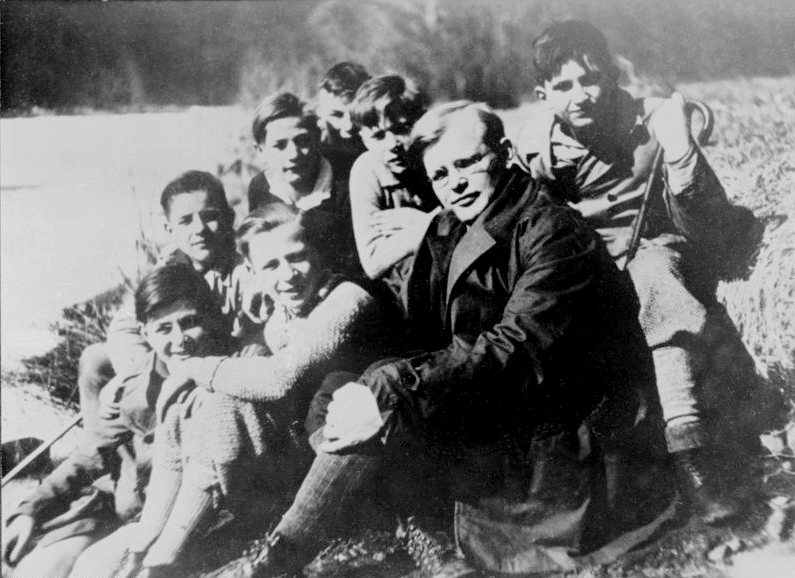
It was soon after that when violence against the Jews became publicly sanctioned and people like Bonhoeffer realized that it was only going to become worse.  He joined a resistance group which was made up of political, military and religious leaders.  One of their accomplishments was providing for the safe escape of seven German Jews to Switzerland.  Unfortunately, that was also the last piece of evidence needed for the SS Guards to arrest Dietrich Bonhoeffer.  He was 36 years old when he was arrested and newly engaged to woman named Maria.

Jesus was known to use a fairly common oratory tactic, that of the hyperbole, exaggeration.  I like to remind people of that whenever they mock me for my tendency to exaggerate, as it is God ordained.  Today’s Gospel reading is a good example of this tactic.  “Whoever comes to me and does not hate father and mother, wife and children, brothers and sisters, yes, and even life itself, cannot be my disciple.”  This is a little extreme even for Jesus.  Hate, as we often like to say, is a strong word.   

The word that is translated to hate was a fairly common Hebrew* expression meaning “to turn away from, to detach oneself from….”  The text would then read, “Whoever comes to me and does not turn away from father and mother, wife and children, brothers and sisters, and even life itself, cannot be my disciple.”  While this is a little more palatable, it’s still pretty uncomfortable.  I am pretty sure you are never going find that on a book mark or magnet in a Christian Bookstore.  

One of the reasons that people struggle with this text is because it contradicts so much of what we consider Christian family values.  However, the Bible sends us mixed messages about family.  One of the 10 Commandments commands us to honor our mother and father.  But there are also horrific examples of violence against family. The first murder in the Bible is a man killing his brother.  Abraham, one of the great patriarchs of our faith was ready to kill his only son.  There are countless other examples of violence within families in the Old Testament.  While the New Testament lacks much of the violence we see in the Old Testament, it still has some mixed messages on how we consider families.  

The only stroy we know about Jesus as a child is when he leaves his parents so he can worship in the synagogue, never considering how his absence might affect them.  There is a story in Matthew where Jesus appears to ignore his family.  Jesus was addressing the crowd and someone told him, “Look, your mother and your brothers are standing outside, wanting to speak to you…” Jesus replied, “Who is my mother, and who are my brothers?” And pointing to his disciples, he said, “Here are my mother and my brothers! For whoever does the will of my Father in heaven is my brother and sister and mother.” I don’t know about the rest of you, but that would have hurt my feelings…just a little.

There is no doubt that Jesus loved his family and his family loved him.  Even after all his disciples abandoned him, it was his mother who stayed at the foot of the cross.  According to the Gospel of John, one of his last acts was to make sure that his mother was cared for after he died.  Jesus did not hate his family.  What he hated was the fact that so many people put other things or people above God.  Usually when we critique things that distract us from God, we mention things like wealth and success.  Yet, anything, even good things can get in the way of God.  Any time we put something, or someone over God, we are making a compromise in our lives as disciples. 

One of the books of that Bonhoeffer is best known for is the Cost of Discipleship.  In the book he argues vehemently against the idea of cheap grace.  He wrote, “Cheap grace is the preaching of forgiveness without requiring repentance, baptism without the discipline of the community, it is the Lord’s Supper without confession of sin.... Cheap grace is grace without discipleship, grace without the cross...”**    Bonhoeffer had seen all too clearly what happened to a church that chose safety and convenience over the sacrificial discipleship that Christ calls us to.  

For most of his life, Bonhoeffer was a confirmed bachelor, with no intent on marrying.  But he fell in love. During his two years in prison he and his fiancĂ©e Maria corresponded regularly.  She urged him to free himself to write emotionally and during that time some of his views softened a little and he went from writing theology to love poems.  Two days before his concentration camp was liberated he was hung.  When the liberators came, they buried or burned all the bodies because there were too many to identify.  Maria wandered Germany for months looking for him because she did not know he had died.  His parents learned of his death when they heard his memorial service on the radio.  His brother and two brothers in law were all killed at different concentration camps within days of each other.  Bonhoeffer loved his family and his family loved him. But in the end, he chose discipleship over them. That is what Jesus meant in our Gospel for today.

Most of us, probably none of us, will have to pay that kind of cost for discipleship.  But we are still called to make sacrifices.   In our Gospel reading, Jesus is telling his followers and all of us that there is nothing easy about the Christian life.  It’s not meant to be easy.  But if you think about your life, I think we often find that some of our most rewarding experiences have been the result of hard work and sacrifices. There will be times when we fall short and can’t make the sacrifices that are required. We can’t all be Dietrich Bonhoeffer.  We definitely can’t be Jesus.  But we can try to follow their example.  When we have an opportunity to choose between what is easy and what is right, we can choose to do the right thing.  We can choose God over convenience.   We can do that because we know that God’s love has already been poured out on us and there is nothing cheap about that.


[*] It was actually a common Semitic expression.   Semitic language includes a wide variety of languages in the Near East.  Hebrew is one the Semitic languages.

[**] Bonhoeffer, Dietrich.  Discipleship. p.44

Monday, June 27, 2022

When Jesus Isn't Nice: June 26, 2022

Year  C, Pentecost 3                                             Luke 9:51-62                                                                                               

            I’m going to be honest with you.  These readings are not my favorite readings, especially for a baptism.  I could preach on the psalm.  It’s a nice one.  It has some very uplifting verses.  Or I could pull one line out of the Gospel or Galatians and take it totally out of context.  It’s tempting, but I am not going to do it.  Sometimes we have to talk about the uncomfortable passages in the Bible, even the ones where Jesus doesn’t act the way we think he should act.

            The Gospel starts out in a fairly standard way. Jesus had “set his face to go to Jerusalem.”  That means that Jesus was resolved to go to Jerusalem where he would be crucified.  We don’t like that he has to be crucified, but we are certainly used to hearing about it at this point and since we know how the story ends, we don’t get overly concerned with Jesus setting his face to Jerusalem.  He sent James and John (who he previously nicknamed the “sons of thunder.”) to Samaria to get things ready. 

            The Samaritans rejected them.  We don’t know why. It could have been anything.  But James and John were upset about it as they asked Jesus if he would like them to command fire to come down and consume the Samaritans.  Now before you label this as an overreaction on the part of James and John, it might be helpful to remember that there was precedent for this reaction.  There were a few times in the Old Testament when God rained fire on a city or a group of people. 

            Fortunately a cooler head prevailed.  Jesus rebuked them.  There would be no fire raining down on anyone. So far so good.  This is classic Jesus. He’s going to be crucified.  The disciples say something absurd. Jesus rebukes them and they move on. But this is where things get a little uncomfortable.  As Jesus walked along, three different people approached him and either asked to follow him or were asked to follow him.  When the first one offered to follow him, Jesus explained (using metaphoric language) that this was not an easy life as he was essentially a homeless man wandering from place to place.  He didn’t say no, but he wasn’t very encouraging.

The next person, Jesus asked. That person was willing but had one reasonable request: “Lord, first let me go and bury my father.”  Jesus said no. You either bury the dead or you proclaim the kingdom.  Not a very pastoral or kind response.  

The third potential disciple told Jesus he wanted to follow him, but he needed to say goodbye to his family first.  Another reasonable request.  Jesus was even harsher in his rebuke “No one who puts a hand to the plow and looks back is fit for the kingdom of God.”  When it comes to being Jesus’s disciple, there are no “but firsts.”  There is no looking back or saying goodbye.  You stop what you are doing and you follow.  You change your plan.  You change the course of your life.  This might be why Jesus didn’t have a large band of followers.  He had 12, maybe a few more that they didn’t count---but definitely not a large group.

            This is a disturbing story because we want Jesus to be kind, compassionate and loving.  A kind and loving person would be understanding if someone wanted to bury their father. He would say something like, “Take the time you need. I will be here when you are ready.” But here’s the thing. Jesus was a man on a mission.  His mission was to save humanity, to release people from the bondage of sin and death.  He was on his way to Jerusalem, which meant he was on his way to his death.  He didn’t have time to be patient with people.  They either followed him or they didn’t.  There was no “but first.”  There could be no other priority in their life, not even their family.  So no, he wasn’t very kind in these instances.  Nothing was more important than what he was doing.

            Ok.  Maybe we can accept that. We don’t necessarily like what Jesus had to say, but we can accept that was what was required of Jesus’ disciples when he was on his way to his crucifixion.  Here’s the tricky part---what does this passage mean for us now?  (Is it too late for me to preach on the psalm? I think it is.)  The thing is, it is highly unlikely that Jesus will return in the flesh, walk right by you and ask you to follow him.  Does that mean that we don’t have to worry about what is required of us as disciples?  Of course not.  We are still called to follow Jesus.  However, we are called to discipleship in more nuanced ways which makes it more challenging and easier at the same time. It is more challenging in that we don’t have Jesus in the flesh telling us exactly what to do. It is easier in the sense that the modern call to discipleship can be ignored or quickly forgotten.

            In the end, what Jesus was asking these potential disciples and what he asked all the disciples was, “Will you change your plans and your life for me?”  So we might each ask ourselves, would my life be any different if I wasn’t a Christian?  How has a relationship with God changed the way I live? Most people I know like to have some kind of plan for their life.  Then once that happens, they might try to fit God into that plan. But what Jesus asked his disciples 2000 years ago and what he still asks us now is to let our plans, our dreams, our goals, be secondary to his holy and life giving mission. I understand how hard to that is---how hard it is to follow God’s plan when it is far easier to fit God into a corner of our plan. 

            One of the final prayers in the baptismal liturgy is: “Give them an inquiring and discerning heart, the courage to will and to persevere, a spirit to know and to love you, and the gift of joy and wonder in all your works.”  We say that prayer for the baptismal candidate, but it’s a prayer that every baptized person shares.  And I wonder if it might help us to figure out how to be better disciples.  I would encourage us all to find this in the prayer book and read it every day.  But pray it for yourself, that you might have the courage to will and persevere and a spirit to know and to love God.  Because if you have those things, you will find a way to let God play a bigger part in your life, to lead you in the right direction.  It’s never too late to start following God’s plan for you.