Showing posts with label sacrifice. Show all posts

Sunday, September 4, 2022

Cheap Grace: September 4, 2022

 Luke 14:25-33                     Pentecost 13, Year C

Dietrich Bonhoeffer had a very promising career in academia and the church.  He received his doctorate at age 21 and began teaching at the University of Berlin at 25.  He was also an ordained Lutheran Pastor. Two years after his ordination, in 1933, Hitler seized control of Germany.  Bonhoeffer could have gone the way of the majority of the Protestant Pastors in Germany and sworn allegiance to Hitler while covering the cross with a swastika, which was not uncommon at that time.  Instead, he created the anti-Nazi Confessing Church.  He also started an independent seminary for the Confessing Church.  During that time, he wrote The Cost of Discipleship which remains on many seminary’s curriculum to this day.  While the seminary met in secret, it was discovered and closed after only two years.   
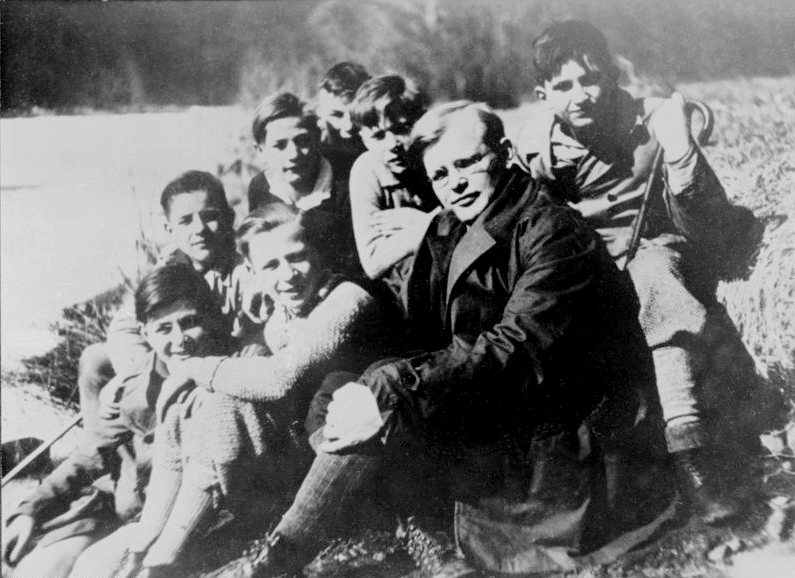
It was soon after that when violence against the Jews became publicly sanctioned and people like Bonhoeffer realized that it was only going to become worse.  He joined a resistance group which was made up of political, military and religious leaders.  One of their accomplishments was providing for the safe escape of seven German Jews to Switzerland.  Unfortunately, that was also the last piece of evidence needed for the SS Guards to arrest Dietrich Bonhoeffer.  He was 36 years old when he was arrested and newly engaged to woman named Maria.

Jesus was known to use a fairly common oratory tactic, that of the hyperbole, exaggeration.  I like to remind people of that whenever they mock me for my tendency to exaggerate, as it is God ordained.  Today’s Gospel reading is a good example of this tactic.  “Whoever comes to me and does not hate father and mother, wife and children, brothers and sisters, yes, and even life itself, cannot be my disciple.”  This is a little extreme even for Jesus.  Hate, as we often like to say, is a strong word.   

The word that is translated to hate was a fairly common Hebrew* expression meaning “to turn away from, to detach oneself from….”  The text would then read, “Whoever comes to me and does not turn away from father and mother, wife and children, brothers and sisters, and even life itself, cannot be my disciple.”  While this is a little more palatable, it’s still pretty uncomfortable.  I am pretty sure you are never going find that on a book mark or magnet in a Christian Bookstore.  

One of the reasons that people struggle with this text is because it contradicts so much of what we consider Christian family values.  However, the Bible sends us mixed messages about family.  One of the 10 Commandments commands us to honor our mother and father.  But there are also horrific examples of violence against family. The first murder in the Bible is a man killing his brother.  Abraham, one of the great patriarchs of our faith was ready to kill his only son.  There are countless other examples of violence within families in the Old Testament.  While the New Testament lacks much of the violence we see in the Old Testament, it still has some mixed messages on how we consider families.  

The only stroy we know about Jesus as a child is when he leaves his parents so he can worship in the synagogue, never considering how his absence might affect them.  There is a story in Matthew where Jesus appears to ignore his family.  Jesus was addressing the crowd and someone told him, “Look, your mother and your brothers are standing outside, wanting to speak to you…” Jesus replied, “Who is my mother, and who are my brothers?” And pointing to his disciples, he said, “Here are my mother and my brothers! For whoever does the will of my Father in heaven is my brother and sister and mother.” I don’t know about the rest of you, but that would have hurt my feelings…just a little.

There is no doubt that Jesus loved his family and his family loved him.  Even after all his disciples abandoned him, it was his mother who stayed at the foot of the cross.  According to the Gospel of John, one of his last acts was to make sure that his mother was cared for after he died.  Jesus did not hate his family.  What he hated was the fact that so many people put other things or people above God.  Usually when we critique things that distract us from God, we mention things like wealth and success.  Yet, anything, even good things can get in the way of God.  Any time we put something, or someone over God, we are making a compromise in our lives as disciples. 

One of the books of that Bonhoeffer is best known for is the Cost of Discipleship.  In the book he argues vehemently against the idea of cheap grace.  He wrote, “Cheap grace is the preaching of forgiveness without requiring repentance, baptism without the discipline of the community, it is the Lord’s Supper without confession of sin.... Cheap grace is grace without discipleship, grace without the cross...”**    Bonhoeffer had seen all too clearly what happened to a church that chose safety and convenience over the sacrificial discipleship that Christ calls us to.  

For most of his life, Bonhoeffer was a confirmed bachelor, with no intent on marrying.  But he fell in love. During his two years in prison he and his fiancĂ©e Maria corresponded regularly.  She urged him to free himself to write emotionally and during that time some of his views softened a little and he went from writing theology to love poems.  Two days before his concentration camp was liberated he was hung.  When the liberators came, they buried or burned all the bodies because there were too many to identify.  Maria wandered Germany for months looking for him because she did not know he had died.  His parents learned of his death when they heard his memorial service on the radio.  His brother and two brothers in law were all killed at different concentration camps within days of each other.  Bonhoeffer loved his family and his family loved him. But in the end, he chose discipleship over them. That is what Jesus meant in our Gospel for today.

Most of us, probably none of us, will have to pay that kind of cost for discipleship.  But we are still called to make sacrifices.   In our Gospel reading, Jesus is telling his followers and all of us that there is nothing easy about the Christian life.  It’s not meant to be easy.  But if you think about your life, I think we often find that some of our most rewarding experiences have been the result of hard work and sacrifices. There will be times when we fall short and can’t make the sacrifices that are required. We can’t all be Dietrich Bonhoeffer.  We definitely can’t be Jesus.  But we can try to follow their example.  When we have an opportunity to choose between what is easy and what is right, we can choose to do the right thing.  We can choose God over convenience.   We can do that because we know that God’s love has already been poured out on us and there is nothing cheap about that.


[*] It was actually a common Semitic expression.   Semitic language includes a wide variety of languages in the Near East.  Hebrew is one the Semitic languages.

[**] Bonhoeffer, Dietrich.  Discipleship. p.44

Friday, April 19, 2019

What is your sacrifice?: April 19, 2019


Good Friday
            On April 12th, 1963, while Martin Luther King was in the Birmingham jail because of the demonstrations against segregation, eight prominent Alabama clergymen (including the Episcopal Bishop of Alabama) published a letter in the local newspaper.  The letter urged people to cease their support of Martin Luther King as he was inciting violence, despite the peaceful intent of the protests.  Four days later, on Good Friday, Martin Luther King wrote a lengthy response to these clergy men.  The letter is referred to as “Letter from a Birmingham Jail.” It would be impossible for me to summarize it as the letter as it is approximately 7,000 words, and they are all important words. 
            The letter was critical of what King referred to as the “White Moderate”—those who supported desegration but wanted to wait until a more appropriate time.  King was also critical of the white churches.  He wrote: “But the judgment of God is upon the church as never before. If today's church does not recapture the sacrificial spirit of the early church, it will lose its authenticity, forfeit the loyalty of millions, and be dismissed as an irrelevant social club with no meaning for the twentieth century.”
            It is not a coincidence that he wrote these words on Good Friday, a day when the church talks the most about Jesus’ sacrifice, a day when we are reminded of the betrayal of not only Judas, but Peter and the other disciples who abandoned Jesus when he needed them the most.  At my last church we always did a drama for Palm Sunday. As the assistant, it was my task to cast the drama.  There were of course a few people who I called on several times.  At one point one man said to me, “How come I always have to be the bad guy?”  I responded, “The only good guy in this story is Jesus and no one wants to play him either.”  It’s true.  If you look at all the people in the story that we hear every Palm Sunday and every God Friday (which includes Peter, the chief priests, Pilate, the soldiers, the crowd), no one ever comes out looking good.  Only Jesus, and he gets crucified. 
            Of course the biggest betrayal comes from those closest to Jesus--his disciples.  We all know about Judas and his outright betrayal.  We know about Peter’s denial.  Yet there were 10 other apostles.  Where did they go? Where were they during the trial?  Where were they at the crucifixion?  The Gospel of John mentions that one of the 12 apostles was at the foot of the cross.  The Gospel does not name the disciple.  It only refers to the “beloved disciple.”  I sometimes wonder if that was done so that we could all see ourselves in that spot.  There were some women (including Jesus’ mother) who were at the foot of the cross, but the other 11 disciples were missing.  
            We can’t be sure why they are missing, but since the Gospel tells us later that they went into hiding because they were afraid, I assume they were trying to save themselves.  They were afraid that if people associated them with Jesus, they would either be arrested or crucified.  I do not blame them. They were terrified and I would have been as well.  They were not ready for this kind of sacrifice.
            I often wonder if I would have been brave enough to support Martin Luther King as a white pastor at that time.  I just heard a pastor talk about the experience of having to flee in the night because his father had the audacity to work with African American pastors in the 1960s.  His life was threatened.  The life of his family was threatened.  His father risked a great deal to stand with African American pastors and he paid a price.  I am not sure I would have been that brave. I would have almost surely been part of the white moderate. 
            In the quote I read at the beginning of this sermon, King said that we need to recapture the sacrificial spirit of the early church.  Yet we can see that before the early church was born, the leaders of that early church made a lot of mistakes. They weren’t ready to sacrifice, not until after the resurrection.  They needed to witness not only Jesus’s sacrifice, but his triumphal re-entry. 
            It’s hard to reclaim that sacrificial spirit because we have been comfortable for far too long.  Most people don’t come to Holy Week service.  Sometimes it is because work or family makes that difficult.  But sometimes I think it is because we would really rather just skip over the sacrifice and rejoice in the triumph of the resurrection.  We feel that the sacrifice already happened and now we can just enjoy the benefits of that sacrifice.  Unfortunately, without the sacrifice, as Martin Luther King said, we forfeit our authenticity.  If we cannot stand up for unpopular truths and marginalized groups, then we are no longer the church that the early apostles created and ultimately died for. 
            I am not going to tell you what sacrifice looks like for you.  Only you can know that. But for me, it means that I can no longer let fear determine my actions or reactions.  I cannot constantly worry about what other people will think.  Good Friday asks us all to consider what sacrifice looks like for us.  If you are already the kind of person who likes to “tell it like it is,” then doing that more, isn’t really a sacrifice.  For some of us sacrifice will look like more listening and less talking.  For some of us, it will be about speaking out more.  Only you and God can know what sacrifice looks like for you.  But I can tell you one thing, if the sacrifice feels good and is easy, it’s not sacrifice.  If it makes you a little sick and anxious, it just might be. 
            While sacrifice is not easy, it is not the end.  At the end, we have resurrection.  Martin Luther King never gave up on the church and Jesus never gave up on his disciples.  He forgave them after his resurrection and they were transformed into a new p eople---a people bold enough to proclaim the Gospel in a hostile environment.  The last line of Martin Luther King’s Letter was: “Let us all hope that the dark clouds of racial prejudice will soon pass away and the deep fog of misunderstanding will be lifted from our fear drenched communities, and in some not too distant tomorrow the radiant stars of love and brotherhood will shine over our great nation with all their scintillating beauty.”  That is what Christian hope looks like.

****I encourage you to read the full letter: https://www.africa.upenn.edu/Articles_Gen/Letter_Birmingham.html

Monday, March 18, 2019

Look at the Stars: March 17, 2019


Year C, Lent 2                                                                         
Genesis 15:1-12, 17-18                                                                     
            I started the ordination process when I was 26.  I had just finished my 3rd year in seminary, so things were a little backwards for me.  Typically you enter the ordination process before going to seminary. Therefore, when they told me ordination was probably 2 years out (and that was only because the Bishop was supporting an expedited process), that seemed like forever.  It wasn’t-- but at age 26, it felt like forever.   People kept telling me to be patient and that, “God’s time is not your time.”  That was really annoying…because what can you possibly say to that when the vocation you are pursuing is one  that expects that not only will you trust God, but also talk to other people about the importance of trusting God?  I was told by a mentor that I needed to be careful that I never gave the impression (to anyone in authority) that I was in a hurry and certainly that I should not complain to anyone about how long it was taking. That turned out to be very good advice.      
            Thankfully God doesn’t have the same rules about complaining.  Because if God did, Abraham would never have become the father of a nation and one of the fathers of our faith. Then again, he had more to complain about than I did.  God had picked Abraham out of obscurity to be a leader.  He had promised Abraham, that if he obeyed him, he would be given land and children.   The piece about children was extra important to Abraham because by the time God called him, his wife Sarah was already considered barren, which means they were a bit on the older side.  Despite their inability to conceive, God had promised Abraham that his descendants would be as numerous as the dust of the earth. Yet by the time we get to our reading for today, decades have passed since that initial promise---Abraham had done everything that God had asked of him--- and he and his wife were still childless. 
            Thus, when God came to him and declared, “Do not be afraid…I am your shield; your reward shall be very great”---Abraham’s response was a little exasperated.  Now, obviously, I wasn’t there, but I imagine Abraham reacting a bit like this:Image result for hand slap to head emoji.

         He essentially said, “You haven’t even come through on the first promise you gave me.  I want a child!” God’s response is interesting.  God didn’t say, “Look, your time isn’t the same as my time.  You need to be patient.” He said, “Look toward heaven and count the stars, if you are able to count them.  So shall your descendants be.” He didn’t defend his promise or the lack of progress on that promise.  He expanded the promise.  He said to Abraham, this is bigger than you can possibly imagine.  Forget the whole dust of the earth analogy I used before, now I want you to imagine the stars of the sky.  That is how vast your progeny will be. 
And you know what, that was all it took for Abraham.  He believed.  He still had some complaining to do---but he believed.  Minutes later when God again promised him acquisition of land, Abraham asked him to give him some proof.  It’s not that Abraham didn’t believe God’s promise. He did.  But he needed something tangible.
            That’s when things get a little weird in our reading.  God asked Abraham for some animals that could be sacrificed.  He asked Abraham to cut the animals in two and then Abraham fell asleep.  When it was night, a smoking fire pot and a flaming torch passed between the two halves of each animal.  After the smoking pot and flaming torch passed between the sacrificed animals, the Lord made his covenant with Abraham.  Really, he affirmed the covenant that he had already made.
            Let me break down the imagery of the smoking fire pot and flaming torch.  First of all the Hebrew word translated to covenant means, “to cut.” Thus, cutting the animals in half symbolized creating/cutting the covenant.  In this scene, the smoking pot and flaming torch symbolized the Lord and by passing through the cut animals, the Lord was showing Abraham that he was the one making the promise.   By passing through these dead animals, God was deepening the promise by making it about life and death.  One commentator (Rolf Jacobson) described this by giving God these words: “I pledge my very life as surety of this promise.  If I fail to keep this promise, let me be slain just as the goat, the sheep and the ram were slain.”[1]  It’s hard to get more tangible than that.
            Here’s the thing about God.  God always keeps his promises.  Sometimes it takes a little longer than we would hope.  It would be many more years before Sarah would conceive her first born.  And it would be even more years before God would make that ultimate sacrifice that he predicted that night with Abraham—sacrificing himself. 
We are in the season of Lent.  Every Sunday, Jesus comes a little closer to his death. While God did keep his promise with Abraham, God’s people did not hold up our end of the deal. We still could not commit to a relationship with God.   But God never breaks promises and God never gives up on his children.  His love is so deep and so wide, that God will do anything to redeem that love, even if it means dying on the cross.  So despite the fact that God did not break his promise, God decided that the only way we could see his love was by sacrificing himself. 
            It’s ok to complain to God.  Because if you are complaining, that means you are still talking.  If you are still talking, that means that you still have hope.  And as long you maintain that sliver of hope, God will find a way to break through and show you how deep and wide his love for you is.  When God told Abraham to look at the sky and try to count the stars, he wasn’t just reminding him of the number of ancestors he would have.  He was encouraging him to look outside of himself.  So often, we can get caught up in our own worries (or the worries of those closest to us) that we forget to open our eyes wide enough to see the evidence of God’s love that is all around us. 
During Lent we emphasize the importance of inner reflection and examination.  That is important.  But sometimes when we are doing that internal reflection, we are just talking to ourselves instead of talking to God, or more importantly, listening to God.  God’s love is deep and wide. It lives within us and beyond us.  If for some reason, you can’t feel God within you, look outside.  Maybe, do something trite like watching the sun set over the water or gaze at the stars on a clear night or listen to a particularly powerful piece of music or maybe just take a deep breath and remember how lucky you are to be breathing when for so many, breathing is agony.  Then when you have that experience, send me an e-mail or give me a call because I need reminders of God’s majesty and love as much as each of you.  Hopefully, that is what we are for one another in the church, evidence of God’s love, a love that will never give up.


[1] Rolf Jacobson from Working Preacher: http://www.workingpreacher.org/preaching.aspx?commentary_id=4001