Showing posts with label Darkness. Show all posts

Wednesday, January 8, 2025

Christmas in the Dark: Dec. 25, 2024

Year C, Christmas                               Isaiah 9:2-7                                          

          “The people who have walked in darkness have seen a great light; those who lived in a land of deep darkness—on them light has shined.”  We hear a lot of Isaiah during Advent and Christmas.  We hear it in the music, especially in Handel’s Messiah.  If that is your only exposure to Isaiah, it would be natural to assume it’s meant to be a bit of a preview for the dramatic unveiling of the Christ Child. But that would be a disservice to the Book of Isaiah, and the Jewish faith.  The Book of Isaiah is one of the longest and most significant books in the Hebrew scriptures.

          Because it’s so long and covers such a long time frame, it is usually divided into three parts.  The first part was the prophet trying to convince people to change their ways, or they would be conquered by a foreign power. In the second third, the Babylonians invaded and the people were driven from their land.  Their city, the city of God was in ruins.   Some were left homeless and friendless, but most were taken away to Babylon to live as slaves.  In that section of the book, Isaiah provided a message of consolation.  He assured them that God would save them.  The final third of Isaiah describes life after the Hebrew people have returned to their home.  But it didn’t look like the way they remembered it.  They had to rebuild and start over.  There were no easy beginnings or endings in Isaiah.

          Our reading for today comes in the first section of Isaiah.  There is a warning, but there is also hope. One of the challenges of the people of Israel was their tendency to put their hope in human kings.  They believed that their kings were divinely ordained and if only they could find the right king, then they would be safe and secure.  In many ways the US was started with a rejection of this concept, the idea that one person or a line of people could be our salvation.  Yet we still fall into that trap, don’t we----thinking that one person can save us or worse yet, one person can destroy us.

          Biblical scholars and historians believe this text from Isaiah wasn’t necessarily talking about a messiah who would be born hundreds of years later, but the reign of King Hezekiah.  King Hezekiah was a good and righteous king.  Despite that, during his reign, the Assyrians invaded and Israel was conquered.  This was not what Isaiah predicted in our reading for today. Our reading for today predicted a great light and the end to war.  It says, “For all the boots of the tramping warriors and all the garments rolled in blood shall be burned as fuel for the fire.” That was an allusion not just to the end of war, but the end of being the conquered.  That is not what happened. Not only were they conquered, King Hezekiah was followed by a corrupt king.

          One might wonder how prophetic Isaiah really was.  He promised a period of endless peace.  When we look at the Middle East, one would hardly describe it as endless peace.  Does that mean that Isaiah was wrong…or was he just wrong about that king---perhaps they just had to wait 500-700 years for the birth of Jesus.  Even the most passionate believers of Jesus Christ and his role as a savior and messiah would never try to argue that he brought a period of peace.  Look at any news outlet at any period in the history of our world---war has been a constant.  It is as reliable as death and taxes.

          And yet…I think Isaiah was on to something.  “The people who walked in darkness have seen a great light; those lived in a land of deep darkness---on them light has shined.”  We can never know the beauty of light until we have stood in darkness.  We can never know what it is to yearn for light until we have survived the night that seems interminable.  We can never truly fathom joy until we have experienced grief. 

          Isaiah knew that salvation would not come in a king or any temporal leader, but only from a God so intent on bringing light to humanity, he would enter the darkness with us.  For millennia, we have associated darkness with sin, pain and grief.  We have shunned darkness in favor anything that can bring us light.  Yet what we know is that new life always starts in the dark---whether it is a seed in the ground, waiting for the soil to soften enough so it can break through, or a baby in a womb waiting to be born, or Jesus in the tomb, waiting for Easter morning.  New life starts in the dark.[1] 

          Jesus, the person who we celebrate tonight and every night, was not born in a palace—in a place of light and glory.  He was born in a barn, more likely a cave as that is where people kept their animals at the time. You know what caves are—they are dark. He was born in a war torn country to people who have been conquered over and over again.  He was born as an infant, as we all are, the most vulnerable of all creatures. The movies always show this big light shining down on this scene, but in the Gospel of Luke, there is no star, there is only darkness and a few people who found their way through the darkness. 

          I think sometimes we come to Christmas service to hear this heartwarming story that kind of ties our faith up in a neat and clean bow.  But the beauty of this story is that it’s not clean and it’s not neat.  It’s not even magical.  It’s real and it’s only the beginning.  It is meant to show us that even in the deep darkness of our lives, a light shines—not in spite of the darkness but because of the darkness. 

It’s not just a light---it’s a fire, a fire that fought hard to exist—a fire that refuses to be covered.  But like all fires, it needs oxygen to keep going.  It requires that all of us fight to protect it and refuse to ignore it.  In a few minutes, we will walk out of this (slightly) warm church---leaving the soft glow of candles. We will all have to go back into the dark.  I want you to hold on to that fire, stoke that fire so that it burns bright enough, not to defeat the darkness, but to bring more life into places where most only see death.  That’s our calling as Christians, to be bearers of light and fire, because we worship a God who has not defeated darkness, but who enters the darkness with us and then lights it on fire.


[1] From Learning to Walk in the Dark by Barbara Brown Taylor

Monday, June 19, 2023

Prisoner of Hope: June 18, 2023

 Year A, Pentecost 3                                        Romans 5:1-8                                                                       

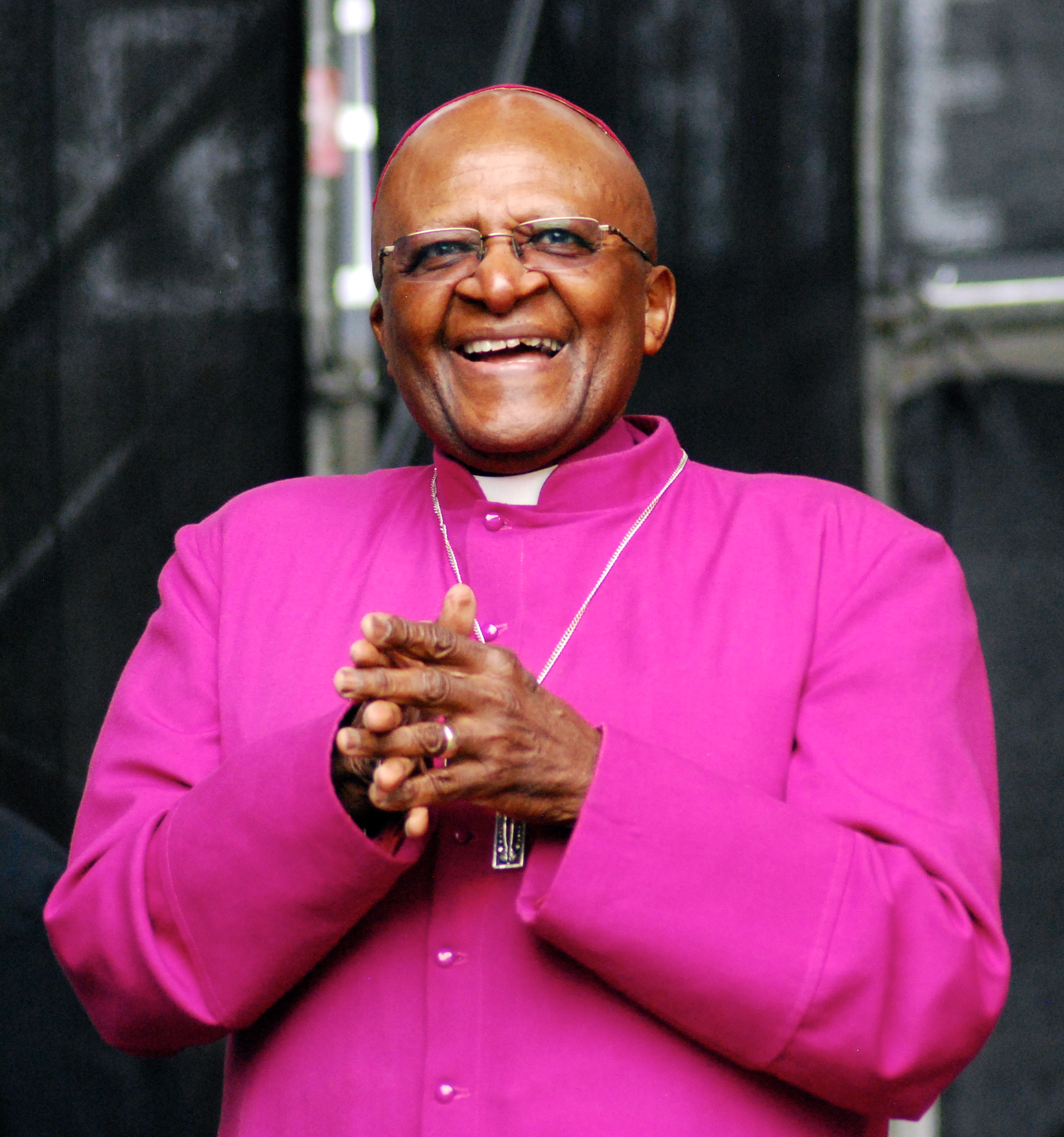
Desmond Tutu was the Archbishop of Cape Town South Africa for over 30 years.  For even longer than that he led the fight against apartheid in South Africa.   Being black in South Africa during that time was a struggle— being black and on the frontlines of that struggle would have no doubt led to suffering and frustration.  He didn’t have an easy life.  Even after apartheid ended in 1994, he continued the hard work of truth telling by leading the Truth and Reconciliation Committee that worked to address the injustices committed during apartheid.  Archbishop Tutu never shied away from hard truths.  Yet I think what he is best known for is his joy, love, hope and his infectious laugh.  At the same time, he made sure to distinguish the hope that he practiced from the sunny optimism the world often associates with the word hope. He said, “I have never been an optimist. I am a prisoner of hope.”

            The Apostle Paul, the author of our 2nd reading, would not have called himself an optimist, but was definitely a proponent of hope.  In his letters, he mentioned hope over 50 times.  In today’s reading he says, “…but we also boast in our sufferings, knowing that suffering produces endurance, and endurance produces character, and character produces hope, and hope does not disappoint us...”  One commentator described this as “chain reaction of grace” because it starts with the fact that we are standing in grace.  Grace is the free, undeserved gift that God has given all of us.  It’s the love that God gives us regardless of whether we deserve it or even want it. We have all been called to stand in grace.

            I have to say that I both love and hate these words of Paul.  I love the idea that suffering can create endurance which would then lead to character and inevitably hope.  I love the idea.  What I am not too fond of is the actual experience of suffering.  I don’t know anyone who is.  It kind of reminds me of that phrase “What doesn’t kill you makes you stronger.”  I have never liked that phrase much either.  Because I have witnessed a lot of suffering that didn’t lead to strength or hope.  Sometimes suffering just leads to anger or depression. 

            It would be easy to say well the difference is that as Christians, we have faith and that enables us to transform our suffering into strength and hope.  Yet I have seen many Christians who can’t make it to the other side of suffering. And it’s not because they weren’t good Christians.  It’s not because they weren’t faithful enough.  Sometimes it’s because the suffering was too intense, too endless. There was no reprieve.  I don’t believe that Christians have some special sauce that enables us to have hope in the midst of pain.  I think our hope is different. 

            You see our hope isn’t based in some idyllic life that we have been promised.  It’s not based merely on what can be. It’s based on what Jesus did for us and what he continues to do for us.  Christian hope is born not in life, but in death, in the death of Jesus Christ.  Jesus suffered in both his life and death.  That suffering is what enabled Jesus to be resurrected and thus enables us all to have new life.  Our hope is different than the hope we might read about in greeting cards and chicken soup for the soul kind of messages. Our hope was forged out of darkness and death. [1] That is why darkness and death cannot defeat Christian hope...because darkness and death---they birthed hope.  That is what makes the hope we have in Jesus so incredibly powerful.

            But here’s the thing, this Christian hope isn’t easy.  Having it doesn’t even make our lives easier. In some ways, life becomes harder with hope.  Esau McCauley, a priest and writer, wrote, “Hope is a demanding emotion that insists on changing you.  Hope pulls you out of yourself and into the world, forcing you to believe more is possible.” [2]

            That’s what Archbishop Tutu meant when he said that he was a “prisoner of hope.” Once that hope took hold of him, he could not give up.  He could not despair.  Despair is a horrible feeling, it really is.  No one would want despair.  Yet while hope is demanding, “despair allows us to give up our resistance and rest.”[3]  That makes being in a state of despair easier because we can stop trying to make the world better….we can stop being aware of the pain and anguish that surrounds us.  We can just stop.  And I have to say, that can be tempting sometimes.  In a world that is broken and in desperate need of repair, it’s tempting to throw our hands up in the air and say, “Well, there is obviously nothing I can do about this, I might as well just stop trying…stop hoping.”

            We think that hope is something that should come to us naturally…but it’s not our natural state.  It’s something we have to work for.  That work can be exhausting.  You might be thinking, that doesn’t sound very good.  If that is what hope is, why would we want it? Why?  Because we Christians stand in grace.   That is God’s gift to us.  It’s our starting point.  And while hope is challenging, it’s also uplifting.  It brings joy.  It is life giving.  It gives us life and it gives those around us life.  Despair, it’s easier because we don’t have to do anything.  We don’t have to face the hard truths or our world. We don’t have to face how even our actions contribute to the despair of others.  But that is not why God put us on this earth.  We are not here to lean into despair.  We have not been given grace so we can squander it.  We, (the church) must be beacons of hope in this dark and lonely world.  We cannot give into the despair or the hate or the apathy. 

            Our Gospel reading says that Jesus saw the crowds and had compassion on them because they were harassed and helpless.   Then he told the disciples, “The harvest is plentiful, but the laborers are few; therefore ask the Lord of the harvest to send out laborers into the harvest.” The harvest is the people who are living in despair, who can’t see out of their despair. Sometimes we are part of the harvest.  There are times, when we all might be in that place.  But there is also a lot of time when we are the laborers, when we are prisoners of hope who can’t possibly give up.  The harvest is plentiful.  Despair and darkness can indeed feel overwhelming.  But never forget that Christian hope was forged in darkness and death, which is what makes it indestructible and impenetrable.  Be a prisoner of hope.  Let hope captivate you.   Whatever is happening in our world, whatever suffering we might encounter, never forget Christianity was created because death was defeated. And that—that is a hope that never disappoints.  


[1] This idea comes from a commentary by Scott Hoezee and can be found here: https://cepreaching.org/commentary/2016-05-16/romans-51-5/

[2] https://www.nytimes.com/2023/04/08/opinion/easter-jesus-judas-hope.html?searchResultPosition=2

[3] https://www.nytimes.com/2023/04/08/opinion/easter-jesus-judas-hope.html?searchResultPosition=2


Thursday, April 21, 2022

Waiting for the morning: April 17, 2022

Year C, Easter                                                             Luke 24:1-12                                                                       

            When I was in the hospital, I hated the night.  Visitors had to leave at 8pm and could not return until 8am.  At 8pm I would start to panic because I knew I had 12 hours ahead of me.  And it’s the hospital, so it’s not like you can sleep at night.  Because I had an infectious disease, I couldn’t leave the room or open the door.  It felt like I was in a tomb.  Even when I came home, I dreaded the night.  Never in my life have I been so desperate for the morning.  As I look back on it, I am reminded of Psalm 130. "I wait for the Lord, my soul waits, and in his word I hope; my soul waits for the Lord more than those who watch for the morning, more than those who watch for the morning."  I would like to tell you that the Psalm came to me in the darkness of the night when I most needed it, but it didn’t. Sometimes you have to wait.  Some nights last more than 12 hours.

            I have preached on this text from Luke several times.  Every time I read it, something different strikes me.  This year, it was the time of day that caught my attention. “On the first day of the week, at early dawn, the women who had come with Jesus from Galilee came to the tomb…”  Early dawn. There are 4 Gospels that tell the story of the resurrection and they are all a little different in the way they tell the story.  One of the things they have in common is that the women come either right before dawn or at dawn. 

            There could be a ritualistic reason they came early in the morning.  Typically bodies were anointed before burial. However, because Jesus’ death and burial was unusual for a variety of reasons, the women had not been able to anoint him when they normally would have---right after death.  That must have been upsetting to them.  The act of anointing was a way these women could mourn someone who was dear to them.  It was their last opportunity to minister to him.  So it’s possible they were simply eager to move forward with this important ritual that they had been denied.

Because of COVID, most of us have had experiences of not being able to mourn people as we were once able.  It could have been being denied a timely funeral or even not being able to gather friends and family to share stories.  Some who died of COVID or were in nursing homes or hospitals with strict policies had to say goodbye through a computer or phone screen.  I said final prayers for someone through and open window while huddled with the family under an umbrella. The traumas of the past two years have been compounded by our inability to mourn and process.   Thus I think many of us can understand why it was so important for these followers of Jesus to anoint him as soon as they could.

Yet I also could not help but wonder what their nights must have been like after Jesus was crucified.  It has been two nights and two days.  Jesus rose on the third day.  The women who came to anoint him were the very same women who had been with him while he shared his parables, when he performed miracles, when he raised Lazarus from the dead.  They were the same women who had been with him when he was crucified. After witnessing the crucifixion of not just a dear friend, but a man you believed was God in the flesh…how well do you think you would sleep?  Trauma can do some crazy things to your sleep.

The psalm I opened with mentions someone watching for the morning.  I bet these women did more than watch. I would think they were desperate for the morning---desperate for a time that they could be with their friends who had shared this experience, friends they could weep openly with. Desperate for some sense of closure.

They arrived at early dawn, which means they started their journey when it was still dark.  Can you see it?  These heart-broken women trudging through the darkness to a tomb.  They must have been carrying more than just broken hearts and spices.  Because a broken heart will not propel you forward.  There must have been an ember of hope buried inside them—a memory dancing on the edges of their consciousness.  He said he would rise again.  It didn’t make sense when he said it, but what if??  It was desperation, but it was also hope that drove them into the night. Desperation and hope are often tangled together. 

I have traditional book commentaries that I consult when I am preparing a sermon and a few online commentaries.  When things get desperate (as they did this week), I occasionally just google random thoughts and words.  When I did that this week, I kept seeing websites and articles with titles like, “Evidence for the resurrection.”  Those were not links I pursued. We don’t believe in the resurrection because of evidence.  There is no body of evidence that can prove that the resurrection happened.  Despite that lack of evidence, we are still telling this story thousands of years after the event.  That in and of itself is amazing.  A religion that started with a man born in a backwater town, who collected a small band of followers and then died a gruesome death currently has 2.4 billion followers.  And that doesn’t include all of those Christians who have lived over the last 2000 years.  How could any movement survive that long without proof?

When the women went and told the other disciples that Jesus had risen, they had not yet see the risen Lord.  They had just seen the empty tomb and been told that he was risen by two men in white.  They had no real evidence. But they remembered who he was in life.  They remembered the hope he had given them, the hope they still carried even after he was crucified—when there was absolutely no good reason to hope.  Who holds on to hope after someone has been brutally murdered? Christians.  We do.  And that my friends, is what gets us through the darkest of nights and the haziest of dawns. It’s not the light that we currently see, it’s a light that we are promised. A light that seems heart wrenchingly dim at times, a light we can best see when we have experienced total darkness.

Photo by Daniel Joshua on Unsplash

Just like those desperately hopeful women, we too have to start in the night if we want to make it to the dawn.  Every single person in this church has suffered in some way over the past several years, some more than others.  I would do anything to be able to take some of that pain away.  I can’t.  I can’t give you proof of the resurrection.  But I can promise you this—that ember of hope that propelled those women through the darkness to an empty tomb burns in each one of us.  If it were not so, you would not be here.  Something brought you here. It might seem to be a family obligation, or a tradition---some perfectly ordinary reason.  But God’s works miracles in the ordinary. 

Today we receive communion at the altar for the first time in 25 months.  Communion is about a lot of things and one of those things is remembering Jesus’ words.  It’s a weekly reminder that despite the lack of proof, we still gather with hopeful expectation.  We still believe that we have a God who works miracles out of the ordinary—a God who promises that no darkness last forever.  The morning always comes.


Sunday, December 17, 2017

Don't quench the Spirit: December 17, 2017

1 Thessalonians 5:16-24                                                
Yea B, Advent 3                                                                      

            One of the things I have enjoyed about being the parent of a toddler is imagining all of the things that he might become.  When he jumped off the couch and landed on his feet I thought, he is going to be a famous gymnast.  When he said his first full sentence, I decided he was most certainly going to be a Rhodes Scholar. When he played something on the piano that kind of sounded like something resembling a song, I reminded myself to look up when Mozart started playing the piano because there was a chance that Joshua could be a savant.  It’s fun thinking of all of these possibilities.  At some point, he might tell me he hates the piano and I will cross “next Mozart” off the list.  But right now, he could be anything. 

I remember a time when I was absolutely convinced I would be a senator.  There was no doubt in my mind that I could accomplish whatever I wanted.  And I hope that most of us have some memory like that, a time when anything was possible.  While I was thinking about all of this, I tried to remember the moment when I realized that not everything was possible…or that some or many of my dreams would not be realized.  I don’t think it was any one moment.  It was just a jumble of realizations, some of them painful, some of them enlightening.  I think part of what forms us, what makes us who we are is how we deal with the failures and rejections in life. 

It’s like we are born with a flame.  At first there is a flicker/a spark.  It grows and provides light and a little heat.  Then a couple of things can happen. 

1.      It continues to burn, but goes through different phases. Sometimes it flickers and seems like it is about to extinguish. Sometimes it grows so big it seems like it will burn the whole place down.  It never dies, but sometimes it may seem like it will.

2.      Or it could be a flame that stays sheltered.  It is steady and unchanging, but can only grow so much. 

3.      Or, it is a flame that rises to a certain height and then appears to be smothered, until all you see is embers.

We are these flames. Either we experience success and failure and keep burning through it all.  Or, we stay safe and controlled, not taking much risk.  Or we burn and then something or someone quenches our fire.  The flame ends in ash. The dream dies.  The Spirit is quenched.

            That line from Paul’s letter to the Thessalonians captured me when I was initially reading these texts.  I keep coming back to it, “Do not quench the Spirit.” Paul was talking to new Christians.  This letter to the Thessalonians is the oldest books in the New Testament.  It was written before the Gospels, less than 20 years after Jesus ascended to heaven.  As you came imagine, there was a great deal of fervor in the new community.  There was passion for Jesus and all that he had taught.  They believed in this new movement despite the fear of persecution.   They knew that they could be stoned for worshipping Jesus. This fledgling Christian community was surrounded by people who thought this Jesus thing was just a passing fad, another little cult that would end with that generation. 

In addition to this fervor and passion, these new Christians experienced doubt and fear as well. They had expected that Jesus would return in their lifetime. As people in their community died, they got worried.  What happened if Jesus didn’t come back?  Even Paul had expected Jesus to come back in his lifetime. Thus as the years went by and Jesus did not return, the fervor and the passion that had carried these new Christians wavered.  It was a scary place to be….this in-between place. Despite the fear and the doubt, they held on.  Paul continued to support them and reassure them.  They lived in hopeful expectation. But the longer they waited the less hopeful they were. 

            While we cannot be sure what was happening, it is evident from this letter that Paul was concerned for them.  Otherwise he would not have felt that he had to remind them not to quench the Spirit.  We assume that Paul was talking about the Holy Spirit, but I think it was more than that---at least more than how we perceive as the Holy Spirit.  For most of us, we see the Holy Spirit as something outside of us.  On our good days we see it as something that may inspire and guide us. Other days, we forget about the Holy Spirit entirely. 

But let’s assume for a minute that for the early Christians, the Holy Spirit was part of them.  It was the flame that I spoke of in the beginning of my sermon.  It was the flame that drove them through life. When it was quenched, when it was extinguished, then everything was quenched.  Without it, they were walking in the dark with no light to guide them.  Therefore, it was critical that the Holy Spirit not be quenched.

While we tend to relegate the Holy Spirit to Pentecost and ordinations, the Holy Spirit is part of us.  It is no coincidence that there is a preponderance of candles in churches.  They are not just for aesthetic purposes. The flames serve as reminders of the presence of the Holy Spirit.  They also represent the light of Christ.  The Holy Spirit is what sustains that light within each of us.  We do not have to worry when Jesus will come again, because we have this guiding light at all times.  We have a light that not only shines outwardly, but one that burns within each of us.

Here is the thing about the light of Christ or the flame of the Spirit.  No matter how hard we try to quench it, we can’t.  We can cover it up.  We can try to hide it.  We can ignore it.  But we cannot extinguish it.  Despite that, wouldn’t it be better if we fanned the flames instead of quenching them? Wouldn’t it be better if we tended to the flame in each one of us and one another? 

Much of Paul’s letter to the Thessalonians is about how to be a Christian community. “Rejoice always, pray without ceasing, give thanks in all circumstances…” All of our hopes and dreams might not be realized.  Some of us, many of us, will have moments when the flame within us will feel more like ash than flame…which is why we have one another to fan the flames.  We are here to be inspired and to inspire.  After Christmas, we will move the Advent wreaths back into our closets or attics, but that doesn’t mean that the light is gone; it just comes in different forms.  When the darkness seems like it will overcome us, try to imagine the light within you.  If that is too hard, find a candle to remind you that there is always light—the Spirit cannot be quenched. 

Thursday, December 8, 2016

Burning makes us Brighter: December 4, 2016

Year A, Advent 2                            
Romans 15:4-13                                                                    

            Most of us have heard of Sigmund Freud, a famous Austrian Psychiatrist who lived in the beginning of the 20th century.  He was a Jew and died shortly after WW2 began.  There was another Austrian Psychiatrist who was younger, but considered Freud to be a mentor.  His name was Viktor Frankle and he was also Jewish.  In 1942, he and his whole family were sent to Auschwitz.  He spent three years in various concentration camps.  He was there until the concentration camps were liberated. 

As you can imagine, much of his later work was informed by this experience.  In reflecting on his experience in the concentration camps, he tried to determine what the difference was between those who died in the concentration camps and those who survived. He said that it was not about physical strength. He saw many strong men die and many weaker men survive.  He said that finding meaning in your own life was critical to survival and that sometimes we need to find meaning in the suffering. He concluded that the difference between those who died and those who survived was hope. 

            The Apostle Paul lived through a great deal of suffering.  He was a strong believer in hope.  Our reading for today begins with, “Whatever was written in former days was written for our instruction, so that by steadfastness and by the encouragement of the scriptures we might find hope.” Paul found hope in the Holy Scriptures. You might think, wait Paul wrote the scriptures.  That is true.  Paul wrote a good portion of what we consider scripture, the New Testament.  However, in Paul’s day, the only scriptures were the Hebrew Scriptures, what we refer to as the Old Testament. He believed that the hope the Old Testament promised was embodied in the life, death and resurrection of Jesus Christ.  Jesus fulfilled the prophesies of the Old Testament. 

This did not mean that Jesus brought utopia to earth. He did not bring freedom to the Hebrew people, which is what many expected from the Messiah.  In many ways, he left the earth in the same place it was before he was born---but not in the important ways.  For people who knew Jesus, who experienced his love, the world was forever transformed.  There was also a hope in what was to come, when Jesus came again.  Jesus left this world with a promise to return, a promise that something better was coming.  Paul believed in this promise.  He believed that after death, he would meet God.  He believed that we all have that potential, which is why it was so important to him that he share the good news of Jesus Christ. 

This did not change the fact that people were suffering under the Roman occupation. They were oppressed and hurting.  Even those who knew of Jesus and believed in Jesus were losing hope.  They had assumed that Jesus was going to return in their lifetime. But Jesus wasn’t back.  The Romans were still oppressing the Jews. Their lives were no better.  It is understandable that they were growing weary and losing hope. 

Earlier in Paul’s letter to the Romans, he wrote, “For in hope we were saved. Now hope that is seen is not hope. For who hopes for what is seen? But if we hope for what we do not see, we wait for it with patience.”[1]  One of the things we have to remember is that Paul did not know Jesus while Jesus was still living.  Paul heard the voice of Jesus only after Jesus died and ascended to heaven.  He did not even see Jesus--he heard his voice. 

Therefore Paul knew all too well what it was to believe without seeing. He knew what it was to suffer and hope when there seemed to be absolutely no reason to hope.  For Paul, hope was dependent not on the current situation but the ability to believe despite the current situation—to hope when there seemed to be no reason to hope.  

In my life, I have found hope in despair, but only when there was a spark, a spark of light in the darkness. I cannot imagine how difficult it must be to find hope when there is only darkness and a promise of more darkness.  As Christians, we always have a reason to hope, even when all seems lost.  We find that reason in scripture. We find it in this community of faith.  We find it in our worship. 

However, sometimes we do not have the energy to look for hope.  We don’t want to have to find it.  We want it to come to us. Occasionally that happens. Sometimes, hope is easy.  In times of suffering and despair, it is not. It can feel almost impossible.   

After his experience in the concentration camp, Viktor Frankle wrote a lot about humanity’s search for meaning.  He specialized in the study of psychology and religion.  While he survived the concentration camp, both of his parents and his wife died.  There is no way to explain away the murder of 6 million people.  We cannot always explain suffering away by saying there is a reason for it all.  While I doubt that Frankle claimed a reason for the suffering of so many, he found a way to learn from his own.  During his life and career, he was able to help a lot of people because of what we had learned from his own suffering.  He wrote, "What is to give light must endure burning."


In Advent, we talk a lot about light. We light a new candle every week and sing about the light of Christ.  Even in popular culture, there is light. We hang lights on our bushes and trees.  We put up a tree inside the house and cover it with lights.  We put electric candles in our windows.  We do that because it is festive and pretty. We do it because we don’t want to be the only house on the block without lights.  There is also a deeper reason.  We do it because the nights are longer and the days are shorter. We need more light in our lives. 

While Christmas lights are easy to hang (relatively) and candles are easy to light, discovering the light within ourselves can be much more challenging.  In life, we will endure hardship and pain.   Often we find the strength to endure those things because we know they will end.  Sometimes that hope that the suffering will end is not enough.  Sometimes the suffering is so great, the pain lasts so long, we need something else to keep us going.  In those times, we tend to look for a reason for the suffering.  Perhaps we would be better not to look for a reason why we are suffering, but to search for something that we can learn from that suffering. Because in learning something from our own suffering, we might be able to ease the pain of another.  We might be the light of Christ for someone who cannot find it on their own. 

While I do not agree with Frankle that what gives light must endure burning, I do believe that our lights have the capacity to burn a little brighter after we have endured the burning.  And because they are brighter, they will reach even farther into the hearts that need the light the most.

In the end of our reading, Paul provides a benediction.  Benediction is a fancy word for blessing.  We end every service with a benediction from the clergy. This was Paul’s blessing to the Romans and one I share for all of you, “May the God of hope fill you with all joy and peace in believing, so that you may abound in hope by the power of the Holy Spirit.” 


[1] Romans 8:24-25

Sunday, October 11, 2015

There is no answer: October 11, 2015

Year B, 20 Pentecost                                                                         
Job 23                                                                                                 

            When something horrible happens, like the mass shooting at the community college in Oregon last week or the shooting in Charleston three months ago (or any shooting for that matter), one of the first questions that people ask is why. Why did this happen to innocent people?  What were the motives of the shooter?  That is what I often find myself preoccupied with, the motive of the shooter.  I want so desperately to understand their reason, what brought them to such a dark place.  But even when they leave a letter or a video, the reason is never satisfying.  It never makes me feel better.  However, there is something in each one of us that craves reason.  If there is a reason, then we can wrap our head around it. Perhaps we can even find a solution so that it won’t happen again. 

            Why do bad things happen to good people?  It is the question that never goes away.  Countless books have been written on the subject, but there is no easy answer.  There is no answer.  When this question comes up, people often turn to the Book of Job in the Old Testament.  Job is a classic story of really bad things happening to a good person for no clear reason.  In the beginning of the Book of Job we hear that Job is a righteous man, basically one of God’s all stars.  He had 10 children and thousands of livestock.  He was wealthy and successful. 

Then in one day, it was all gone.  All ten of his children were killed in a freak wind storm, lightning struck his sheep and shepherds, and an enemy stole his camels and oxen.  That was all in one day.  The next day he woke to find himself covered with boils from head to toe. He became so deformed that his friends could no longer recognize him. He went from having everything, to having virtually nothing.  The rest of the book comprises his rants toward God, long speeches, and conversations with his three friends who liked to pontificate about the reasons for his suffering. 

The reading from today is Job’s response to one of his friend’s speeches.  In this speech his friend suggested various sins that Job must have committed to deserve such suffering.  Surely he must have done something truly evil to warrant this dramatic turn of events.  This was a safe assumption in this time period.  It was common for people to assume that if bad things were happening, it was because they had sinned in some way.  God rewarded the righteous and punished the sinners.   His friend suggested that he repent and turn back to God. He needed to stop complaining and submit to God’s authority.  In other words, stop fighting this! 

It is rarely a good idea to lecture someone who is suffering especially when the premise of the lecture is wrong.   Job was an upright and good man.  We know that from the beginning of the book and surely his friends knew that as well.  But much like we do today, his friends were trying to find a reason for the suffering.  If they could find a reason, then they could find a solution.  Job would not accept that rationale.  To the end, he defended his innocence. 

What Job wanted was an opportunity to speak to God face to face.  He felt that if he could defend himself before God, then God would see that Job was a good man who did not deserve such treatment.  What Job was struggling with were not the reasons why, but the lack of response from God.  God had been absent for Job.  Job’s search for God was relentless, but also fruitless.   “If I go forward, he is not there; or backward, I cannot perceive him; on the left he hides and I cannot behold him; I turn to the right, but I cannot see him.” Job was searching for God and the harder he looked, the more distant God appeared.  Job was not asking “why.”  He was asking “where.”  Where is God when my life is falling to pieces? Yet through his ranting and his raving, he never lost hope.  Sometimes his words sounded as though he was hopeless, but they were not, because they were still words that he was sharing with God.

A poet named Wendell Berry wrote, “The distinguishing characteristic of absolute despair is silence.”  The poet went on to say that there is a difference between someone who shares their despair with another person and a person who can only admit it to themselves.  As long as Job kept ranting and raving, he held onto hope.  You have all experienced that with yourselves or another.  When you stop hearing from someone, that is when you worry.  When you find yourself withdrawing from others, that is when there is cause for concern.  While Job’s friends are often criticized for their obnoxious lectures, at least they were present.  They were there.

The last line of our reading is Job saying, “If only I could vanish in darkness, and thick darkness would cover my face.”  Many read this as Job giving up, finally admitting defeat.  He was asking for death.  Or….it was something else.  Job’s friend said that Job had accused God of being cloaked in darkness, of hiding in the darkness.  Perhaps what Job is saying here is that if God is indeed in the darkness, then that is where he needs to go to find God.  If the only way he can find God is by vanishing into the darkness, than that is what he will do.  Does that sound like giving up to you?  It’s desperate, but it is not giving up.  Hope and desperation have a lot more in common that we can imagine.

Eventually God does appear to Job.  That is our reading for next week and I don’t want to spoil anything.  But suffice it to say, it turns out God was there the whole time and heard everything Job and his friends were saying.  That does not come until chapter 38!  All of the horrible things happened to Job in chapter 1.  We can assume that Job did a lot of praying, pleading, whining, yelling, begging, crying and moping during that time.  He had to go through a great deal before he could meet God face to face.

            This past few months we have been inundated with stories of shootings, children washing up dead on beaches, historic flooding and droughts….just to name a few.  There are reasons for some of these things, but they are not necessarily reasons that we can agree on.  Asking why won’t get us anywhere.  What we need to start asking is where.  Where is God in all of this?  And if we can’t find God in these places of heartbreak and heartache, that means we need to look harder.  Not only that, we can become the signs of God’s presence.  We need to stand up and let the world know that we are the hands and feet of God.  God gave us this world for which we are stewards.  A steward takes care of the land when the owner is away.  We should be taking care of this land and in doing so, we take care of one another. 

The world is in darkness and we carry the light.  Perhaps the answer is not what matters, as much as the question itself.  Because as long as we keep asking, we are searching and we are caring.   Job’s friends told him to stop searching and  arguing and give up.  That was bad advice. God wants us to continue to question injustice wherever we see it, to search for God in the rubbles of the wars that we have waged.  God wants us to raise our voices and not be satisfied with platitudes and easy answers.  There are no easy answers.  There are hard questions and when we stop asking them, then we’ve really given up.  Now is not the time to give up.  If the darkness surrounds us, then we get our light and we wade into the darkness.  If enough of us do that, it won’t be darkness for much longer.

Sunday, March 15, 2015

March 15, 2015: John 3:14-21

Walking through the Darkness

Year B, Lent 4            
                                                                        
Some of you may have heard of the Netflix original hit called “House of Cards.”  The show centers around a political power couple who are both cunning and at times diabolical.  There was a scene in episode three where the very powerful main character (Frank Underwood) questions himself and the idea of justice.  He goes to the church at night to meet with the bishop. He tells the Bishop “I understand the Old Testament God, whose power was absolute, who ruled through fear. But Jesus?” The Bishop responds, “There's no such thing as absolute power for us, except on the receiving end... It's not your place to choose which version of God you like best…. You serve the Lord, and through Him you serve others. Two rules: Love God, and love each other. When the Bishop leaves, Frank looks at the crucifix and says, “Love. That's what you're selling. Well, I don't buy it.” 

I thought of this scene as I was reading the Gospel for this week.  This reading starts in the middle of a story.  Nicodemos was a Pharisee and the Pharisees had a great deal of power in these times. They were the authorities on the scripture and the law.  Some of them supported Jesus, but many were suspicious.  We see throughout the Gospels that Jesus was fairly critical of them. He was not one to kowtow to those in authority.  Nicodemos was curious and open minded, but also suspicious.  He went to Jesus under the cover of darkness because he did not want others to know that he, a religious authority would have to ask someone like Jesus a theological question.  In the dark, he and Jesus ended up having an enlightening conversation.  

Our reading for today picks up at the very end of the conversation when Jesus told Nicodemus something that would go on to be the most famous quote from the Bible: “For God so loved the world that he gave his only Son, so that everyone who believes in him may not parish but have eternal life.”  This has become a bit of a rallying cry for Christians over the years and I am not sure why.  The only thing I can figure out is that it concisely sums up some critical parts of our faith.

What I find mystifying about the popularity of this text is that it renders us, the people of the world, powerless.  Think about it. God so loved the world that he gave his only Son.  Whose idea was that?  Which one of us would have made that suggestion had God asked us?  We can’t know because God never asked anyone if it was ok if he sent his son to die for us.  Because if he had asked me, I would have said no thank you.  Thanks, but no thanks.  I would have asked God to go back to the drawing board on that one.  There must be another way to give us eternal life.  There must be a less violent method.  But God didn’t ask us.  He just did it.  And now we have to live with this knowledge that God loves each of us so very much that he sacrificed himself for us.  And there is nothing we can do about it.  In the face of such sacrificial love, we are powerless.

Frank Underwood, the character from House of Cards chose not to believe in such a God.  He decided that if this was the kind of love that Jesus was providing, he would pass.  And while most of us would not say, or possibly even think that, we act like it.  We act as though we have some power over God…that we have any power in this relationship.  But we don’t.  We choose to believe.  We can choose to pray or go to church.  We cannot choose how God loves us or how God shows that love.  One of my favorite writers and theologians, David Lose, said it best when he said, “God loves us; whether we like it or not.” 

No. We cannot determine how God loves us.  We choose how to respond to that love.  We choose whether we will share that love with others.  We choose how we love God in return.  In today’s passage, we do not hear how Nicodemus responded to Jesus.  Unlike some, he did not decide immediately to follow Jesus.  He took some time.  Nicodemus showed up two more times in the Gospel of John.  The 2nd time, he was there to defend Jesus to his peers.  He did not defend him as the Son of God or Messiah.  He said that Jesus deserved a fair hearing.  Nicodemus defied his peers when he defended Jesus in this way and took a huge risk.  Nicodemus did it in the daytime. 

Nicodemus returned one more time after Jesus was crucified.  He was one of the two people who anointed Jesus after his death. It was Nicodemus and Joseph of Arimathea who put Jesus in the tomb.  Jesus had told him that the Son of Man must be lifted up.  Maybe seeing Jesus being lifted high on the cross was the moment when Nicodemus realized what that love truly meant.  In that moment, he made a decision.  He could run away and hide like so many of Jesus’s disciples or he could choose, choose to participate in God’s radical and relentless love.   He no longer waited for darkness to approach Jesus.  He chose to be a point of light in the darkness.  In some people’s eyes, he was probably a fool, to give up such a powerful post in the Jewish tradition.   He wasn’t giving up power.  He was admitting what was true and real.  The only power we have is a gift from God. The way that Jesus displayed his power was to die in a way that seemed weak.  In doing so, he transformed the world.  He turned everything upside down, much like his mother Mary predicted in her famous speech known as the Magnificat. She said, “He has brought down the powerful from their thrones, and lifted up the lowly; he has filled the hungry with good things, and sent the rich away empty.”[1]

We all have a choice.  We have a choice that we make every day. We can follow Christ. We can love others and love God. But the choice is not whether or not we allow God to love us.  We are powerless in the face of such love.  It is priceless.  It is not for sale.  God’s love will follow you to the grave and beyond.  The question is, will far you follow him? Holy Week is only a few weeks away.  Holy Week gives us all a tangible way to follow Jesus as he shares a final meal with his disciples, as he washes their feet, as he stands trial for crimes he has not committed, as he dies on a cross, as he is buried and finally as he destroys death and is resurrected.  Come to at least one of our Holy Week services.  Don’t do it because I have asked you.  Do it so you can experience the depth of God’s love.  In order to appreciate the light, you must first walk through the dark.


[1] Luke 2:52-53