Monday, April 24, 2023

Why are we shooting each other? April 23


Year A, Easter 3                                            Luke 24:13-35                                                             

         In the past week, there have been 4 incidents of people being shot for being in the wrong place and being a stranger.  The first was a 16 year old boy who knocked on the wrong door.  He was shot twice. The 2nd was a 6 year old and her father who went to retrieve a basketball that had rolled into someone’s yard.  The third was a young woman who drove into the wrong driveway. She died. The fourth incident involved two high school girls who accidentally got into the wrong car and were immediately shot.  One week.  One young woman killed and 5 injured for making a mistake that everyone of us has probably made.  How many of us have knocked on the door of the wrong house, drove into the wrong driveway, walked into someone’s yard to retrieve a ball or tried to open the door of a car that looked like yours? I have done all of those things.

These were all different areas of the country. The victims were all young, but that was really all they had in common.  The perpetrators all seemed to have little in common as well.  It seems to me that the only common denominator is fear, particularly fear of strangers. None of the victims were known to those who did the shooting. 

What I want to know is how we got to this point, where 4 different people thought the best thing to do was not simply ask a question and take 10 seconds to find out why the person was in the wrong place, but instead, shoot the people.  How did we get to this place? 

            One of the interesting things about the resurrection accounts is that the disciples of Jesus never recognized him, not at first.  He was always a stranger to them.  It is not clear as to why his closest friends and disciples didn’t recognize him.  Some hypothesize that it was a kind of post traumatic stress.  And that makes sense when you think about it.  Listen to what Simon and Cleopas told Jesus, “But we had hoped that he was the one to redeem Israel.”  Jesus had been their chance at redemption and freedom and now he has been killed by the very people who he was supposed to free them from, the Romans.  They had hoped.  They had put all their hope in this man, and now he was dead. 

They were coping with two kinds of trauma—the violent death of someone who they loved and a lost hope.   Anytime someone we love dies, we experience a tremendous loss.  Sometimes that comes with losing hope—hope for a future with someone who is no longer living with us.  Yet Jesus had promised more than just a future with him, he had promised salvation and freedom. He had promised redemption and healing to all people.  When he was killed, people were terrified that all those promises were lost.  It was a trauma of epic proportions.  Embedded in trauma is fear, fear of what will happen next, knowledge that while we may have survived this trauma, we may not survive the next.  Fear is what made it so difficult to recognize Jesus—to believe that it could be Jesus.

On Easter, I talked about Mary Magdalene’s relative lack of fear. I hypothesized that she was able to handle her fear because of the afflictions she had coped with in her life. She didn’t recognize Jesus immediately, but it didn’t take her very long. It took longer for the men in our Gospel reading. I think these two men who met Jesus on the road had a little more fear than Mary did.  This is the first time we even hear their names, so they probably didn’t have as close a relationship with Jesus as Mary and the apostles.  And they were heading away from Jerusalem.  They were basically fleeing the scene.  They were scared. 

So it took them longer, longer to recognize Jesus, longer to remember that hope that they once had.  But they eventually did.  They did because they spent time with him, listened to him, got to know this man who they thought was a stranger.  The more time they spent with him, the less fear they had.  The reason they were able to overcome that fear was because hope was still there. They might have lost their hope for a time, but they never forgot it.  It was that foundation of hope that saved them.

To some varying degree, almost every person in our world is dealing with some  kind of trauma, which means that everyone is afraid.  Not only that, we have become isolated.  It was happening before the pandemic and then COVID made it that much worse.  We also have this wonderful 24 hours news cycle that seems to feed off of fear, which really isn’t helping matters. 

So what’s different now? Why are people so quick to shoot the stranger in front of them?  Part of it is because we have become isolated and it’s easy to avoid people who are different than us.  Many people are able to avoid interacting with anyone not like them. It’s also because fewer and fewer people have the foundation of hope that our faith gives us.  It’s one thing to deal with fear and loss when you have a foundation of hope and love.  It’s another thing to deal with that when you have no hope to begin with.  That is much more dangerous.

Everything that has happened over the last week (and the last several years) makes me angry. It makes me want to lash out and blame someone or something.  That is what a lot of people are doing. But that just feeds the fear and hopelessness.  Jon Meacham wrote: “Fear points at others, assigning blame; hope points ahead, working for a common good. Fear pushes away; hope pulls others closer. Fear divides; hope unifies.”

As people of faith, we cannot allow ourselves to fear the stranger and to blame the other.  We can’t isolate ourselves in our safe places of hope and comfort.  We have to share this hope that God has given us.  Because people are starving for hope in our world and that dearth of hope is killing people.  It is literally killing people.  What can we do?  We can stop blaming the other political party.  We can stop blaming “the other.” We can stop letting fear be our guide when we have a much better guide in Jesus Christ. 

Notice that Jesus walked with the disciples and they walked WITH him, even though they thought he was a stranger.  In the same way, we can start walking along others, even the people who may scare us a little.  I am not telling you to start knocking on strangers doors, but there are safe ways that you can get to know people who are different than you.  If you aren’t quite ready for that, try to talk to the people who you know—who you know but might not agree with, and talk about those things. We are so busy avoiding talking about things that upset us, but it means we are no longer able to understand where others might be coming from.  That means that even people we know are becoming strangers. 

One of my favorite psalms is Psalm 139.  Lord you have searched me and known me.  It’s all about the God who knows us so well because he formed our inward parts.  It’s a gift to be known and loved by God.  Being known by an all loving being is what gives Christians the strength to deal with trauma and pain. And guess what, it’s not just us who God knows.  God knows all his children.  So think about that the next time you see someone who makes you a little nervous, a little wary.  Remember they too are created in God’s image. For God, there are no strangers. 

Tuesday, April 11, 2023

The Wounds that Transform Us: April 9, 2023


Easter, Year A                                             John 20:1-18                                                                           

           Mary Magdalene wasn’t afraid.  She wasn’t afraid when she walked alone to the tomb in the dark…not when she realized that the stone had been rolled away, not when the two angels appeared out of nowhere…not even when a mysterious man approached her who she thought might just be the person who stole the body of Jesus.  She wasn’t afraid. Now you might be thinking, but how could you possibly know if she was scared since her emotions aren’t detailed in the text? That’s true.  But if you compare the 4 Gospels, you will see an interesting juxtaposition.  Matthew, Mark and Luke all have multiple women going to the tomb. John is unique in that it mentions only Mary Magdalene.  All 4 Gospels describe either angels or someone robed in white appearing to the women.  Matthew, Mark and Luke all say that the women were afraid or record the angels telling them not to be afraid. 

            This phrase (Do not be afraid) might be familiar to you, not just because of the Easter story, but because of the Christmas story.  When the angels appeared to share good news, they were always telling people not to be afraid.  This is a theme throughout the Bible, the appearance of an angel scares people.  Yet in John, it never says that Mary is afraid and the angels never tell her not to be afraid. Then when she sees the man who she doesn’t recognize, she doesn’t cower in fear, she demands an answer from him.  “Tell me where you have laid him.”  A woman alone with a strange man, even in this day would be intimidating.  But in Jesus’ time, it was downright terrifying for any number of reasons.

            There was a fierce courage to Mary of Magdela.  There have been a lot of misconceptions about Mary over the years.  Dan Brown made it significantly worse with the DaVinci Code.  She was not a prostitute nor was she a woman caught in adultery.  At some point, someone just conflated all the unnamed women in the Gospels to one woman and all of their gifts and sins got attributed to Mary of Magdela.  The only thing we know about her was that she was an early follower of Jesus.  She started following him after he cured her.  She was at the crucifixion, at the tomb and she was the first person to see the risen Christ.  So here is what I want to know, what gave her the courage to sit at the foot of cross and watch him die, then visit the tomb alone and then eventually spread the rather unbelievable news that he had risen?  I want to know because I want that courage.

            In order to find the source of that courage, we need to go back to the first time we hear about her, which was a very brief mention. She started travelling with Jesus and the disciples after Jesus cured her of seven demons.  At the time, people assumed someone who was possessed by demons was evil in some way. But more likely, the individual was tormented, not evil.  It could have any emotional illness that we now have terminology for.  It could have been extraordinary grief. It might have been a physical illness. Anyone who lives with that kind of affliction has to have some courage.

            Think about it— think about the time in your life that was the most difficult, the darkest time. I bet it was hard just to get out of bed.  And maybe you didn’t get out of bed that day, but you eventually did.  That required courage and faith.  This woman had that courage in spades, even before she was healed.  Yet once she was healed, she also had what seem like an unshakable faith, the faith that comes from living through hell and coming out the other side, the faith that comes from a personal encounter with Jesus.

            It was that faith and that courage that allowed to her to stay and watch her Lord and Savior die.  It was that faith and courage that propelled her to the tomb on that dark and lonely morning. Now I am not saying that her faith was absolute.  I almost started this sermon saying she was fearless.  I don’t think she was.   I believe she was resilient because she had to fight over the course of her life.  During her times of greatest pain and anguish, she was probably alone quite a bit, which meant going to a tomb alone didn’t scare her.  And once you’ve been the home of 7 demons, a couple of angels aren’t going to scare you either.  Facing those immense challenges in her life and then being healed by Jesus equipped her with the courageous faith that she would need to be a disciple and then an evangelist.

            Episcopalians don’t typically talk about demons, so this might be a leap, but I want you to think about your own demons.   Maybe change the word to affliction or burden.  It could be depression, anxiety, chronic pain, a disease, addiction….anything that inhibits you and keeps you from being the person that God has called you to be.  Some of these afflictions are with us a lifetime and some are temporary, but they all leave their mark in some way.  Usually we assume those marks make us less than, not good enough, not strong enough.  But if someone with 7 demons could become a disciple and an evangelist, why not you? 

            You might think, well yeah, but she was cured by Jesus.  She was free.  That’s true.  No doubt getting cured by Jesus gave her a bit of a head start.  Yet…I bet those demons—even exorcized demons— left their mark.  She never forgot them. She could either let that hold her back, or propel her forward.  Remember, even Jesus’ resurrected body still had scars.  We are all wounded in some way.  We are all tormented by something. What matters is how we let those afflictions and wounds change us.  Do we try to hide them?  Are we ashamed of them? Or do we give them over to God’s power and let them transform us into a more complete and beautiful version of ourselves?  Do we let them transform us into a beloved child of God?

            Someone once said that courage is telling the story of who you are with your whole heart.[1]  Being a disciple of Jesus, watching him die, and going to the tomb….all required courage. But I wonder, if the thing that really required courage was Mary telling the other disciples, “I have seen the Lord.” Because her story used to be that she was the woman possessed, that there was something wrong with her.  That she was broken.  But now…now she was the woman who had seen the Lord. 

Our faith gives us this gift.  It provides each one of us with the ability to change our story, transform our afflictions and wounds into something new and beautiful.   That gift is freely given.  Yet it is on us, to accept that gift and allow it to transform us—to live into the Easter message, that God can make all things new, even you and me.


[1] Brene Brown

Feet Can be Gross: Maundy Thursday

John 13: 1-17, 31b-35                                                             April 6, 2023

            Some people are weird about feet.  I have never been one of those people.  I can’t say that I get excited about foot washing, but it also doesn’t unnerve me as it does some people. However, there have been a few times in my life when the experience of having someone wash my feet was almost painful. Last year when I was in the hospital, I never got a shower. Because of the nature of the wound, they could not risk it.  I couldn’t put on the stupid hospital socks because I could not reach my feet, which meant I was walking barefoot. I was absolutely disgusting.   One night when I was complaining about my feet in particular, my husband offered to wash my feet. I said yes, but found myself overwhelmed and embarrassed by the experience (even though it was my husband of 17 years).  I felt conflicted in that I wanted clean feet, but allowing even my husband to touch my infected and gross feet was almost more than I could bear.  I wept as he washed my feet, and had to assure him that he wasn’t hurting me, these were different kinds of tears. 

              It wasn’t until that moment, that I fully appreciated the way that Peter must have felt when Jesus bent down before him with a basin of water and a towel. I am not saying I had the same emotions, but the intensity was similar.  In those days people wore sandals and the roads were not paved.  That meant that people often had dirty feet.  It was customary to have them washed before a meal or upon entering a home.  Typically the person who did the washing was a servant. If there wasn’t a servant, it was the woman of the house.

            There were all kinds of reasons why this action of Jesus should have confused and disturbed Peter.  His feet were actually dirty, a lot more dirty than his hands and his head (which he suggested Jesus wash).  And even if they were clean, it was still inappropriate for a man, any man to be doing this. Then when you add the fact that that wasn’t just any man, this was the Son of Man, the Messiah—well then things got really weird.  So Peter wasn’t too excited about what was about to be happen. 

            His reluctance is understandable, but the intensity of Peter’s reaction indicated something more than just discomfort.  It was fear.  What was the source of the fear? There are a lot of theories, as there often are.  Some think that Peter didn’t want Jesus to see that dirty, gross part of him. Perhaps it wasn’t just the physical dirt, but also weakness. Only a few verses later Jesus revealed that Peter would deny him.  I don’t think Peter knew that would happen, but perhaps, deep down, he knew he was capable of that.  And should he, a weak man, let an all-powerful God wash his feet? Peter was afraid that Jesus would see this weakness, which of course he did.         

            He didn’t need to be close enough to wash his feet to see the weakness. He had always known.  But he loved him anyways.  His love and his display of that love gave Peter strength---gave him enough strength to allow himself to be washed. Later that strength would fail him, but it would return after the resurrection.  Most of our weaknesses and sins are temporary.  We always have opportunities to redeem ourselves.

            The other thing that Peter feared was what this meant for Jesus.  This wasn’t merely an act of humility on Jesus’ part, this was an act of humiliation.  Between this action and all the comments Jesus had made about his impending death, Peter was afraid that this Jesus who seemed divine and otherworldly, might just die in one of the most humiliating ways possible.  But despite all those fears and questions that were rolling around in his brain and making it difficult for Peter to let his guard down and receive this gift of love---despite all of that, Peter allowed Jesus to humiliate himself in front of him. He allowed Jesus to see the ugliness of his feet, the weakness of his faith.

            In the Episcopal Church, we emphasize the importance of the last supper and communion.  Every Sunday we say these words that come from our reading in 1st Corinthians and from Matthew, Mark and Luke: "Take, eat: This is my Body, which is given for you. Do this for the remembrance of me." And "Drink this, all of you: This is my Blood of the new Covenant, which is shed for you and for many for the forgiveness of sins. Whenever you drink it, do this for the remembrance of me."  Yet on the night we focus on the story of the Last Supper, we read from the Gospel of John, which doesn’t include these words.  In John, Jesus never presents bread and wine as his body and blood.  Instead, John tells the story of Jesus washing the feet of the disciples.  Jesus then tells them that he has set an example in the washing of the feet and they should do likewise.  Yet we only do it once a year and many churches never do it.

            I did some research and tried to figure out why this was and I could not find anything except from a few people who said that we really didn’t need to wash feet anymore since we wear shoes and bathe regularly.  But I think what it really comes down to is that it’s too intimate.  It requires too much humility and humiliation.  When I was in the hospital, I actually needed my feet washed, but that made it that much worse. It’s so hard to let someone see a part of you that you are not comfortable with. Yet in the end, it was probably one of the most beautiful moments I’ve had with my husband.  Of all the amazing things people did for me when I was ill, that was when I felt most loved and it actually hurt a little, to receive love when I felt weak and unlovable. 

            Jesus told his disciples that everyone would know they were his disciples by how they loved one another.  I think the part of love we can often overlook is how we receive the love of others and of God.  It can be challenging to receive love because it makes us so incredibly vulnerable and no matter how much we talk about it, we still don’t like to be vulnerable.  The beautiful thing about the practice of washing feet is that it forces us to be vulnerable, which is why I encourage you to try it.  I know that many of you won’t.  That’s ok.  It might be too far out of your comfort zone.  If you don’t, I want you to think about ways you can receive God’s love and the love of others.  Consider what might be stopping you from opening yourself to that love and acceptance. Pray about it and then find some small way you can move out of your comfort zone, because in a way, that is what our faith does.  It’s constantly pushing us beyond what we are comfortable with.  That’s what Jesus did for his disciples and that is what he continues to try to do for us. 


Monday, March 27, 2023

Claim the Spirit: March 26, 2023

Year A, Lent 5                              Ezekiel 37:1-14                                                            

           Some of you may know that our lectionary rotates on a cycle.  That means that our readings repeat every three years.  So the readings we heard today were last heard in March of 2020.  Now this will shock you, but I don’t usually remember what I preached three years ago.  Sometimes I don’t remember what I preached 2 weeks ago.  But when I looked at this reading from Ezekiel, I thought, I definitely preached this three years ago.  I didn’t remember it word for word, but I remembered those dry bones. 

            When I preached the Ezekiel sermon 3 years ago, it was to a mostly empty church and a video camera.  We were about 2 weeks into our national quarantine.  I think it was around the time we realized this was going to last more than 2 weeks, but we had no idea we would be dealing with this for years. I reread the sermon from 3 years ago as I was preparing today’s and I thought, man, that was kind of depressing.  In my defense, it was a depressing time.  It’s amazing how different these words from Ezekiel look three years later.

            Ezekiel was a priest and prophet who lived about 500 years before Jesus was born.  He lived in a critical time--- when the majority of the Hebrew people were forcibly exiled to Babylon.  He was one of the people exiled.  The primary audience for the reading we heard today were the people who were displaced, cut off from their homeland for generations.  They were people who would not live to see their homes.  They would die in a foreign land.  Some of their descendants might return, but many would not. The exile lasted approximately 70 years.   

            When I preached this text 3 years ago, I identified with those displaced people.  At the time, we all knew what it was to be cut off from family, friends and our faith community.  I identified with the bones who spoke near the end of our reading.  They said, “Our bones are dried up, and our hope is lost; we are cut off completely.”  But here is the thing about this dramatic and vivid reading.  It’s not about the bones or even about what the bones represent—which is the Hebrew people who were displaced.  It’s not even about the prophet Ezekiel. It’s about what God can do for these bones. 

What God can do for these bones is the impossible, or at least the thing that should be impossible.  God can bring new life to these dried up, displaced, utterly hopeless bones.  God will not only give them new life, God will bring them back to Israel, back to their home.  This reading isn’t just about new life, it’s about homecoming and how closely homecoming and life is connected. 

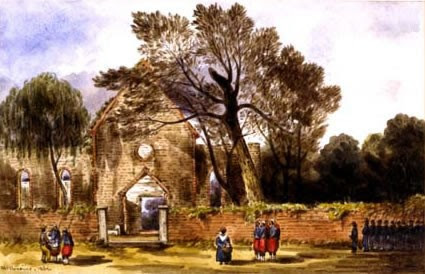
            One of the things that initially drew me to St. John’s was the history, primality through the lens of one our historians Jim Tormey.  We know that this church was founded in 1610 and some assume that there was a fairly smooth trajectory from then to now. Of course that’s not true. There were some rocky times in the 1600s and 1700s, but I want to talk mostly about the period between 1780 and 1880. 

            After the American Revolution, the church faced significant financial hardship as the British were no longer supporting us financially.  We could not even afford a minister.  By the time the War of 1812 came, the church was in a free fall and the building had deteriorated.  Unfortunately the British then took up residence in the church during the Battle of Hampton and by the time they left, the church was intact, but barely.  It was virtually ruined. Fortunately the people of the church rallied and rebuilt.  By 1830 they were whole again.  By 1840, they had 30 communicants and that doubled by 1860. 

However, it was short reprieve because the Civil War had a huge impact on the church.  The rector reported in 1861, “Congregation broken up, some families are gone, we fear, to return no more.”  That was three months before the whole town was burned.  It would be 10 years before the church was habitable again.  Between 1780 and 1880, there were 3 periods of near hopelessness within and outside these walls, 3 periods of time that people were convinced the church would never survive—after the revolution, after the War of 1812, and after the Civil War.  3 times when the church was a pile of stones, dry bones. Yet each time, the people rallied and rebuilt.   They met in different buildings, often without a priest.  They never gave up.  In 1890, 20 years after they rebuilt the church for the 2nd time, there were 230 communicants, which is pretty close to what we have now.   

            I could point you to about 100 articles on what COVID has done to our churches.  Many people have hypothesized that churches will never recover from this.  And there are moments, I feel this too.  But then I remember the story of St. John’s Church and the story of the whole Christian Church.  I remember what God told Ezekiel at the end of our reading: “you shall know that I am the Lord, when I open your graves, and bring you up from your graves, O my people. I will put my spirit within you, and you shall live, and I will place you on your own soil; then you shall know that I, the Lord, have spoken and will act.”

            I bet this story from Ezekiel would have worked just as well if there was just one skeleton rather than a valley of bones.  I mean, just brining one skeleton to life would have made the point that God can do whatever God wants.  So why a valley?  Was it purely for dramatic purposes?  No. There was a valley of bones because this story isn’t about how God breathes new life into individuals, it’s about how an entire community can be resurrected.

            Today the buildings and grounds of St. John’s are in great shape, thanks to volunteers, staff, the generosity of each of you, and our endowments.  However, that doesn’t mean that our community doesn’t need God’s spirit.  It doesn’t mean that we don’t have rebuilding to do.  And it’s not just because of the pandemic, it’s because the church as a whole has become complacent and comfortable.  The pandemic accelerated what was already happening.  The church has been declining since the 1970s. But it’s only become obvious in the last 10-20 years.  We can blame the decline on any number of things, but I think what it comes down to is that people who don’t know the church don’t perceive it as relevant.  To them, it’s just a bag of dead bones.  It’s dead.

It’s up to us, to convince them that it’s not dead—that we are still alive.  And we can’t do that by trying the latest greatest fad. I think it’s quite simple actually.  We need to start believing what we say on Sundays.  We need to believe that if God can resurrect a valley of dry bones, if Jesus Christ can rise from the dead after 3 days, if this church can live through three wars and still thrive…then we too can claim that the spirit of God lives in this place.  Because that spirit of God never left us, not once.  But the spirit of God needs the people of God to rise up and not just reclaim what we had, but claim what we have never had, bring new life into this beautiful old church.

If you are wondering how that happens, it’s all about participation, not just in worship, but it a lot of different parts of the church.  Soon we will be looking for volunteers for an initiative called Invite, Welcome and Connect—which is all about bringing new life into the church. If this church can recover from 3 wars in its church yard, surely we can rise up and claim the spirit once again.

 *All historical information about the church from How Firm a Foundation by Jim Tormey.

Keep Talking: March 12, 2023

Year A, Lent 3                                    John 4:5-42                                                                             

            Three strikes.  The woman in our Gospel reading for today had three strikes against her—three good reasons for Jesus to avoid her.  First, she was a woman.  Men and women who were not related didn’t interact, especially if they were alone. It would have been scandalous for a man, especially a rabbi to have an extended conversation with a woman he had just met.  Second, she was Samaritan.  The Jews and Samaritans didn’t get along—they hadn’t gotten along for centuries.   It was unusual for a Jew even to be in an area populated by Samaritans.  Third, she was not married and had 5 husbands in her past.  Some have described her as a harlot of even a prostitute, but let’s remember that women didn’t have the right to divorce their husbands at this time.  If she had 5 husbands, it was because they died or they divorced her, probably because she was barren.  Regardless of the reason she had gone through 5 husbands, she would still have been judged harshly by the people in her community. 

Any one of these reasons would have been a good enough reason for Jesus to avoid her. Instead, he engaged in a rather lengthy theological dialogue.  In all the Gospels, in all the recorded conversations that Jesus ever had with anyone, this was the longest.  Why? Was he just passing time until the disciples returned?  Of course not, if John felt this was important enough to include in the Gospel, then this conversation had a purpose.  It meant something—not just for the woman and Jesus, but for the people in the new Christian community, for whom the Gospel of John was written.

It starts with a simple request on the part of Jesus.  He’s sitting by a well in the heat of the day and he is thirsty.  So he asks the woman with the bucket if he could have some of her water. Seems like a perfectly natural and reasonable request.  She is shocked by this request because Jews and Samaritans didn’t share things and why in the world is this man sitting by a well without a bucket. (It’s not like there was a hose attached.)

And then, because this is the Gospel of John and John likes to use symbols as much as possible, Jesus starts talking to the woman about living water.  Now you might remember that just last week, in the chapter before this one, Jesus tried to have a similar conversation with a learned Pharisee named Nicodemus.  That conversation was much shorter because Nicodemus either didn’t understand or didn’t want to understand what Jesus was saying.  However this woman, who would not have had the education of Nicodemus or the confidence that would be required to converse with a man like Jesus— this woman engages with Jesus.  When Jesus starts talking about living water she asks how she can get this water instead of dismissing the idea.  When she thinks she understands what it means, she asks him for the water.  This is an extraordinarily brave dialogue for a woman with little social standing and probably considerable shame to have with a man like Jesus.

Then Jesus asks something rather peculiar, at least to my ears.  He asks her to get her husband and then come back.  Now, if I was in her situation, I think I would have just said, “Sure, I will do just that.” Then I would have just not come back.  I mean really, what does she owe this stranger? He doesn’t need to know anything about her personal life.  Either she wasn’t as ashamed as most women in this period would have been or she could tell Jesus was special and she wanted to continue the conversation.  She responds with a statement of her own, one that spoke to the difference between the Samaritans and the Jews. She points out that they worshipped at different places.  Some people think that she was just trying to change the subject, that he had gotten a little too personal and it was better to delve into theological differences instead of her marital history.

But I think that when Jesus reveals what he knew of her she could tell that he wasn’t just any man…not only because he knew something he had no reason to know, but because it doesn’t seem to bother him.  It doesn’t end the conversation.  He doesn’t judge her the way others might have.. because perhaps he sees her for what she is, not a cast off wife of 5 husbands, but a child of God who wants to know more about God.  She does the thing that Nicodemus (a supposed man of God) could not do.  She continues the conversation.  She allows herself to be known by this holy man she didn’t quite understand.  And in return, Jesus revealed himself as the God he is.

He speaks the word that eventually gets him killed.  “I am he.”  Literally translated, “I am.”  This is how God refers to Godself in the Old Testament.  When Moses asks God to tell him his name, God responds with, “I am.”  This became the name of God, the name that cannot be pronounced.  At this time, to say the name of God would be blasphemy.  Thus Jesus reveals to this woman the greatest and most dangerous truth of all.  He bears his own soul, which is what allows her to open herself to him and to start believing in him.

How do we know she now believes? Remember this is the Gospel of John and symbols matter.  She leaves the well, but also leaves her water jar. Most people only had one water jar.  It was the only way to collect water. Without it, she would die of thirst.  So either she was coming back or she understood more about this living water thing than most give her credit for.  Or maybe it was both.

She returned to the town, to the people who probably had all judged her for going through 5 husbands and told them, “Come and see a man who told me everything I have ever done! He cannot be the Messiah, can he?”  She still isn’t sure.  You can tell by the way she asks the question.  She is expecting a negative response.  Yet she also knows that there is something there, something worth sharing. 

She is the first person in the Gospel of John to spread the news about Jesus.  She is the first evangelist. And guess what, many came to believe because of her message.  It wasn’t just her message.  Her message led them to Jesus and he ended up being the one who convinced them.  That’s how evangelism works. 

We introduce people to Jesus and Jesus does the rest of the work. Sometimes I think people assume that they have to be secure in their faith and be outstanding Christians before they can possibly pass on the good news of Jesus Christ.   Yet this woman, this very first evangelist, still had questions when she passed on the news.  She also had passion and excitement.  Maybe that is what we are missing more than assurance.  We have forgotten what it is to be excited about what Jesus has to tell us and teach us.  It’s possible we never had that excitement.

 I think it’s harder to get excited about your faith when you been in it most of your life. We also don’t have the benefit of a face to face conversation with Jesus. That doesn’t mean all hope is lost for those of us who can’t meet Jesus at a well. It just means that we have to try a little harder.  We have to keep having the conversations with God and also having the conversations with others about God.  This Samaritan woman came to know Jesus through questions and conversation.  It wasn’t a miracle or a revelation. 

Perhaps that is the exciting part—we don’t need to wait for miracles or revelations in our faith journey.  No, we just get in there and talk to God.  We talk to God, we worship God, we serve God’s people and we talk to God some more. It’s not always fun or exciting.  Sometimes it can even feel a little dull.  That’s ok.  They key is that you never stop talking to God, never stop asking the hard questions and never be afraid to show your true self to God.    The more of ourselves we can share with God, the more God will share with us. 

Wednesday, February 22, 2023

Lent Will Break Your Heart: February 22, 2023

 Year A Ash Wednesday                        Joel 2:1-2, 12-17                                                                                         

            The reading from the prophet Joel begins, “Blow the trumpet in Zion; sound the alarm on my holy mountain! Let all the inhabitants of the land tremble, for the day of the Lord is coming near—a day of darkness and gloom…”  Welcome to Lent!  This is what you expect from Lent, isn’t it? Darkness, gloom, and then guilt and shame.  It’s your fault all these terrible things are happening.  If you want things to turn things around, you must repent.  That’s’ the way these readings from the prophets normally go. And if you read Joel with that expectation, that is what you will get.  However, upon closer inspection, you might see that Joel is a bit different than the other prophets.

            The first two chapters talk about the destruction of the land due to an enormous locust invasion.  A locust infestation would have destroyed their crops, which was their source of food and money.  It wasn’t just a nuisance; it was a disaster that affected every part of their lives.  What is interesting is that Joel never blames this invasion of locusts on the sins of the people, which was a fairly typical tactic at this time. 

            He painted an alarming and disturbing picture, but given the fact that this was their unavoidable reality, it seems a reasonable thing to do.  But he never blames anyone. In the midst of this disturbing picture, Joel shifts the tone and writes, “Yet even now, says the Lord, return to me with all your heart…” Typically when we see the word return in this context of Ash Wednesday, we think: repentance, confession. And Joel does suggest fasting, weeping and mourning—which we might also associate with repentance.  But consider this, their crops have been decimated.  They are already fasting out of necessity.  If they aren’t weeping and mourning, it’s only because they don’t feel comfortable doing so.  Maybe they are just holding it all together like so many of us do. In some ways, Joel is giving them permission to weep and mourn.

             Then Joel says, “rend your hearts and not your clothing.” Joes doesn’t want them to rip their clothing which is a traditional display of guilt and shame.  He doesn’t ask them to roll in the dirt.  He’s not asking them to repent of sins and he’s not accusing them of anything.  He asks them to fast, to weep, to mourn and to rend their hearts. 

`           Rend your hearts.  It literally means to tear your heart…which sounds a lot like a broken heart.  Frankly I would rather tear my clothing.  But we must remember that these people were already suffering. Their hearts were probably already broken.  Joel was asking them to break them a little more…but not so they could punish themselves.  He was asking them to rend their hearts so that they could renew their relationship with God.  “Return to the Lord, your God, for he is gracious and merciful, slow to anger and abounding in steadfast love.”

            We don’t know why the people have distanced themselves from God. Maybe it was something they did, maybe it was totally out of their control. Perhaps, they didn’t even know it was happening.  And then suddenly they realized, they no longer had a relationship with God. Maybe the stress of the famine had been too much for them. Or they lost too many people they loved. It could have been an intentional decision, but more likely, it was just a gradual distancing.  That is what it usually is. 

            Joel wasn’t telling people to repent (and just so you know, there is nothing wrong with repentance, it’s a good and important thing), but that is not what this story was about.  How do we know? Because he wasn’t telling them what to repent from.  No, his very ardent desire was for them to reconnect with God, reorient their lives in a way that God would once again be at the center. 

            Joel wasn’t spending time asking why all these horrible things are happening and why God feels so far away—as we so often see in the psalms and even our own lives.  No.  He was calling for action.  He believed that what we do as humans matter.  It affects the world and it affects our relationship with God.  In Hebrew thought, the heart isn’t the seat of the emotion as much as it’s a place of thought and reflection.  When Joel told the people to rend their hearts, he wanted them to spend time considering how they can repair their relationship with God. Don’t obsess over why it’s happening or why it isn’t fair.  None of that will help.  Instead, Joel is saying, “Ok, this is the horrible stuff we are dealing with and this is how we are going to climb out of it. 

            First we will fast. Then we will weep and mourn. Then we will spend time reconnecting with the God of grace and mercy.  Then…well Joel doesn’t actually predict what will happen after that.  He doesn’t promise that the harvest will return and all will be well again.  Joel doesn’t make any promises at all…it’s more like an appeal.  He encourages them to join together—weep together, pray together, reconnect with God and with the people of God.

            That is what we are asking during Lent as well. We haven’t had an invasion of locusts, but we’ve had about every other imaginable thing.  Maybe you feel like you are 100% committed to God right now and there is absolutely no way you can improve upon that. If so, you can stop listening.  Otherwise, it might be time to take the advice of Joel.  Fast…if not from food, from the thing that distracts you most from your relationship with God.  Weep and mourn…if not for yourself for someone else.  There is no shortage of suffering people in our world today.  Tear you heart, not with the intent to hurt, but to open it up a little more to God’s mercy and grace.  Join the community of faith, because this is hard stuff and you might need some support.  Come to our Lenten program Wednesday nights where people will be sharing parts of their faith journey.  Attend every Sunday service you can attend.  Make an appointment with Mark or me if you need to talk. Seriously, clergy live for those kinds of conversations.  Return to God with all your heart. 

Sunday, February 19, 2023

Glory Is All Around: Feb 19, 2023

 Year A, Last Sunday of Epiphany                                       Matthew 17:1-9                                                        

         It’s the last Sunday before Lent begins, the last Sunday for us to sing as many Alleluias as possible and sing them loudly. This Sunday ends our season of Epiphany, the time we talk about light and revelation. It’s a season that we can easily overlook, like the calm before the dark storm that is Lent.  Lent isn’t really stormy.  It’s just a season that we happen to associate with suffering and darkness.  The first day of Lent is Ash Wednesday.  What do we do on Ash Wednesday? We smear ash on people’s faces and remind them that they are going to die.  It’s truly a wonder that anyone comes to that service. 

            This Gospel reading is an interesting transition from Epiphany to Lent.  It’s a story of light and revelation, but there is a certain foreboding within the story---well really on either side of the story.  Right before Jesus ascended the mountain with three of his disciples, he explained that he would have to suffer and die.  Peter argued with Jesus when he made this revelation.  Peter could not wrap his head around the idea that the messiah—the person who was supposed to save them all—would soon be killed. 

It was after this information was relayed that Jesus brought his friends to the top of the mountain.  I have often wondered about the timing.  Was Jesus hoping to provide some clarity for his disciples about the message he had just given them, or was he just trying to have some quality time with his friends who were probably reeling from this new and disturbing information?  We really don’t know. 

            We often hear people talk about mountain top experiences.  Sometimes it is literally about the experience of climbing to the top of a mountain and witnessing an extraordinary view that takes your breath away.  Sometimes people use that phrase to describe a time of transcendence—a moment where they felt closer to God, a time of faith and assurance.  We can actually use that phrase for a lot of different things.

Mount Tabor
However, Jesus’ disciples would have had some specific associations with mountain tops. The mountain was where heaven and earth met. It was a place that people encountered the divine.  Mountains are mentioned more than 500 times in the Bible, most notably in Moses’ interactions with the voice of God.  That is where Moses received the 10 Commandments. Important things happened on mountains in the Jewish faith. All of Jesus’ disciples would have known these stories well and thus known the significance of the mountain.

            Therefore, it’s not surprising that these amazing things would happen at the top of the mountain.  First Jesus was transfigured before them—meaning his face got shiny and his clothes were extra bright. Then two prophets, who were long since dead, appeared.  After that a voice from heaven spoke to the disciples…the disciples.  And here is the crazy thing, of all those miraculous events that happened on that mountaintop, it wasn’t the glowing Jesus or two dead prophets back to life, it was something as simple as a voice.  That is what really got the disciple’s attention.  It wasn’t just any voice.  It was God’s voice. And for once, God was talking directly to the disciples. 

That is what really freaked them out. They were accustomed to things happening to Jesus, and maybe even to the people around them.  They had witnessed their share of miracles. But this was different, because God was talking to them and more importantly he was telling them to do something, to listen to Jesus.  And what had Jesus just told them? He had told them that he had to suffer and die and they too would have to take up their cross if they wanted to be his followers.   It’s not the kind of thing you want to hear from a heavenly voice. It’s the kind of thing you want to tell yourself was just a big misunderstanding and of course Jesus didn’t mean that he was really going to suffer and die.

            When the three disciples heard the voice from heaven, they fell to the earth in fear.   Because the earth was what they knew.  It was firm. Maybe, just maybe if they stayed there for a while they could forget this all happened.  Then Jesus bent over and touched them and he said, “Get up and do not be afraid.”  When they looked up, they saw it was just them and Jesus, just the way it should be.  And maybe they thought this was all just a dream and they could forget it.  But no, Jesus made sure to remind them on the way down the mountain, that he would have to suffer and die. This time, no one argued with him. 

            Lent isn’t merely a time of suffering and darkness.  It’s a time when we confront certain truths, maybe truths that we don’t want to confront.  It’s a time to repent from our sins.  No one likes to talk about sin.  But repentance isn’t just a about feeling guilt and shame, it’s a reorientation. It’s an opportunity to change, for the better.  The reason we have the story of the transfiguration right before Lent is to remind us that even in the midst of suffering and repentance, there is also glory and light.  There is a God who desperately wants us to listen to him, but is also willing to get on the ground with us, put his hand on our shoulder and say, “It’s time to get up and stop living in fear.”

            On the way down Jesus told his disciples not to tell anyone about what happened until he was resurrected.  I like to think he told them this because he knew that they would need this reminder of a light that we can find even in the darkest of times.  They didn’t need to use this moment to evangelize and teach.  It was just for them, a place to return in their mind and heart when the world seemed to be ending.  When Jesus was hanging on the cross, they could close their eyes---see the light and feel his hand on their shoulder telling them not to be afraid.

            That’s what many of us need—a reminder to find courage when we are afraid, a reminder that we need not fear the terror of the night—that we can confront those things we would rather avoid and forget.  Lent is a time to face our fears, our failures, and our sins---but to do that with the knowledge that those failures and sins can never defeat us because we have a God who can both glorify the earth and also kneel down next to us when our face in on the ground, brush us off and tell us not to be afraid because glory (God’s glory) is all around us.