Showing posts with label Year A Lent 5. Show all posts

Monday, March 27, 2023

Claim the Spirit: March 26, 2023

Year A, Lent 5                              Ezekiel 37:1-14                                                            

           Some of you may know that our lectionary rotates on a cycle.  That means that our readings repeat every three years.  So the readings we heard today were last heard in March of 2020.  Now this will shock you, but I don’t usually remember what I preached three years ago.  Sometimes I don’t remember what I preached 2 weeks ago.  But when I looked at this reading from Ezekiel, I thought, I definitely preached this three years ago.  I didn’t remember it word for word, but I remembered those dry bones. 

            When I preached the Ezekiel sermon 3 years ago, it was to a mostly empty church and a video camera.  We were about 2 weeks into our national quarantine.  I think it was around the time we realized this was going to last more than 2 weeks, but we had no idea we would be dealing with this for years. I reread the sermon from 3 years ago as I was preparing today’s and I thought, man, that was kind of depressing.  In my defense, it was a depressing time.  It’s amazing how different these words from Ezekiel look three years later.

            Ezekiel was a priest and prophet who lived about 500 years before Jesus was born.  He lived in a critical time--- when the majority of the Hebrew people were forcibly exiled to Babylon.  He was one of the people exiled.  The primary audience for the reading we heard today were the people who were displaced, cut off from their homeland for generations.  They were people who would not live to see their homes.  They would die in a foreign land.  Some of their descendants might return, but many would not. The exile lasted approximately 70 years.   

            When I preached this text 3 years ago, I identified with those displaced people.  At the time, we all knew what it was to be cut off from family, friends and our faith community.  I identified with the bones who spoke near the end of our reading.  They said, “Our bones are dried up, and our hope is lost; we are cut off completely.”  But here is the thing about this dramatic and vivid reading.  It’s not about the bones or even about what the bones represent—which is the Hebrew people who were displaced.  It’s not even about the prophet Ezekiel. It’s about what God can do for these bones. 

What God can do for these bones is the impossible, or at least the thing that should be impossible.  God can bring new life to these dried up, displaced, utterly hopeless bones.  God will not only give them new life, God will bring them back to Israel, back to their home.  This reading isn’t just about new life, it’s about homecoming and how closely homecoming and life is connected. 

            One of the things that initially drew me to St. John’s was the history, primality through the lens of one our historians Jim Tormey.  We know that this church was founded in 1610 and some assume that there was a fairly smooth trajectory from then to now. Of course that’s not true. There were some rocky times in the 1600s and 1700s, but I want to talk mostly about the period between 1780 and 1880. 

            After the American Revolution, the church faced significant financial hardship as the British were no longer supporting us financially.  We could not even afford a minister.  By the time the War of 1812 came, the church was in a free fall and the building had deteriorated.  Unfortunately the British then took up residence in the church during the Battle of Hampton and by the time they left, the church was intact, but barely.  It was virtually ruined. Fortunately the people of the church rallied and rebuilt.  By 1830 they were whole again.  By 1840, they had 30 communicants and that doubled by 1860. 
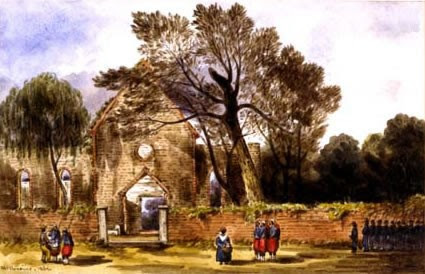
However, it was short reprieve because the Civil War had a huge impact on the church.  The rector reported in 1861, “Congregation broken up, some families are gone, we fear, to return no more.”  That was three months before the whole town was burned.  It would be 10 years before the church was habitable again.  Between 1780 and 1880, there were 3 periods of near hopelessness within and outside these walls, 3 periods of time that people were convinced the church would never survive—after the revolution, after the War of 1812, and after the Civil War.  3 times when the church was a pile of stones, dry bones. Yet each time, the people rallied and rebuilt.   They met in different buildings, often without a priest.  They never gave up.  In 1890, 20 years after they rebuilt the church for the 2nd time, there were 230 communicants, which is pretty close to what we have now.   

            I could point you to about 100 articles on what COVID has done to our churches.  Many people have hypothesized that churches will never recover from this.  And there are moments, I feel this too.  But then I remember the story of St. John’s Church and the story of the whole Christian Church.  I remember what God told Ezekiel at the end of our reading: “you shall know that I am the Lord, when I open your graves, and bring you up from your graves, O my people. I will put my spirit within you, and you shall live, and I will place you on your own soil; then you shall know that I, the Lord, have spoken and will act.”

            I bet this story from Ezekiel would have worked just as well if there was just one skeleton rather than a valley of bones.  I mean, just brining one skeleton to life would have made the point that God can do whatever God wants.  So why a valley?  Was it purely for dramatic purposes?  No. There was a valley of bones because this story isn’t about how God breathes new life into individuals, it’s about how an entire community can be resurrected.

            Today the buildings and grounds of St. John’s are in great shape, thanks to volunteers, staff, the generosity of each of you, and our endowments.  However, that doesn’t mean that our community doesn’t need God’s spirit.  It doesn’t mean that we don’t have rebuilding to do.  And it’s not just because of the pandemic, it’s because the church as a whole has become complacent and comfortable.  The pandemic accelerated what was already happening.  The church has been declining since the 1970s. But it’s only become obvious in the last 10-20 years.  We can blame the decline on any number of things, but I think what it comes down to is that people who don’t know the church don’t perceive it as relevant.  To them, it’s just a bag of dead bones.  It’s dead.

It’s up to us, to convince them that it’s not dead—that we are still alive.  And we can’t do that by trying the latest greatest fad. I think it’s quite simple actually.  We need to start believing what we say on Sundays.  We need to believe that if God can resurrect a valley of dry bones, if Jesus Christ can rise from the dead after 3 days, if this church can live through three wars and still thrive…then we too can claim that the spirit of God lives in this place.  Because that spirit of God never left us, not once.  But the spirit of God needs the people of God to rise up and not just reclaim what we had, but claim what we have never had, bring new life into this beautiful old church.

If you are wondering how that happens, it’s all about participation, not just in worship, but it a lot of different parts of the church.  Soon we will be looking for volunteers for an initiative called Invite, Welcome and Connect—which is all about bringing new life into the church. If this church can recover from 3 wars in its church yard, surely we can rise up and claim the spirit once again.

 *All historical information about the church from How Firm a Foundation by Jim Tormey.

Sunday, March 29, 2020

We Wait: March 29, 2020

Year A, Lent 5                                                                      Ezekiel 37:1-14                 
          I have heard and preached the story of the “dry bones” many times.  Never has it seemed more appropriate and more profound than when I read it this week.  Ezekiel was a priest and prophet who lived about 500 years before Jesus.  He lived in a critical time--- when the majority of the Hebrew people (including Ezekiel) were exiled to Babylon.  In the beginning of the book, Ezekiel was warning people about the invasion that was to come.  He called on people to change.  However, once Israel was defeated and the people were scattered to foreign lands, his tone change.  There was more comfort and hope.  Ezekiel’s primary audience became the people who were displaced, cut off from their homeland.  The vast majority of people would not live to see their homes.  They would die in a foreign land.  Some of their descendants might return, but many would not. The exile lasted approximately 70 years.  That is a very long time to be cut off from your homeland, from your people, and even your place of worship.  They didn’t even have facebook!

            Our reading for today comes near the end of the Book of Ezekiel and provides a vision of hope, that it is truly a vision.  It was a valley of dry bones.  Some assume this valley was full of the bones of people who had died in battle.  However, I think that the valley of bones represented not the dead, but the living, the people who had lost so much.  We only hear the voice of the bones after they have been given life.  After they are restored to life they say, “Our bones are dried up and our hope is lost; we are cut off completely.” These are not the bones of the dead, but of the living.  One commentator wrote, “Everything they had trusted, everything that had given their lives shape and meaning, was gone…”  For this group, that was their land, their homes, their communities and their holy city, the place where God resided. That is a great loss indeed.  It is no wonder that they felt as though they were cut off completely.

            Even in the places that have been affected most severely by the coronavirus, people are not quite as cut off as the Hebrew people were.  But there have been people who have lost their homes, lost their jobs and have been cut off from family and friends and many who have lost their lives.  People have died alone, or lived knowing their loved ones are dying.  For those of us who are fortunate enough not to have lost those things, we still mourn the smaller losses because they don’t feel like small losses.  Our children and young adults have lost out on their last few months of school.  Some will not be able to graduate.  Many of us feel lost without a job to go to and a schedule to follow.  I find myself mourning my loss of a schedule and routine.  As I considered this particular loss, I could not help but wonder if I have given far too much meaning to my job and routine.  Is that where meaning resides, in what I do day to day?  Do we have to be busy to have a purpose in life?  I feel like this is an opportunity to consider where we find meaning in our lives.  Our meaning is not in what we do, but who we are.

            Even the most fortunate of us are facing hardship right now.  We are being asked to make sacrifices, not merely for us, but for the good of the community.  This is a time we must be patient.  Our Psalm says, “I wait for the Lord; my soul waits for him; in his word is my hope.”  Right now, we wait and we make small sacrifices so that this virus will lose some of its power.  Ezekiel waited until Jerusalem was destroyed to share this vision of hope, this knowledge that no matter how difficult things get, no matter how much we feel we are cut off, God never forgets us. 

While we may feel as though our bones are dried up and life as we have known it is changed forever…we still have life in us.  There is still meaning and purpose in this life.  So we wait.   We pray. We live, because no matter how suffocated we may feel, God breaths for us.  God’s Spirit is with us.  Then when the worst is past (and it will pass) we will rebuild a better country and world—where we find meaning not in the success of our economy or the might of our army, but in the people we love and the world that God has entrusted to us.

Sunday, April 2, 2017

When God's People are Displaced: April 2, 2017

Year A, Lent 5                                                    
Ezekiel 37:1-14                                                                      

 
            Recently I came across several articles regarding the efforts in Iraq to regain cities that were lost to ISIS.  For so long, the news about the fight against ISIS had been all about their power and progress.  It appeared hopeless.  No one seemed to know how to fight these extremists who represented no country and operated with no moral code whatsoever.  Yet recently, there are indications that they are being driven out bit by bit, mile by mile.  People are returning to the towns that ISIS had control over.  There was one article about a town called Bartella, which is not too far from Mosul.   Bartella is one of the oldest Christian towns in the world.  Thousands were forced out after ISIS came in.  It was over 2 years before the town was reclaimed by American and Iraqi soldiers.   In the article I read, some of the displaced people said that they planned to return, but many were afraid to do so.  Many were worried that there was nothing to return to.  They were afraid that ISIS would regain control or some other extremist group.[1]

The people or Bartella were forced out of their homes for a little over two years.  It’s a long time to be displaced, especially when you don’t know if you will ever return to your home, or if there will be a home to return to.  The people of Israel were exiled for over 50 years…more than a generation.  That 50 years is known as the Babylonian Exile and is a defining moment in Jewish history. To put it in context, it was approximately 500 years before Jesus was born.  

The Book of Ezekiel begins with the prophet warning people of what was to come. There was a great deal of judgment and anger.  By the time we get to chapter 37, which is where our Old Testament reading for today comes from, Jerusalem had been destroyed and most of the people were forced to leave their home and live in another land.  Ezekiel was one of those displaced people.  He was there with the others in Babylon.   While he was a little hard on them before the exile, his tone shifted after the exile.  They didn’t need judgment anymore.  What they needed was hope. 

You see it wasn’t just that they had been defeated.  It wasn’t just that they had been forced from their homes.  It wasn’t just that they had seen so many of their people die in battle.  Any of those things would be enough to leave a person in despair.  Yet for the Hebrew people, it was that much worse because they were away from their spiritual home.  For the Hebrew people, God was in the temple in Jerusalem.  That was where God lived.  What did it mean that the temple was destroyed?  How could they worship God when they were no longer near him?  They felt as though they were completely cut off from God. Even though they were no longer fighting a bloody war… even though they were not living in this valley of bones, they might as well have been.  Their home was destroyed.  Their God had abandoned them.  Hope was buried under the rubble that was once their home. 

God knew what the people were feeling. He knew their grief.  Thus, he gave Ezekiel a remarkable vision to share with these displaced people. In this vision, God brought Ezekiel to this valley of bones and he showed him how to bring life back to these bones. As you heard in the reading, the rubble of bones became people of flesh and blood and even breath.  There was new life in the valley.  After showing Ezekiel this, the Lord said to him, “Mortal, these bones are the whole house of Israel. They say, ‘Our bones are dried up, and our hope is lost; we are cut off completely.’  God told Ezekiel who these bones represented and what the vision was in response to. 

The Psalms have all kinds of prayers of people who were living through the Babylonian Exile.  In these Psalms, the people who were crying out often referred to their bones.  In many ways, references to bones, is like a reference to our deepest self.[2]  We still use phrases like, “I can feel it in my bones.” Or. “I’m bone tired.” It’s almost like referring to our core or our essence, much like it was in the time that Ezekiel was writing. 

When the people said, “Our bones are dried up, and our hope is lost…” God took that dreadful image of bones piled up and he transformed that image. God showed how these bones could have life.  It was/is a way to show that hope is not lost…not as long as you have the breath of God.  Because that is what made the difference. Ezekiel said, “I prophesied as he commanded me, and the breath came into them, and they lived, and stood on their feet, a vast multitude.”  It was the breath of God, the Spirit of God that allowed them to live, that gave them the power to stand together.

It is important to note that they stood together.  When these bones came to life, it wasn’t just a couple of them.  It was this whole community, the multitude.  It had to be because it was the whole community who had been exiled.  It was not enough for one of them to have hope.  They all needed to be inspired.  They all needed this breath of God.  It was the only way they would find the strength they needed. The people of Israel were exiled for a long time, but eventually they returned to their beloved city of Jerusalem.  Much as they feared, their city was in ruins.  There was no temple. There were no homes to return to.  Once again, they had to find a way to bring life to a place that seemed to be lifeless.  They had to do it together.

The town of Bartella in Iraq was liberated in October of 2016. That Christmas, about 200 people returned to the town to celebrate Christmas Eve in their church.  For most, it was the first time they had returned to their home.  While it was uplifting to celebrate that holy day in their sacred space, their church, they were surrounded by rubble. The church had to be guarded by snipers so they could celebrate in relative safety.  Many said that while it was nice to have this experience and good to be back home, they would not be returning for good because it was not safe.  They could not take that risk.  Yet one woman who was interviewed said, “Daesh (ISIS) came to kill the soul. But they couldn’t. They killed the body. We are back now.”[3]  ISIS thought they could take the life from the town, from the people.  They thought that they had left only rubble and bones.  But there was still life there.  The breath of God remained with the people of God.  When the soldiers reclaimed that city, one of the first things they did was to go to the church and ring the church bells. 
Christmas Eve Bartella
Both the people of Israel, the people in Iraq, and people everywhere who have been forced to flee from their homes, they survive on hope…a hope that God will continue to breathe life into them and a hope that when God does breathe that life into them, there will be a community to stand with them.

After the Civil War, the St. John’s community returned to find their homes and their church in rubble.  Yet they found a way to rebuild, to survive so that we could worship here today. They did not do it alone. They did it with the help of people from around the state, even the country.  That is what we are called to do as Christians, to help others rebuild, to be the breath of God for communities and people who have lost hope. I will be honest.  I am not sure how. Ezekiel had a wonderful vision that changed him and helped him inspire others.  But he had to first be open to that vision and then act on that vision.  I suppose that is the first step for all of us, a willingness to envision the world transformed….and to see ourselves as the agents of that transformation.


[1] http://www.telegraph.co.uk/news/2016/10/22/near-mosul-church-bells-ring-out-in-a-christian-town-freed-from/
[2] https://www.workingpreacher.org/preaching.aspx?commentary_id=39

Sunday, April 6, 2014

April 6, 2014: Ezekiel 37:1-14


Year A, Lent 5                        

            As most of you know, this church (both the worshipping community and the building) have been through a lot in the last 404 years.  Many of us know the dramatic story of its burning in the Civil War; but the Civil War was not the first war that it witnessed.  This structure stood through both the Revolutionary War and the War of 1812.  It would be easy to assume that it was the wars that led to the deterioration of the building and the worshipping community. However, it was more than that. A contributing factor was a shift in the way the church was perceived in the culture as a whole.  The church was no longer supported by the government and no one knew how to support a church without the British Empire or the Church of England. 

The War of 1812 was the final straw.  The British troops used the church as a barracks and left it almost destroyed.  For the 10 years after the War of 1812, nothing was done to restore the church.  However there were still a few people who maintained hope for St. John’s.  One of them was Richard Servant.  He found inspiration in a rather unlikely place. He told a story of visiting the graves of ancestors near the ruined church with a friend named Jane.   As she stood at the dilapidated door of the church she said, “Cousin, if I were a man I would have these walls built up.”  In a letter he wrote “her words were like electricity, and from that moment my determination was fixed.”  Within 4 years, people were worshipping in the restored church once more.[1]         

            Ezekiel lived about 600 years before Christ.  He was a prophet who was exiled to Babylon with many of the Hebrew people.  His writings contain visions which prophesy the destruction of Jerusalem and the holy temple.  Most of the Hebrew people believed that Jerusalem would never fall because God protected it.  They believed that the temple was God’s home and therefore it would always stand.  While Ezekiel’s prophesies were not appreciated, they were accurate.  The Babylonians destroyed the city of Jerusalem as well as the temple.  Most of the people were exiled to a foreign land where they were left for generations.  After the destruction of the temple, one of Ezekiel’s missions was to restore hope to a battered and beaten people.  The temple was more than just a beautiful place that people worshipped, it was where God resided.  For many of the people, it was not only the temple that was destroyed, it was their faith in God.

            The vision that we heard today described Ezekiel being set down in the middle of a valley that was full of bones.  Many people have surmised that this was a battlefield.  This would make sense since there was a massive battle to defend Jerusalem from the Babylonians and many people died.  Most of the people who survived were sent to Babylon.  I suspect the city itself looked a little like Hampton after it was burned in the Civil War.  There was nothing left.  Thus it is not hard to imagine a valley littered with bones.  But let’s remember that this was a vision.  This was God trying to teach Ezekiel something in a very dramatic way. 

            The vision is near the end of the Book of Ezekiel.  The exile had probably lasted far longer than any of the Hebrew people expected.  The temple remained in ruins.  So perhaps it was not the dead who God was worried about—who God was trying to speak to.  What if the bones represented not the dead, but the living?[2]  If you were to read this text in Hebrew, you would see one word used nine times.  It is ruach and is translated to three different English words in these fourteen verses: breath, wind and God’s Spirit.  The word ruach appears all over the Old Testament, even in the creation story when God’s spirit moved over the waters. The essence of the word is life giving force. In Ezekiel’s vision (even after the bones came together, the muscles and tendons were added, and the skin covered all the necessary parts) ---even after all of that--there was still no life.  It was not until God breathed into these empty bodies were they truly alive. 

The people of Israel, even those who had lived through the exile, were missing something.  They were missing the breath of God because they felt cut off from God.   They felt as though God had deserted them.  We hear that in the Psalm for today, “Out of the depths have I called to you, O Lord; Lord hear my voice…”  With the temple destroyed and being displaced from their home, they did not even know where to look for God.  There was no hope because the source of their hope had deserted them.  At least, that is what they thought.

            The Hebrew people thought that if only they were not exiled and their temple was still glorious and powerful, then they would know God was with them.  They would feel his presence.  The people of St. John’s (200 years ago) might have thought if only they still had the support of the government, then their church would stand tall again.  I find in my life that it is really easy to make excuses and to use those excuses not to take risks.  Believing in God is a risk, especially when we don’t have a strong establishment or government supporting us…especially when all we are looking at rubble or bones. 

            One commentator wrote that it would be far easier to prophesy after the bones came to life.  Yet God asked Ezekiel to prophesy to a valley full of lifeless bones.  If I were Ezekiel I would have been mortified.  What would be the point? But obviously there was life in them, or they never would have heard the prophesy.  There was something there that was just waiting for those words, God’s words.  I think that often, even when we feel that all hope is lost, really it is only we who are lost.  Our souls are hibernating waiting for that infusion of breath.   Hope, that was the last name of Jane, the person who challenged others to rebuild the walls of St. John’s.  She was standing among graves when she said it and I bet she felt like she was just talking to a valley of bones.  But there was one person there, one person just waiting for the opportunity, the spark that would electrify the community into action.       

            While we are undergoing a little renovation now, our building is in pretty good shape.  We don’t have to build it up again, but that does not mean that we do not have a mission.  We are not talking to the graves…but we are living in the midst of a community that doesn’t care much about what we are saying as the Church of Christ.  When some people look at us, all they see is a graveyard.  And we might not be able to change many people’s hearts and minds, but I bet (like Jane Hope) we can change one. And that one might just be the spark we need, the spark that could electrify the community and to provide that life giving spirit that we all so desperately need. So prophesy. Prophesy when it seems all hope is lost, because that is when we need it the most.


[1] Tormey, James.  How Firm a Foundation. Pages 73-76