Showing posts with label St. John's Hampton. Show all posts

Monday, March 27, 2023

Claim the Spirit: March 26, 2023

Year A, Lent 5                              Ezekiel 37:1-14                                                            

           Some of you may know that our lectionary rotates on a cycle.  That means that our readings repeat every three years.  So the readings we heard today were last heard in March of 2020.  Now this will shock you, but I don’t usually remember what I preached three years ago.  Sometimes I don’t remember what I preached 2 weeks ago.  But when I looked at this reading from Ezekiel, I thought, I definitely preached this three years ago.  I didn’t remember it word for word, but I remembered those dry bones. 

            When I preached the Ezekiel sermon 3 years ago, it was to a mostly empty church and a video camera.  We were about 2 weeks into our national quarantine.  I think it was around the time we realized this was going to last more than 2 weeks, but we had no idea we would be dealing with this for years. I reread the sermon from 3 years ago as I was preparing today’s and I thought, man, that was kind of depressing.  In my defense, it was a depressing time.  It’s amazing how different these words from Ezekiel look three years later.

            Ezekiel was a priest and prophet who lived about 500 years before Jesus was born.  He lived in a critical time--- when the majority of the Hebrew people were forcibly exiled to Babylon.  He was one of the people exiled.  The primary audience for the reading we heard today were the people who were displaced, cut off from their homeland for generations.  They were people who would not live to see their homes.  They would die in a foreign land.  Some of their descendants might return, but many would not. The exile lasted approximately 70 years.   

            When I preached this text 3 years ago, I identified with those displaced people.  At the time, we all knew what it was to be cut off from family, friends and our faith community.  I identified with the bones who spoke near the end of our reading.  They said, “Our bones are dried up, and our hope is lost; we are cut off completely.”  But here is the thing about this dramatic and vivid reading.  It’s not about the bones or even about what the bones represent—which is the Hebrew people who were displaced.  It’s not even about the prophet Ezekiel. It’s about what God can do for these bones. 

What God can do for these bones is the impossible, or at least the thing that should be impossible.  God can bring new life to these dried up, displaced, utterly hopeless bones.  God will not only give them new life, God will bring them back to Israel, back to their home.  This reading isn’t just about new life, it’s about homecoming and how closely homecoming and life is connected. 

            One of the things that initially drew me to St. John’s was the history, primality through the lens of one our historians Jim Tormey.  We know that this church was founded in 1610 and some assume that there was a fairly smooth trajectory from then to now. Of course that’s not true. There were some rocky times in the 1600s and 1700s, but I want to talk mostly about the period between 1780 and 1880. 

            After the American Revolution, the church faced significant financial hardship as the British were no longer supporting us financially.  We could not even afford a minister.  By the time the War of 1812 came, the church was in a free fall and the building had deteriorated.  Unfortunately the British then took up residence in the church during the Battle of Hampton and by the time they left, the church was intact, but barely.  It was virtually ruined. Fortunately the people of the church rallied and rebuilt.  By 1830 they were whole again.  By 1840, they had 30 communicants and that doubled by 1860. 
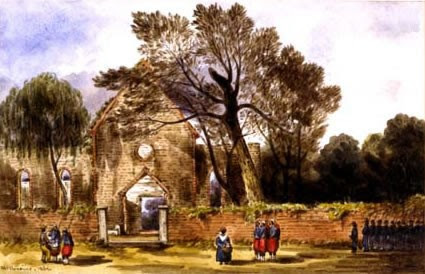
However, it was short reprieve because the Civil War had a huge impact on the church.  The rector reported in 1861, “Congregation broken up, some families are gone, we fear, to return no more.”  That was three months before the whole town was burned.  It would be 10 years before the church was habitable again.  Between 1780 and 1880, there were 3 periods of near hopelessness within and outside these walls, 3 periods of time that people were convinced the church would never survive—after the revolution, after the War of 1812, and after the Civil War.  3 times when the church was a pile of stones, dry bones. Yet each time, the people rallied and rebuilt.   They met in different buildings, often without a priest.  They never gave up.  In 1890, 20 years after they rebuilt the church for the 2nd time, there were 230 communicants, which is pretty close to what we have now.   

            I could point you to about 100 articles on what COVID has done to our churches.  Many people have hypothesized that churches will never recover from this.  And there are moments, I feel this too.  But then I remember the story of St. John’s Church and the story of the whole Christian Church.  I remember what God told Ezekiel at the end of our reading: “you shall know that I am the Lord, when I open your graves, and bring you up from your graves, O my people. I will put my spirit within you, and you shall live, and I will place you on your own soil; then you shall know that I, the Lord, have spoken and will act.”

            I bet this story from Ezekiel would have worked just as well if there was just one skeleton rather than a valley of bones.  I mean, just brining one skeleton to life would have made the point that God can do whatever God wants.  So why a valley?  Was it purely for dramatic purposes?  No. There was a valley of bones because this story isn’t about how God breathes new life into individuals, it’s about how an entire community can be resurrected.

            Today the buildings and grounds of St. John’s are in great shape, thanks to volunteers, staff, the generosity of each of you, and our endowments.  However, that doesn’t mean that our community doesn’t need God’s spirit.  It doesn’t mean that we don’t have rebuilding to do.  And it’s not just because of the pandemic, it’s because the church as a whole has become complacent and comfortable.  The pandemic accelerated what was already happening.  The church has been declining since the 1970s. But it’s only become obvious in the last 10-20 years.  We can blame the decline on any number of things, but I think what it comes down to is that people who don’t know the church don’t perceive it as relevant.  To them, it’s just a bag of dead bones.  It’s dead.

It’s up to us, to convince them that it’s not dead—that we are still alive.  And we can’t do that by trying the latest greatest fad. I think it’s quite simple actually.  We need to start believing what we say on Sundays.  We need to believe that if God can resurrect a valley of dry bones, if Jesus Christ can rise from the dead after 3 days, if this church can live through three wars and still thrive…then we too can claim that the spirit of God lives in this place.  Because that spirit of God never left us, not once.  But the spirit of God needs the people of God to rise up and not just reclaim what we had, but claim what we have never had, bring new life into this beautiful old church.

If you are wondering how that happens, it’s all about participation, not just in worship, but it a lot of different parts of the church.  Soon we will be looking for volunteers for an initiative called Invite, Welcome and Connect—which is all about bringing new life into the church. If this church can recover from 3 wars in its church yard, surely we can rise up and claim the spirit once again.

 *All historical information about the church from How Firm a Foundation by Jim Tormey.

Sunday, July 19, 2015

Christ as the Foundation-No Walls Needed: July 19,2015

Pentecost 7, Year B                                                  
Ephesians 2:11-22                                                                   

            When I first arrived at St. John’s, a lot of people were baffled by the fact that I lived in Norfolk.  Even after explaining the reasons (I prefer to live with my husband), people still seemed aghast.  I know that part of it is the Hampton Roads Bridge Tunnel (Herbert), but it is more than that.  It is almost like Norfolk is a different world.  You might not know this but Herbert is technically in Hampton, which means I live 4 miles from Hampton and 9 miles from the church.  This is not an insurmountable distance.  But it’s not about the distance.  It’s the culture.  I lived in Norfolk for 8 years before I started at St. John’s and I had been to Hampton 5 times.  It is amazing what a bridge can divide.  It’s not just bridges that divide us.  Norfolk and Virginia Beach are right next to each other and they are entirely different places.  Virginia Beach doesn’t want to connect to the Norfolk light rail because they know that will make it easier for Norfolk people to get to Virginia Beach and they don’t want us there.  These are obvious divisions, divisions that we can see on a map.  But there are a lot more divisions in Hampton roads. There are the divisions between white and black, poor and rich, military and civilian, Virginia Tech and University of Virginia…. This is certainly not unique to Hampton roads, nor is it unique to this moment in time. 
            The division in the first century was primarily between the Jews and the Gentiles, the circumcised and everyone else.  The differences between Jew and Gentile were not just differences of religion, but culture and national identity.  The Gentiles hated the Jews because their customs were strange.   They had rules about circumcision, what could be done on the Sabbath, what could be eaten and who could be worshiped.  Even to Christians today, some of these rules seem extreme.  On the other side, the Jews had absolutely no respect for the Gentiles.  The Jews were the chosen people…chosen by God.  Despite the fact that they were a people without country they had a seemingly indomitable national pride.  They were committed to the rules of the Torah and the rules of the rabbis.  This allowed them to judge anyone who did not follow these rules.   There was a metaphorical wall that divided them and a solid wall as well. 
            The temple of the Jews was a holy place.  Jews believed it was the home of God.  There was a wall that surrounded the temple and then a courtyard outside.  It was this courtyard where the Gentiles were allowed.  On the wall surrounding the temple was an inscription that read: "No foreigner may enter within the balustrade around the sanctuary and the enclosure. Whoever is caught, on himself shall he put blame for the death which will ensue.”   Any non-Jew who entered that holy area could be killed.  
            Jesus was not one to tolerate such walls of division.  In the Gospel of Mark, we have already heard that he went into Gentile territory to teach and to heal.  Yet even he could not eliminate these divisions, not in his short life.  The disciples and those who came after him worked hard to break down these walls, both real and imagined.   The apostle Paul was a Jew.  He honored the Jewish law.  But he also knew that Christ was calling him and others to move past these walls that surrounded them.  So he preached to all, Jews and Gentiles alike.  In his letter to the Ephesians, he wrote, “For [Jesus] is our peace; in his flesh he has made both groups into one and has broken down the dividing wall, that is, the hostility between us.” 
There are disagreements regarding the wall  that Paul is referring to.  Some think he was referring to the actual wall that separated the temple from the courtyard.  Others think that he was referring to the laws that the Jews interpreted in such a way that kept people away from God, away from Jesus.  I am not sure it makes much of a difference.  The point is that there was something real that was separating one group from another.  The life and death of Jesus provided an opportunity.  It started the dismantling process.  It was Jesus blood that ran through this crumbled barrier and brought two enemies face to face. 
            We sometimes depict the death of Christ as a victory.  That language is misleading.  There was no triumph in the violence that caused his death.  The triumph was what came after.  The triumph was the resurrection.  We tend to want to skip over the difficult parts, the parts that make us uneasy. We think we can break down a wall without actually dismantling a thing.  Jesus was beaten and then broken on a cross.  His body was broken….not just for us, but for all people, the people in Norfolk, the people in Virginia Beach, the people who left the Episcopal Church because they did not like the 1979 prayer book, the people who left because they did not like the ordination of women, the people who stayed and considered themselves the victors, the people who stayed because the Episcopal Church was their home….his body was broken for all of us. 
            I know there are some of us who are not pleased about the Episcopal Church’s stance on same sex marriage.  There are some people who are joyful.  There are some who are in the middle.  Most of us who have seen division in the church are anxious, anxious about what this all means.  We no longer have literal walls around our holy places.  Anyone can approach the altar.  Anyone can worship here.  The walls we have now are more subtle and nuanced.  They are protective walls, walls that we hope will keep us safe.    We need to talk about the walls.  Not talking about them will not make them go away.  We’ll just keep running into them until we are battered and beaten and no closer to the love of Christ. 
            I know that there is fear that if walls come down the whole structure comes down, but this is not so. If our foundation is firm, if our foundation has Jesus Christ as the corner stone, then we don’t need these walls dividing our holy places.  Look at this holy place. Do you see walls between us?  And yet this building continues to stand, through wars, hurricanes, floods and even a rector who lives in Norfolk.   Paul wrote, “In him the whole structure is joined together and grows into a holy temple in the Lord; in who you also are built together spiritually into a dwelling place for God.” 
I do not know what is coming.  I really do not.  I do not know what is on the horizon for St. John’s, the Episcopal Church, or even our nation.  But I know this.  Together, we are stronger.  Even when we disagree….we are stronger together.  Outside of this holy place, we depend on common interests and alliances bringing us together.  But here, in this holy place we depend on something so rudimentary, so very uncultured that we don’t even like to say it very loud.  We depend on the blood of Christ.  Jesus was not broken so that we could build more walls and live in our own privately holy places.  He was broken so that we could come together, into one whole and holy body. 

Instead of building walls or maintaining the ones that we have, let us build one another up.  Let us support one another in our desire to be closer to God and closer to one another.  That is how we achieve peace.  We will never agree on everything.   That is not what brings peace.  Peace comes with the ability to love one another even when we are disagree….even when we don’t like one another, we love one another.  Jesus didn’t die so we could all just get along.  Jesus died so we could live with one another, not divided by walls.  Break down the walls. 

Monday, March 9, 2015

March 8, 2015: John 2:13-22

When Ruins Become Resurrection

Year B, Lent 3                                                       

            When I was first ordained, I never imagined that I would serve at a historic parish.  I am still not sure that I am called to serve at historic parishes in general as much as I am called to St. John’s specifically.  What I found most appealing about St. John’s was their story of continual rebuilding.  This site we are on now is the 4th site of this church.  We have been on this site since 1728 and this building has been though three wars.  It has been burned and pillaged.  It has been rebuilt.  And that is what has fascinated me the most about the history of this church, the rebuilding and the tenacity of the community itself.

            Of course, I confess that I am occasionally guilty of the bragging rights that come with being the oldest English speaking church in continuous existence in America.  I have been known to refer to certain 300 year old churches as contemporary.  I also like to put air quotes around the word “historic” when it is describing any church that is not St. John’s.  It is slightly obnoxious, but I just can’t help myself at times. 

            I was thinking about my pride in this church as I was reading this Gospel reading regarding the Temple in Jerusalem.  Religious authorities had a lot of pride in the temple.  Jesus wasn’t always a fan of religious pride. This Gospel story is one that surprises people.  It does not fit into the image that people have of Jesus.  People picture Jesus with a lamb over his shoulders and children on his lap.  They imagine him teaching and healing.  They don’t usually picture him with a whip driving animals and people out of a temple while overturning tables and in general causing a scene.  This is not the peace loving Jesus who we imagine in our heads.  Yet it was clearly an important event in the life of Jesus because all four Gospel writers recorded it. 

What was it that got Jesus all riled up?  There are a lot of theories about that.  Since he said, “Stop making my Father’s house a marketplace!” some people have assumed that he was angry about the fact that people were selling animals in the temple.  This is possible but unlikely.  Selling animals was a necessary part of the temple system.  People were supposed to make sacrifices and most people did not travel with sacrificial animals.  So it made sense to sell the animals at the temple. Others have said that Jesus was not upset that these animals were being sold, but that they were being sold at an unfair price.  The sellers were taking advantage of people and profiting from these sacrifices that were meant for God alone.   This makes more sense in light of Matthew, Mark and Luke.  In those three Gospels, Jesus tells the people that they have made his father’s house a den of robbers.  But he does not say that in John’s Gospel.  He just tells them to stop making his father’s house a marketplace. 

             I wonder if what he really meant was that they were making the temple a market place for God.  It was as if they were implying that they had exclusive rights to God…that people would only be in God’s presence when they were in the temple.  This was especially a concern in a time when there were many people who were ostracized from the temple.  Not just anyone could go in the temple, which means that God’s love was limited. Jesus knew that this was not the case.  He knew that God was everywhere, present at all times.  Jesus also knew that his life, death, and resurrection would transform how and where people perceived God.   He wanted to introduce that change now. 

            The people who had the power in the temple were angry that Jesus thought he had any right to call this holy temple his father’s house.  So they asked him for a sign…presumably a sign of his power.  His response was even more troublesome.  He said, “Destroy this temple, and in three days I will raise it up.”  They were astounded. The temple that he was standing in had already been under construction for 46 years and it wasn’t even finished yet.  And this carpenter was going to destroy it and build a new one in 3 days?  But Jesus was not talking about a temple made of bricks and mortar.  He was talking about his body.  His body was where God dwelled.  And his body would be destroyed in the crucifixion, but in three days in would be raised.

Jesus was not saying that God was not present in the temple anymore.  He was saying that God was not limited to the temple and no human institution had control over God’s presence.  No person or religious body could say that some people had access to God and some people did not.   That is what got Jesus all riled up.  People weren’t just trying to control money and power; they were trying to control God.  They were trying to limit who had access to God.

http://www.loc.gov/pictures/resource/cph.3g06697/
            One of my favorite images of St. John’s, is the painting that depicts the church right after the burning of Hampton.  It is called “the ruins of church at Hampton.” During the civil war, the town of Hampton was burned down.  The one structure that was left standing were the walls of St. John’s.  I have always loved this image because it conveys the strength and sturdiness of the church.  Recently, I discovered a new perspective.  The walls remained, but the doors, the windows, and the roof were gone. There is an openness to that image that is refreshing.  I imagine God’s presence overflowing from the open windows, doors and roof.  There are no limits on the expansiveness of God’s love. It’s like God’s love is breaking down the doors.  It is bursting out.

Obviously, since then we have rebuilt the roof, the windows and the doors.  Yet what if we were to adopt that image of the wide open church in some way? We could rename that painting.  It would no longer be called “ruins”, it would be called “resurrection,” not because of the building that it would one day be, but because of the opportunity that we have been given again and again to rebuild.   Since we now have actual windows, doors and a roof, the members of this historic church are called on to be our windows and our doors.  We are the connection to the church and the community.  We are here to tell the community that there is no limit to God’s abundant love.  It is overflowing and walls cannot contain it.  We, the members of St. John’s are to be the vessels of Gods overflowing love.  Not only that, but we too are temples of the Holy Spirit.  God dwells in us and even our walls cannot hold that.