Thursday, April 21, 2022

Waiting for the morning: April 17, 2022

Year C, Easter                                                             Luke 24:1-12                                                                       

            When I was in the hospital, I hated the night.  Visitors had to leave at 8pm and could not return until 8am.  At 8pm I would start to panic because I knew I had 12 hours ahead of me.  And it’s the hospital, so it’s not like you can sleep at night.  Because I had an infectious disease, I couldn’t leave the room or open the door.  It felt like I was in a tomb.  Even when I came home, I dreaded the night.  Never in my life have I been so desperate for the morning.  As I look back on it, I am reminded of Psalm 130. "I wait for the Lord, my soul waits, and in his word I hope; my soul waits for the Lord more than those who watch for the morning, more than those who watch for the morning."  I would like to tell you that the Psalm came to me in the darkness of the night when I most needed it, but it didn’t. Sometimes you have to wait.  Some nights last more than 12 hours.

            I have preached on this text from Luke several times.  Every time I read it, something different strikes me.  This year, it was the time of day that caught my attention. “On the first day of the week, at early dawn, the women who had come with Jesus from Galilee came to the tomb…”  Early dawn. There are 4 Gospels that tell the story of the resurrection and they are all a little different in the way they tell the story.  One of the things they have in common is that the women come either right before dawn or at dawn. 

            There could be a ritualistic reason they came early in the morning.  Typically bodies were anointed before burial. However, because Jesus’ death and burial was unusual for a variety of reasons, the women had not been able to anoint him when they normally would have---right after death.  That must have been upsetting to them.  The act of anointing was a way these women could mourn someone who was dear to them.  It was their last opportunity to minister to him.  So it’s possible they were simply eager to move forward with this important ritual that they had been denied.

Because of COVID, most of us have had experiences of not being able to mourn people as we were once able.  It could have been being denied a timely funeral or even not being able to gather friends and family to share stories.  Some who died of COVID or were in nursing homes or hospitals with strict policies had to say goodbye through a computer or phone screen.  I said final prayers for someone through and open window while huddled with the family under an umbrella. The traumas of the past two years have been compounded by our inability to mourn and process.   Thus I think many of us can understand why it was so important for these followers of Jesus to anoint him as soon as they could.

Yet I also could not help but wonder what their nights must have been like after Jesus was crucified.  It has been two nights and two days.  Jesus rose on the third day.  The women who came to anoint him were the very same women who had been with him while he shared his parables, when he performed miracles, when he raised Lazarus from the dead.  They were the same women who had been with him when he was crucified. After witnessing the crucifixion of not just a dear friend, but a man you believed was God in the flesh…how well do you think you would sleep?  Trauma can do some crazy things to your sleep.

The psalm I opened with mentions someone watching for the morning.  I bet these women did more than watch. I would think they were desperate for the morning---desperate for a time that they could be with their friends who had shared this experience, friends they could weep openly with. Desperate for some sense of closure.

They arrived at early dawn, which means they started their journey when it was still dark.  Can you see it?  These heart-broken women trudging through the darkness to a tomb.  They must have been carrying more than just broken hearts and spices.  Because a broken heart will not propel you forward.  There must have been an ember of hope buried inside them—a memory dancing on the edges of their consciousness.  He said he would rise again.  It didn’t make sense when he said it, but what if??  It was desperation, but it was also hope that drove them into the night. Desperation and hope are often tangled together. 

I have traditional book commentaries that I consult when I am preparing a sermon and a few online commentaries.  When things get desperate (as they did this week), I occasionally just google random thoughts and words.  When I did that this week, I kept seeing websites and articles with titles like, “Evidence for the resurrection.”  Those were not links I pursued. We don’t believe in the resurrection because of evidence.  There is no body of evidence that can prove that the resurrection happened.  Despite that lack of evidence, we are still telling this story thousands of years after the event.  That in and of itself is amazing.  A religion that started with a man born in a backwater town, who collected a small band of followers and then died a gruesome death currently has 2.4 billion followers.  And that doesn’t include all of those Christians who have lived over the last 2000 years.  How could any movement survive that long without proof?

When the women went and told the other disciples that Jesus had risen, they had not yet see the risen Lord.  They had just seen the empty tomb and been told that he was risen by two men in white.  They had no real evidence. But they remembered who he was in life.  They remembered the hope he had given them, the hope they still carried even after he was crucified—when there was absolutely no good reason to hope.  Who holds on to hope after someone has been brutally murdered? Christians.  We do.  And that my friends, is what gets us through the darkest of nights and the haziest of dawns. It’s not the light that we currently see, it’s a light that we are promised. A light that seems heart wrenchingly dim at times, a light we can best see when we have experienced total darkness.

Photo by Daniel Joshua on Unsplash

Just like those desperately hopeful women, we too have to start in the night if we want to make it to the dawn.  Every single person in this church has suffered in some way over the past several years, some more than others.  I would do anything to be able to take some of that pain away.  I can’t.  I can’t give you proof of the resurrection.  But I can promise you this—that ember of hope that propelled those women through the darkness to an empty tomb burns in each one of us.  If it were not so, you would not be here.  Something brought you here. It might seem to be a family obligation, or a tradition---some perfectly ordinary reason.  But God’s works miracles in the ordinary. 

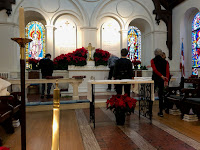
Today we receive communion at the altar for the first time in 25 months.  Communion is about a lot of things and one of those things is remembering Jesus’ words.  It’s a weekly reminder that despite the lack of proof, we still gather with hopeful expectation.  We still believe that we have a God who works miracles out of the ordinary—a God who promises that no darkness last forever.  The morning always comes.


Sunday, January 2, 2022

Too Much Magic: January 2, 2022

 Epiphany  Year C                                           Matthew 2:1-12                                                     

 Over the last month several people have commented to me how wonderful it is to have Christmas with a child.  They often tell me to enjoy the magic of the experience, because this is the time when it’s especially magical for children.  I follow a few parenting groups online and I watched people talk about how to make this time especially magical for their children and then worry about losing the  magic.  I found myself wondering when we became so obsessed with having a magical Christmas.  I don’t remember that from my childhood. I remember the excitement and the anticipation, but I don’t recall people talking about magic. I have seen it in the Christmas cards as well.  Instead of religious language referencing Jesus,  cards will say something like, “Enjoy the magic of the season.” I suppose we could blame it on the secularization of Christmas.  But how weird is it that in order to secularize Christmas we have to give it magical powers?

            When I was much younger I was curious about astrology and psychics.  I went to a couple psychics and palm readers in high school and college.  For some reason I always felt drawn to these people. I know some people think it’s a sin.  I think it is only dangerous when people actually live their life according to what a psychic advises. I was never sure what to believe as they were never very helpful.  I guess I was so desperate for answers at that time in my life, I would try anything.  Obviously if Jesus was sitting at a table somewhere, I would have preferred to ask him the questions, but he was not.  I had to rely on my own ability to discern God’s answers to my questions, and as we all know, that is not very easy. 

I guess that was what I was looking for, something as tangible as a palm reader, but still magical in some way.  I was looking for the manifestation of magic, or really—the divine.  We are starved for those things when we grow up and enter the so called real world.  That is why books like Harry Potter and Lord of the Rings are so popular.  Yet where we fail to look is in the one story that we all know so well, the life of Jesus.

               One place where we can really see the miraculous is in the story of the wise men. There are many theories about the wise men.  Sometimes they are referred to as wise men, sometimes as kings.  The Greek word that was translated to wise men is magi.  It has many translations, but one of the most accurate is an astrologist.  Today, astrologers are not seen as extremely significant, but in this day, they were the wise and insightful people.  They were the philosophers, scientists and poets.  They were also very spiritual and adhered to another religion, Zorastrianism which was an ancient religion from the area which is now Iran.  The unique thing about this religion was its belief in one God (monotheism).  At this time, it was primarily the Hebrew people who believed in one god, so the fact that these magi coming from a far off place and believed in one true god is significant.  Knowing this, it makes more sense that these magi knew what they were looking for.  They were looking for the one true God. 

            Zorastrians believed that a star could be a counterpart or an angel to a great man.  Thus, each great man would receive a star at his birth.  This was a pretty common belief at the time.  So when news of a traveling star reached Herod, even he knew that this was no ordinary star, no ordinary child.  People have been trying to make sense of this star for many many years.  Some say it was Jupiter and Saturn because they were in close alignment at the time and therefore would create a bright light that would only be present for a short time.  Some say it was Hailey’s comet which passed through that region in 12 AD. 


While all these theories are interesting, I think the people who try to identify the star are missing the point.  If this indeed was the Star of David that had been prophesied in the Old Testament and if this star led the magi to the exact location of Jesus, do you really think there should be some rational explanation for that?  It’s the birth of God.  Isn’t that enough of an explanation?  You want to talk about magic, there it is.  There are so many things that are magical about the birth of Jesus.  Yet, it’s not just magical when we are talking about God, it’s miraculous.  Why do we have to explain it all?  Why do we need to come up with simple/rational answers for a mystery?  Doesn’t Jesus deserve more than that?  Don’t we deserve more than that?  We would not have to look for magic in other places if we could stop removing the magic and miracles from the greatest story ever told. 

            Perhaps these card makers are also desperate for magic, or know that all of us are.  Maybe that is why the story of the wise men is such a popular one.  We can identify with their search, their longing.  I have often wished that I were so bold as to follow a star.  I wish that I were not so desperate for easy answers, and so ashamed to admit it.   These wise men followed stars and their dreams.  They were able to see God in more than just scripture, more than just words—which is something that I think we as Episcopalians sometimes lose sight of. 

We love our books. We love the beautiful prayers, and as someone who considers herself a lover of the written word and a bit of a snob, I get that.  Yet what the Episcopal Church (and others like it) try to capture in our liturgy (which is the way the service is put together) is some of the mystery of God’s presence with us. Because in the end, words cannot capture the miracle of God in the flesh.  Nothing can.  But what we try to do in our worship is share glimpses of the miracle, glimpses of the divine.  

  And so my wish for you is that you too can have the courage to search for God in both unexpected and expected places.  I pray that when you find that guiding light, that you hold on to it with everything you have, and follow it no matter how difficult the terrain may be---no matter how evasive  the divine might feel. Because I promise, if you look for it, you will find it.   

Google has no good news: December 24

Year C, Christmas                  Isaiah 9:2-7  and Luke 2:1-20                                                                    

            This Christmas was supposed to be our triumphant return...or maybe that was last Christmas. At some point, we were supposed to have a triumphant return.  Yet even when planning back in November when the infections were low and omicron was just a word no one could properly pronounce—even then we knew it would not be as triumphant as we hoped.  There would still be masks, still be anxiety.  But…we would be able to sing Christmas carols and put on a Christmas pageant.  While I am usually someone who likes to be realistic and keep expectations low, I was pretty excited about Christmas Eve.  And then just this week, it has seemed like the sky is falling again.  It’s not.  But it feels that way.

            “The people who walked in darkness have seen a great light; those who lived in a land of deep darkness---on them light has shined.”  What a beautiful verse.  When I read it about 10 days ago, I thought—this is perfect.  We have been walking in darkness for almost two years and now we have seen the great light.  When I read it a week later (just a few days ago), I found myself asking—how great would this light have to be, to shine on those haunted by darkness.  Sometimes the darkness feels impenetrable.

            I have preached many times about the importance of not expecting huge miracles, or impressive signs from God.  God comes to us in more subtle ways.  Yet I found myself yearning for something dramatic this year, yearning for it more than ever.  So I come back to the question, how bright would that light have to be to penetrate the current darkness?

            We all know the Christmas story from the Gospel of Luke.  We hear it every year.  The repetition lulls us into a sense of complacency.  We see the story in gauzy light, like a halo in the fog. But this story is not meant to comfort.  It’s about disruption and drama.  When you consider the Christmas story—it’s full of disruption.  Mary and Joseph’s life was first disrupted by Mary’s pregnancy and then by the long and arduous trip to Bethlehem when she was 9 months pregnant.  And then we see the shepherd’s lives disrupted.  There they were, doing their jobs—protecting their flock and a heavenly host showed up and told them to leave that place, abandon their jobs and search for a baby.

            It’s easy to overlook the shepherds.  They are extras in the story and rarely have any lines in the Christmas pageant.  But imagine for a moment what kind of scene that must have been.  They were in their field in the middle of the night, probably sleeping and suddenly an angel appeared.   They were terrified- understandably.  Even if the angel did appear in human form, it must have still been unsettling. Now when I have imagined this scene, I have always imagined a bright light surrounding the angel.  That’s probably because every painting and picture I have ever seen has depicted the scene this way. Yet as I thought about it, I could not help but wonder why an angel would need extra light.  They would probably need a little light since it was pitch dark, but not much.  We all know how even a small amount of light can illuminate a very dark space.

            How bright would the light have to be? Now the shepherds had an angel.  Even if there was no magnificent light show, someone extraordinary appeared before them and gave them a message that inspired them to leave their sheep and search for a baby in a manger.

            The world right now is dark and I would really like an angel, or a light show.  At the beginning of the pandemic, I found myself googling “good news about COVID.”  There were no hits on the world wide web for that search criteria.  I found myself doing that again this week.  While there were not an overwhelming amount of hits, there were some.  There were some saying that while a new wave was hitting us, we are much more prepared than we were previously. We have vaccines and even medicine for those who have gotten very sick as a result of COVID.  Yet I have to confess, I found little comfort there.  It’s just been too long and we are all so tired of it all. 

            What I realized as I was desperately googling “good news” was that I was forgetting something kind of important about our Gospel message. It is the good news.  The Gospel—the story of Jesus’ birth, life, death and resurrection is the good news.  But I still feel like I need the light to illuminate the good news because it’s been a really hard couple of years. Then I was reminded of a line from Psalm 139:If I say, ‘Surely the darkness shall cover me, and the light around me become night,’ even the darkness is not dark to you; the night is as bright as the day, for darkness is as light to you.”  I keep praying for a light that will overcome the darkness.  But perhaps what we should really pray for is that the darkness will no longer have power over us, because with God, darkness is just different lighting. 

            I don’t know what is going to happen with COVID, or the environment, or inflation, or the rampant violence in our nation and world.  What I know is that we cannot merely search for good news using google.  The good news is in God’s love for us.  The good news is in a God that loved the world so much that he sent his son to become a human so he would know what it is to walk in darkness and search for the light. The good news is that we have a God who loves us so much that he died and came back to life to show us what it really is to live in the light. 


Thursday, December 16, 2021

Joy and a Brood of Vipers: December 12, 2021

Advent 3, Year C                                  Zephaniah 3:14-20                                                     

I have been ordained for 16 years now and  it’s taken me about that long to grow accustomed to the lectionary readings that we read every Advent.  Despite the fact that I had been going to church every Sunday for my entire life, I remember looking at the readings assigned for the Sundays during Advent when I was first ordained and thinking, what in the world is going on here? These don’t make me feel good.  Why is there so much John the Baptist?  We need more feel good stuff, more joy because this is supposed to be a joyful season.  Isn’t that what they say, “It’s the most wonderful time of the year.”  Finally, on the 3rd Sunday of Advent we get a little joy in the first few readings.  But we are still stuck with John the Baptist calling us a “brood of vipers.”  So I will start with the other readings for now.

            Zephaniah…now that is an interesting one.  The Book of Zephaniah is only three chapters long.  We know little about the author.  Some believe that Zephaniah was writing and preaching right after the reign of a horrible king, which explains the first two chapters detailing how awful everything is. It might be hard to believe based on our reading for today, but Zephaniah is considered one of the gloomiest parts of the Bible.  In fact, the 2nd verse of this book is, “I will utterly sweep away everything from the face of the earth, says the Lord.” That is how bad things are.  The prophet concluded that God’s only option for this land and these people was total destruction.  Remember, God promised never to do that after the great flood.  Things were so bad, Zephaniah thought complete destruction was the only option.  Just start over again.          

            The Book of Zephaniah was written after Israel and Judah split.  Israel had been conquered and Judah was on the cusp of being conquered.   Zephaniah seemed to have little hope.  But as is so often the case in the books of the Bible, something shifts dramatically in the middle of chapter three.  After the accusations, the judgment and the warnings, suddenly there is joy.  “Sing aloud, O daughter Zion; shout, O Israel! Rejoice and exult with all your heart; O daughter of Jerusalem!”

Christmas 2020--no inside service, but we still decorated.
This reading comes up every three years right at this time, but never has that line struck me so profoundly.  We went months without meeting in person and then several more months without being able to sing.  While we remain masked when we sing, I now realize what a gift we have been given for this Christmas.  We get to sing Christmas carols on Christmas.  Do you remember how much we longed for that last year? Sure, many of us look forward to Christmas carols every year, but it’s so much more meaningful when we know what it’s like to be deprived of them, when we know what it’s like not to be able to sing aloud and rejoice. 

Yet, it remains a little awkward.  We are still wearing masks and trying to be careful.  We are still in the middle of a pandemic that is supposed to be long over. How can we truly sing with joy? How can we shout in exultation when shouting is dangerous?

            That is what is so astonishingly appropriate about this reading from Zephaniah.  This joy that comes in chapter three is that much more incredible because it’s not supposed to be there.  Why? Because nothing seems to have changed.  Judah was conquered. The Hebrew people still struggled mightily.  But God decided to show up anyway.  God’s presence broke through the fear, the sadness and even the hate.  That is true joy---joy that is grounded in God’s presence. 

It’s the same in our reading from Philippians.  Paul was writing from prison.  He knew there was a good chance he would be executed. He had every reason to be sad, angry and anxious.  But he was able to tell the people to rejoice and not to worry.  Why?  Because, “The Lord is near.”  That is what Paul wrote in his letter to the Philippians.  That is what Zephaniah also said 100’s of years before, “The Lord is in your midst…”  And while John the Baptist is kind of scary and intimidating, he was saying the same thing in our Gospel today, “God is coming and that is good news.” That doesn’t mean there won’t be hard times. That doesn’t mean we don’t have to prepare, repent, try to be better.  It means that God is coming no matter what.

Joshua has been talking a lot about Santa’s list and I confess we have as well.  But I finally said, “You know Joshua, I don’t know what Santa will do. But I can promise you that we will give you presents no matter what. Because that is what we do as parents. We love our children, no matter what.  That is the kind of love that God has shown us over and over again  over the course of human history. Unrelenting and completely unreasonable---love.

We have no idea if the people of Judah ever repented or changed their ways.  In the end, it wasn’t about them.  It was about God choosing to love them no matter what.  I read a quote in a commentary that I just loved. It said, “…true repentance bows in helpless submission in the face of this great forgiveness.”[1] 

Sometimes we have to know what it is to be forgiven before we can find the strength or courage to ask for that forgiveness, or even know that we need it.  Sometimes we have to experience utter desolation to understand joy. And sometimes, our voices have to be silenced to know what it truly means to sing.


[1] Andrew H. Bartelt, “Third Sunday in Advent,” in Concordia Journal 11:6 (Nov 1985), 227.

Tuesday, November 9, 2021

Forget Normal: November 7, 2021

 Year B, All Saints                                                            Revelation 21:1-6a                                              

            I can’t think of anyone who has ever told me that the Book of Revelation is their favorite book of the Bible.  Anyone?  If it is, that’s ok.  It just makes you unique. Despite the lack of popularity around the Book of Revelation, there are a few passages that bring incredible comfort to those who hear them, including the passage we heard today.  It might be familiar because we often use it at funerals.  In fact, all the readings from today are ones that are recommended for funerals. The part from Revelation that usually appeals to most people is: “God himself will be with them; he will wipe every tear from their eyes. Death will be no more; mourning and crying will be no more, for the first things have passed away.”  The part that speaks to most of us is the release from pain, the visual of God wiping the tears from the eyes of those who are suffering.  It moves me every time I hear it or read it.

            If you read the rest of the Book of Revelation, you will see why this release from suffering is so important. There was a lot of pain and suffering before we get to chapter 21. There were beasts, lakes of fire, dragons, Satan, huge storms, rivers of blood… plagues.  We think the last year and a half has been bad….imagine 1,000 years of this--plus dragons and rivers of blood.  Then again, it kind of feels like 1,000 years, doesn’t it?  5 million people have died from Coronavirus alone.  That doesn’t even include all the other ways that people have suffered and died.  This might be the perfect time for us to dwell a little on the Book of Revelation.  If we don’t take it too literally (which I don’t think was ever intended) then maybe we can identify with this book, now, more than ever.

            While the visual of God wiping the tears from our eyes and the end of death and mourning is powerful and comforting, there are other parts of this reading that not only comfort, but inspire.  The writer talks about a new heaven and new earth. It begins with, “Then I saw a new heaven and a new earth, for the first heaven and the first earth have passed away, and the sea was no more.”  Usually when we talk about the world ending, it’s threatening and scary.  But this part of the Book of Revelation gives hope because it allows for this new heaven and new earth, this opportunity to make all things new. 

It’s strange that the writer specified that the sea is no more.  Why even mention that?  Can’t we assume if the old earth is passing away, the sea is included? In Biblical times, the sea represented division. It was what separated people from one another.  It represented a barrier to human relationships.  For God, it isn’t enough to create an entirely new heaven and earth, God wants to ensure that relationships will be renewed as well. There will be no division between red and blue, Christians and Muslims, conservatives and liberals, vegetarians and bacon lovers.  The barriers will be removed and we will once again live as God intended.

            Much of this might seem irrelevant to us today.  If this is about the end times, why are we talking about it now? The Episcopal Church doesn’t talk about the end times.  But what if this is about more than the end? What if we were able to translate this vision of the future to our present?  For the first few months of the pandemic, we talked about going back to normal.  Then we realized that probably wasn’t going to happen, so we talked about the new normal.  But no one really knows what that means, and let’s face, it doesn’t sound that appealing.  Because when we say “new normal” we just focus on things we need to change, not by choice but by necessity.  We all know that change is hard and disruptive. Why in the world would be want to go through that disruption to achieve normality? Normality was never that good in the first place.          

            When the author of Revelation wrote, “See, I am making all things new.”—it wasn’t a threat.  It was a promise.  Because once you have been through lakes of fire, rivers of blood, dragons, beasts, and plagues, “new” sounds pretty good. Instead of worrying about what will have to change or what we can change back, perhaps we can focus on how to make things news.  If what we read in this text of the Book of Revelation is a vision for this perfect future, there must be a way to bring parts of that perfect future to our present world.  I can think of one way: let’s get rid of the seas that divides us. We have planes now and cell phones.  We can overcome the sear.  The only thing that actually divides us is our pride.  Enough of the divisions.  Enough of the fear mongering. Don’t we have enough anxiety without stoking the flames of unnecessary fear?  Normal. We don’t need to go back to normal. We need to go back to God.  Return to God. Make all things new.

Monday, September 27, 2021

Unanswered Prayers: September 26, 2021

 Year B, Pentecost 18                                                               James 5:13-20                                                                 

     Since we have had 5 weeks in the Book of James, I had hoped to preach my three Sundays on James.  Then I looked at the text for today.  “Are any among you suffering? They should pray…. The prayer of faith will save the sick.”  On the one hand, that probably sounds like a preacher’s dream text.  For some it might be, but not this one.  After I looked at this text the first time I thought, you know the Old Testament reading is a good one, maybe I will go with that.  But then as is so often the case, it’s always the texts that I don’t really like that are the most important to preach.

                What I found particularly irksome about this text is it seems overly simplistic.  And frankly, wrong.  We all know we are supposed to pray.  Hopefully most of us do pray.  But we also have experienced praying for someone who is sick and being disappointed when they did not get well.  They did not heal.  In some cases, they died.   So how can James say that the prayer of faith will save the sick?  Does that mean that anyone who isn’t healed doesn’t have someone truly faithful praying for them? Of course not.  This is one of the hardest things to reconcile as a Christian.   We are told to pray and so we do. Yet occasionally, even when we pray for something good and holy, perhaps even righteous, our prayers go unanswered. 

            Since it’s something I have never been able to reconcile, it seemed like something that I should probably avoid preaching about.  So I looked at that Old Testament text again, because it really is a great text. Moses is complaining to God about this ungrateful group of whiners he is stuck with.  This was not the first time the Hebrew people had complained.  Earlier in the story, they had complained about how hungry they were, so God provided them with manna from heaven.  Now they are sick of manna, they want some meat.  It’s kind of understandable.  I love bread, but not even I could eat just bread for 40 years.  So they are complaining again which leads Moses to complain to God about this ungrateful rabble.

God was not upset that they were asking for meat.  What really ticked him off was that they were reminiscing about Egypt, the place that God had freed them from.   Their deliverance from Egypt was an answered prayer.  They had prayed to God that God might free them from their enslavement in Egypt. God had gone to great trouble to free them from their oppressors.  God brought plagues upon Egypt.  God parted water so they could safely pass.  He sent them a leader in Moses, who they then abused.  And now, they want to go back.  This is the thanks God gets for their answered prayer?

            As confounding as it is to us when God doesn’t answer a prayer in the way that we think is good and appropriate, it must also be confusing to God when we have our prayers answered and then end up complaining about it.  I am sure we can all think of a time when we prayed fervently for something and were granted that, but then later found ourselves complaining about the very thing we desperately wanted.

            I think it all comes down to the way we treat prayer.  Do we perceive prayer as a tool to get what we want out of life?  Or is prayer a gift that God has given us, a gift that allows us to create and sustain a relationship with God and one another.  In the previous chapter, James wrote, “Draw near to God, and God will draw near to you” (4:8).  By speaking to God, we grow closer to God.  Because even when we are complaining to God, at least we are in dialogue with God.  Remember, it wasn’t the complaint about the lack of meat that irritated God, it was the desire to return to Egypt. It was the lack of gratitude for their answered prayer.

            The other thing that James is emphasizing in this text is the need for a community of faith.   James wrote, “Are any among you sick? They should call for the elders of the church and have them pray over them, anointing them with oil in the name of the Lord. The prayer of faith will save the sick, and the Lord will raise them up; and anyone who has committed sins will be forgiven.”  James was encouraging people to reach out to those in their faith community to pray for them. 

Remember, a lot of what James has been talking about in this book is the action of Christians—how to live a Christian life. Here he is explaining that one of the actions of a Christian is reaching out and asking for help.  Another is responding to that cry for help.  Prayer isn’t merely about our relationship with God, it’s also how we relate to one another. 

One of the things that we had to stop because of COVID was the healing prayers we offered every Sunday.  It was usually a non ordained person providing prayer in the chapel.  People shared their need and one of our healers prayed over them.  Now, I never asked Jane or Laura or Linda how many people they really healed.  Because I think we all knew, that wasn’t exactly the point.  The point was that people felt the care and compassion of another Christian in the community, in the context of Sunday morning worship.  It was individual prayer enfolded in community of prayer.   I believe that is a perfect illustration for what James is talking about.

Of course the problem with this interpretation is that it still doesn’t explain what the text means when it says, “The prayer of faith will save the sick.” I wish I could tell you.  I really wish I could explain why so many good and worthy prayers go unanswered.  And I also can’t explain why we humans occasionally act like the Israelites complaining about a prayer that God answered that we now wish he hadn’t answered. What I do know is this, giving up on prayer never helped anyone.  I have never spoken to anyone who said, “Yeah, my life really turned around when I stopped praying.”  Because when you stop praying, you give up.  You isolate yourself not just from God, but from your brothers and sisters in Christ. 

Now there might be times, when you simply  don’t have the strength.  That’s ok.  Don’t beat yourself up about not being able to pray at times.  That is where the clergy and the church come in.  Many people stop coming to church when they can’t pray because they think they are being insincere.  But please, please don’t do that.  Keep coming, so the community can hold you up.  Keep coming and if you can, ask for someone else to pray the prayer that is eluding you.  That is what we are here for.  Someone once said that a church isn’t a museum for the saints, it’s a hospital for the sinners.   As beautiful as this church is, I don’t want it to be a museum for super holy people to display their holiness. I hope it can be a place where wounded souls find healing and even the unanswered prayers find some solace.


Monday, September 13, 2021

The America of 9-12: September 12, 2021

 Year B, Pentecost 16                                                                      James 3:1-12                     


                                Recently one of our parishioners posted a meme on facebook that said, “I would never want another 9/11, but I miss the America of 9/12.”  It went on to explain how unified we were the day after our country was attacked.  I remember that as well—going to give blood and being turned away because the line was around the block.  I recall churches full for weekday services that usually averaged 10-12 people.  We weren’t arguing about politics, at least not nearly as much. There were countless stories of heroism and selfless acts.  Now we argue about masks and we can’t even agree on what news station to watch.  At times it feels almost like a different country.

Occasionally I will hear a person lamenting that they have seen someone’s true character after that person has displayed cruelty or weakness, as if all the good they had previously seen was just a façade.   I have fallen into the same trap—choosing to judge someone by their darkest moment, rather than their finest, or even an average moment.  I thought of all this as I looked at that meme.  Which America is real--the America from 9/12 or the America of vitriolic school board meetings and people insulting one another from behind their computers?

            We are reading from the book of James for the third week in a row.  As I told you the first week, James is perceived as one of the more practical books because of the relatable topics he covers.  In today’s reading, it’s about how important the words we use are.  We all know what it is to experience pain because of the words of another.  Often cruelty is not the intention.  It’s just the result of words that were carelessly chosen.   We’ve heard, maybe even said the childhood quip, “Sticks and stone can break my bones, but words can never hurt me.”  Yet both children and adults know that could not be farther from the truth.  The spoken and written word can torment someone far after a physical injury has healed.

            Yet while James warns us of the injury our words can cause, he doesn’t give us any advice on what to do about it.  He admits that no person can tame their tongue. We can try, but even at our very best, we fall short.

            What seems to concern James most about words is not the effect that they might have on another person, but what it means about the person who speaks the words.  In the first chapter of James, he warns of being double minded and thus unstable in every way. He returns to that theme in our section for today, “With (the tongue) we bless the Lord and Father and with it we curse those who are made in the likeness of God.  From the same mouth comes blessing and curse.” James goes on to question whether salt water can produce fresh water or whether a fig tree can produce both figs and olives. No, obviously not.  The implication is that a Christian who praises God cannot be genuine in that praise if that person also curses the person who is created in the image of God.  The question is: which is the true and genuine part of the person?

            Some would say, you can’t be both. You can’t be both snarky and faithful at the same time.  I would disagree. I would say at our best, we worship and serve God as well as loving and serving our neighbor. Yet we also sin and fall short of the glory of God.  However, if we are all created in the image of God, than our true self is always the best of us, not the worst of us.  Therefore, even if we use our mouth to praise God and curse those made in the image of God, our true purpose (our true identity) is praising God.  Yes, we will fall short, we will make mistakes.  And some will veer so far off course that all of their intentions will seem evil.  But no person is beyond God’s saving help.  No person ceases being a child of God. 

            I have noticed that one of the most common things people say of newly born child is that they are “perfect.”  Even newborns who might not be perfect by outside standards, are still perfect in the eyes of their parents.  Now, I don’t know any parents—who while their child is in the midst of a tantrum--- looks at them and says, “Isn’t she perfect.”  Frankly, I don’t think very many people describe others as perfect after infancy.  Because we are not.  Our flaws come out.  We say things we regret.  We do things we regret.  But—we never cease being God’s beloved children. We always have a purpose, not merely as children of God, but as disciples of Jesus.

            Now some of you might be wondering what this has to do with a facebook meme about the America of 9/12.  And for those of you who are new or visiting, this is the first time I have ever highlighted a meme in a sermon.  I believe that our country is still a country of people who care and want to be united.  I believe that we as a nation have made countless mistakes and there continues to be injustice and pain.  But there are even more examples of goodness today.  It’s just harder to see.  So on this day, Sept 12th, let’s try to find the good in one another as opposed to the flaws. Maybe, more importantly, let’s be the good and compassionate person God has created us to be.  Let’s praise God more than we curse the children of God.  And one day we might find that our default is praise and the other stuff just pops up occasionally. 

Today we had a baptism.  My favorite part of the service is when I put the oil on the baby’s head and say, “Anna you are sealed by the Holy Spirit and marked as Christ’s own forever.” I want us to burn that into our heart and mind so that when we find ourselves judging another, we can also remember that they too are Christ’s own.  They too were once without sin.  They too (hopefully) had a parent who considered them perfect.  They and we will always have a God who chooses to claim us as his own.